Wednesday, August 3, 2011

Mao's Last Dancer -- dancing and cultural comparisons


Director: Bruce Beresford, 2009. (PG)

Mao’s Last Dancer juxtaposes the story of dancer Li Cunxin with a comparison of cultures: modern China and America. While the dancing works, the cultural criticism falls flat.

The film is based on the autobiography of Li, who at age 11 was taken from his parents in a poor village in rural China to be sent to Beijing to train with China’s pre-eminent ballet school. What is an honor for his parents is a heartbreak for Li, as he is parted from friends and family to essentially live in a community of dancers.

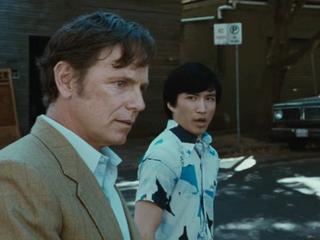
As he grows and develops, Li appears the only dancer who can think and dance apart from the rest of the communist class. When an American delegation from Texas comes to Beijing as part of a cultural exchange, it is Li whose chemistry with an Australian dancer catches the eye of the director Ben Stevenson (Bruce Greenwood).

Stevenson pulls strings to get the adult Li (Chi Cao) an opportunity to visit America to dance with the Houston Ballet company. There Li experiences American culture and American women, falling for one of the dancers.

Director Beresford has established himself with the Oscar-winner Driving Miss Daisy, but here resorts to a by-the-numbers tear-jerker more fitting to the Hallmark Movie of the week. Greenwood is the principal name actor and does a fitting job as the smarmy and self-absorbed dance director. Chi Cao does lovely work in his ballet performances.

Where the film fails is in its cultural comparisons. It paints a black and white picture that seems simplistic at best. The early portrait of China with the young Li shows a peasant experience dominated by Mao TseTung whose picture hangs above the classroom. But America is shown as a seductive place, full of consumerism and sexuality. The endless clothes given to Li by Stevenson appear almost obscene compared to the simple uniforms of his parents. The easy sex available in nightclubs (this is the late seventies of disco dancing) contrasts with the difficult lifestyle of his family.

The evils of the Chinese governmental system juxtapose against the evils of American society. Which is worse? Authoritarian control or libertarian freedom? Both have their own problems but freedom at least allows people to make their own decision. With this comes accountability. The Chinese police may have been able to routinely arrest and punish people for the “crimes” of others, such as their children, but the American judicial system makes people responsible for their own actions, a biblical concept.

Copyright ©2011, Martin Baggs

Sunday, July 31, 2011

The Lincoln Lawyer -- innocence, injustice and pure evil


Director: Brad Furman, 2011. (R)

Despite the American judicial concept of “innocent until proven guilty” we often see a person arrested for a heinous crime and assume he or she is guilty. The state has built a case and arrested the person with due cause. Our allegiance tends to fall with the state, even though they have the burden of proof. The defense attorney is either a slick shyster or filthy rich from defending the wealthy criminals. The Lincoln Lawyer plays off this cliche while dealing with themes of innocence, injustice and evil.

Mick Haller (Matthew McConaughey) is the Lincoln lawyer. He conducts his business out of the back of his Lincoln Town Car while being driven from client to client by Earl his driver. He epitomizes sleazy, defending bikers and prostitutes who he knows are guilty. He works the system, and is not above greasy a few palms to get the “Not Guilty” verdict to match his car license plate.

When Louis Rollet (Ryan Phillipe), a 30-something realtor, is accused of raping a prostitute, he asks Haller to defend him. Mick’s meal ticket has arrived, and he promptly starts laying out the expense account. Rollet claims he is being set up, and Mick sends his trusty investigator Frank Levin (William H. Macy) to dig up the dirt. But he digs up more than he wants and suddenly nothing is as it seems.

The Lincoln Lawyer is based on the book by Michael Connelly. A film cannot capture the details of a 400 page novel, and this one is no exception. There is little to explain why Haller uses the Lincoln. His backstory is not described, except for his simmering relationship with his ex-wife Maggie “McFierce” McPherson (Marisa Tomei). She is one of the LA District Attorneys, on the opposite side of the fence from him. Hence the “ex” in their relationship. But their daughter keeps them on speaking terms.

There are twists and turns aplenty in this taut crisp thriller. The flashbacks tend to be a little confusing at times, but the attentive viewer will remain engaged. McConaughey brings his A-game, showing he is more than just a pretty face. His cynical front slowly melts as the truth confronts him. Phillippe is perfect as the innocent-with-an-attitude rich kid who wants to be put on the stand to get his story told. Tomei doesn’t have a lot to do except encourage Mick, an odd concept from a DA to a defense attorney.

The ethical themes emerge when Mick gets one-on-one with Roulet. He senses injustice. Injustice is the violation of the rights of others. But the injustice seems to be against an earlier client. And the attorney-client privilege, which prevents him from disclosing anything Roulet tells him, puts him into a precarious position.

The dilemma here is how a person avoids injustice if justice (or the law) itself disallows that very same person from seeking redress. It would be wrong to break the law but by not breaking the law the law itself has been broken. It is a paradox, and the beauty of the film is how Mick works this out. The secret is to find the limits of the law and use them, while staying safely within the confines.

Moreover, Mick’s character growth is evident. Initially, he is happy to work a little subtle bribery. But by the end he sees the cost of injustice. He almost exemplifies the words of Habbakuk to God (Hab. 1:3): “Why do you make me look at injustice? Why do you tolerate wrongdoing? Destruction and violence are before me; there is strife, and conflict abounds.” He struggles to right the wrongdoing, and in so doing finds his own plumb line reset correctly.

At one point Mick confesses his lifelong fear, of representing someone truly innocent. He shielded his conscience by assuming that all his clients were guilty. But, he says, “You know what I used to be afraid of? That I wouldn’t recognize innocence. Not guilty or not-guilty. But pure innocence. That it’d be standing in front of me and I wouldn’t know it. You know what I am afraid of now? Pure evil?” He had been forced to face his fears and came away with a view of evil.

Evil resides in the world. Evil lies inside all of us (Jer. 17:9). Most of us restrain it for the most part, covering our sinful heart with a sugar candy coating. But some allow the purest form of evil to emerge in their psychopathic practices and are proud of it. Theirs is close to demonic. Such a personality scared Mick and it should scare us, too.

As the Lincoln Lawyer reaches its climax, we hope beyond hope that justice will prevail. In Hollywood it usually does. In life it often seems to be thwarted. Yet when we realize that God is the true Judge (Psa. 75:7), we also understand that he judges in his time: “with the LORD our God there is no injustice or partiality or bribery” (2 Chron. 19:7). We just may have to wait to the other side of eternity for the full impact of justice to be realized. Meanwhile, with a defense attorney like Jesus Christ our guilt can be turned into a not-guilty verdict. As the apostle John said, “we have an advocate with the Father—Jesus Christ, the Righteous One. He is the atoning sacrifice for our sins, and not only for ours but also for the sins of the whole world” (1 Jn. 2:2).

Copyright ©2011, Martin Baggs

Wednesday, July 13, 2011

Father of the Bride -- cost of a wedding, cost of a marriage


Director: Charles Shyer, 1991. (PG) 

The camera pans across a landscape of scattered confetti, dirty cake plates, discarded champagne flutes and empty chairs. A tuxedo-clad man, George Banks (Steve Martin) is sitting alone, tiredly massaging his feet. Looking into the camera, he gives this introduction: "I used to think a wedding was a simple affair. Boy and girl meet, they fall in love, he buys a ring, she buys a dress, they say I do. I was wrong. That's getting married. A wedding is an entirely different proposition. I know. I've just been through one." The movie starts, thus, at the end, with the wedding over. But with this prolog the difference between a wedding and a marriage is identified and the two themes of the film subtly emerge: the cost of a wedding and the cost of marriage (at least from the father’s perspective).

George is a well-to-do middle-class businessman living in California, owning a successful athletic shoe company. Married to Nina (Diane Keaton), they have two children, young Matty (Kieran Culkin) and 22 year-old Annie (Kimberly Williams). They are epitome of the settled American family. So when Annie comes home from a semester in Rome and breaks the news that she is getting married to Bryan MacKenzie (George Newbern), George’s idyllic world is disrupted, and the movie plays off this.

Father of the Bride is a remake of a 1950 Spencer Tracy film of the same name. Having not seen the original, I cannot compare the two, but this version is funny, sentimental and often touching. It is more than it seems. The concept screams cliche, but the actors deliver on their comic lines. Steve Martin seems natural in the role of the father, talking to the camera and giving spot-on voice-overs of his thoughts. He makes the film successful. His character offers genuine responses that seem totally realistic.

The film touches on the journey of life and how there are key moments along the way that are the memorable signposts we look back on. A number of early scenes show this, but three stand out. The first relates to the moment when Annie breaks the good news to her family. It is over the first family dinner after she returns. She is radiant with excitement and Nina is overjoyed. George, on the other hand, is stunned, shocked even. He finds reasons why Annie cannot marry. To himself he says, “This was the moment I’d been dreading for the past six months. Well, actually for the past 22 years.”

As a father of a 22 year-old daughter myself, with two other younger girls, I totally relate to this thought. When I first saw this film, over a decade ago, I thought it cute. Now, seeing it again in a different family context, it got me all choked up. That could be me reacting to my daughter’s revelations. George looks over at Annie and sees not an adult woman ready to become a wife, but a 5 year-old girl speaking. He still sees her as his little girl. Our daughters will always be our little girls; but they do grow up. And fathers must accept this as part of life and life’s journey . . . for us and them.

The next key scene occurs moments later, when Bryan arrives. Meeting the fiancé is the second signpost. It heralds permanency. Privately, George has speculated that he might be a middle-aged loser, but Bryan unwittingly addresses this as he presents himself to his future in-laws. Speaking from the heart, he gushes:
I just wanna say that I'm an upstanding citizen. I've never been engaged before. I've never really been in love before. And I think Annie's the greatest person I've ever met. And I can't wait to marry her and one day have children, and grand children. And I'm going to do my best to be supportive of her dreams. She's a very gifted architect. I'm just thrilled that I met her. I love your daughter. The feelings I have for her are never gonna change. I'm here to stay.
To Nina, it is the sweetest, most sincere speech she has ever heard. To George, it is a well-rehearsed suck-up. Of course, this is mostly because George just doesn’t want it to be happening. Life is changing for him, but he is not ready for this. Bryan is inadvertently pointing out that George is getting older and might soon be entering the grand-parenting stage of life. Fathers don’t always want to hear this, especially if their internal self-portrait comes from their younger days.

The third significant sign-post is meeting the in-laws. Here I am referring to George meeting his future son-in-law’s parents. When he and Nina go visit they discover that George’s folks are rich and live in a mansion. Given the opportunity to peek into an open check-book, George succumbs to temptation and gets himself into hot water . . . or at least cold water. The awkwardness of the initial meeting is evident from both sides, each wanting to make a good first impression, even though they don’t have to be best friends. In-laws form an integral part of an adult child’s life. Having good relationships, even workable relationships, will form a solid foundation for the future marriage.

The cost of a marriage from a father’s perspective, then, is the loss of a daughter. George comes to a final realization of this as he is about to give Annie away at the altar:
Who presents this woman? This woman? But she's not a woman. She's just a kid. And she's leaving us. I realized at that moment that I was never going to come home again and see Annie at the top of the stairs. Never going to see her again at our breakfast table in her nightgown and socks. I suddenly realized what was happening. Annie was all grown up and was leaving us, and something inside began to hurt.
Everything worthwhile in this life has a cost. (Even salvation, the most important thing in this earthly life, has a cost, though it is received freely – it cost Jesus his life: 2 Cor. 4:10.) But in a strong and healthy family this cost or loss is offset by the gain of a son-in-law and the beautiful relationship that emerges in the new union. Bryan exemplifies this. He completes Annie, as George finally understands. Babies grow up into children, who mature into adults, who usually marry. This is the way of life. It has been from the beginning: “a man leaves his father and mother and is united to his wife, and they become one flesh” (Gen. 2:24).

In the middle of the film, once George has come to accept that a wedding is on the cards, Nina decides to hire a wedding coordinator. And what a coordinator he is: Franck Eggelhoffer (pronounced “Fronk”). Martin Short plays Franck as an unidentifiable European with an unrecognizable accent. But what George cannot discern, Nina and Annie clearly understand. This is symptomatic of the wedding and marriage. And as Franck replaces George in the decision making, George realizes that the wedding is going to cost him a bundle: $250 a head, and that is 20 years ago!

Here is the second theme: the cost of a wedding. The film has a lot of fun with this aspect, but in reality weddings are expensive. Of course, losing dollars is nothing compared to losing a daughter. Yet, fathers tend to control the purse-strings and often hold tight budgets. George does. The humor comes from his attempts at reigning in the expenses while Nina and Annie just want to make a memorable wedding. George’s budget cuts backfire on him though and he ends up acting as traffic controller at the wedding, thereby missing several key moments of the ceremony and celebration.

Obviously, cost is an issue in a wedding. That is why budgets are made. But cost must not curtail memories. George ended up spending a bomb and still missed out on several key memories from the reception. He was too stressed out about cost. Most importantly, weddings are about transition and memories. They are a symbolic cutting of the ties from the parents create a new family. We surround ourselves with family and friends to celebrate but also to remember. Those of us that are married can look back warmly on our wedding day as the starting point of the new chapter of our life’s journey.

Jesus once told his disciples to count the cost before embarking on a project (Lk. 14:28), and this is true for weddings as well as. But rather than looking at what we lose (money or daughters), it is better to look at what we gain: memories and sons. Let’s hope we can learn from George when our time as “father of the bride” comes around!

Copyright ©2011, Martin Baggs

Saturday, July 9, 2011

Gnomeo and Juliet -- lovers and feuds

Gnomeo & Juliet Artwork


Director: Kelly Asbury, 2011. (G)

“Romeo and Juliet” is probably the greatest tragedy of all time, with one of the most famous balcony speeches (“O Romeo, Romeo, wherefore art thou Romeo?”) Now imagine this as “Gnomeo, Gnomeo” spoken by a ceramic garden gnome in a modern English garden, and you get the gist of this Starz Animation comedy.

I love garden gnomes, probably a peculiarity of my English heritage, and so when I heard this was coming out I had to see it. Moreover, my teenaged daughter wanted to see a family friendly film, so we rented it and were not disappointed. The screenwriters have taken some liberties with the plot, realizing that younger kids might not know the Bard’s tale and might not want such a dark ending. And it works well. Furthermore, with Elton John and his partner David Furnish as Producers, the soundtrack features a number of Elton’s songs, including classics like “Your Song” and “Crocodile Rock”. Elton himself even gets an animated cameo!

Gnomeo & Juliet Publicity Still
The film is set in middle-class Verona Street amidst semi-detached houses, where Miss Montague (voice of Julie Walters) lives at number 2B and Mr. Capula (voice of Richard Wilson) lives at not-2B (nod to Hamlet, another of Shakespeare’s famous tragedies). These two neighbors are at odds with one another, and their houses reflect it being painted blue and red respectively. When the humans are not around, the gnomes come to life (a la Toy Story) to maintain their gardens.

Lady Blueberry rules the blue gnomes while Lord Redbrick leads the red gnomes. Both have a child they care about, each with a strange friend. Gnomeo (voice of James McAvoy, X-Men: First Class) has a blue mushroom while Juliet (voice of Emily Blunt, The Adjustment Bureau) has a talking frog. Of course, the Reds hate the Blues and the Blues hates the Reds. That has been the way of their world for as long as they can remember.

Setting the story in England, director Asbury makes full use of a stellar British voice cast. McAvoy and Blunt are pitch-perfect as the star-crossed lovers. But alongside them are Sir Michael Caine as Lord Redbrick, Dame Maggie Smith as Lady Blueberry, and even Shakespearean thespian Patrick Stewart as the Bard himself. Jason Statham shows up as the macho red villain Tybalt, while rocker Ozzy Osborn voices Fawn. Even American wrestler Hulk Hogan has a cameo, announcing the “terrafirminator” on the internet, a monster lawn-mower.

Speaking of lawn mowers, apart from keeping their gardens spick and span the gnomes enjoy competitive lawn mower races, such as the one where Tybalt challenges Gnomeo.

Gnomeo & Juliet Movie Still
The story, though, takes off when Gnomeo and Juliet meet one another while on a quest to pluck an orchid. It’s love at first sight, a love that cannot be allowed in the midst of a feud. Yet it needs a little help from Featherstone, a pink flamingo missing one leg and his better half, to fan the flames into a blazing fire.

The heart of the film is the feud between the reds and blues. The feud, fueled by hatred, separates two families of gnomes and two young lovers. Martin Luther King Jr. once said, “Darkness cannot drive out darkness; only light can do that. Hate cannot drive out hate; only love can do that.” Hate brings on more hate and further violence. Love is the medicine that can absorb hate and dissipate its power. God showed us this on the cross (Rom. 5:8). As Satan poured out his hatred on Jesus Christ, the Son of God, the love of God absorbed this like water into a paper towel. And despite the apparent victory when Jesus died, ultimate victory comes through the resurrection (1 Cor. 15:54) to a better life, one characterized by love. Turning the other cheek (Matt. 5:39) is better than killing the other gnome!

When Gnomeo comes to a shattering end, the blues feel a hatred bordering on murder. For them, revenge is the only solution. But with a weapon like the terrafirminator, victory will devolve into mutual assured destruction, that concept from the nuclear-threatened cold war. Neither side will emerge happy victors.

Vengeance is a terrible thing. That is why it should be left in the hands of a God who can control it. “It is mine to avenge; I will repay,” he said in Romans 12:19. When we seek to pay back our enemies, we are pouring gasoline onto the fire, escalating the violence. Instead, “Do not be overcome by evil, but overcome evil with good” (Rom. 12:21). That is the message that we can glean from Gnomeo and Juliet, amidst their tragic devastation.

Copyright ©2011, Martin Baggs