Friday, September 9, 2011

The Invention of Lying -- truth, lies and parody of religion


Director: Ricky Gervais and Matthew Robinson, 2009. (PG-13)

Have you ever lied? Of course you have! If you answered no, you are lying right there. But what would the world be like if we never lied, if we always told the truth, however uncomfortable that truth might be? That is the intriguing premise behind this film. Unfortunately, it doesn’t really answer the questions it poses and tends to unravel into predictable “can boy win girl” by the end.

Writer-director Ricky Gervais, the British comic, stars as Mark Belliston, a screenwriter. But in this world, people only tell the truth and have little self-control so blurt out embarrassing and potentially hurtful facts. No one lies. No one has ever heard of the concept of lying. So, there is no fiction. Films focus on a narrator reading history to a rapt audience.

When he goes out on a date with Anna (Jennifer Garner), she tells him: “You’re overweight, you have a pug nose, and no job. You’re not good enough for me.” Honesty, if blatant superficiality. Her focus is on the genetic matching, to ensure optimal off-spring. But is she correct in thinking that the exterior looks define the person? Obviously not. Think about Bill Gates or Steve Jobs. They are not the best looking dudes in the world, but obviously are supremely successful in their chosen fields. Genetically, they have something very positive to contribute to their wives and kids. Even Jesus pointed to this issue when he told his opponents: “Woe to you, teachers of the law and Pharisees, you hypocrites! You are like whitewashed tombs, which look beautiful on the outside but on the inside are full of the bones of the dead and everything unclean” (Matt. 23:27).

When we meet Mark his life is falling apart. With the 1300s, which contains the black plague, as his century for writing scripts he has nothing to work with. He is about to be fired. He has too little money to pay his rent, so is about to be evicted. His potential girlfriend Anna does not want a second date. So when he goes to the bank to withdraw all his remaining money and the teller asks how much, the light bulb goes on and he tells the world’s first lie. Of course, since everyone tells the truth the teller believes him even if it disagrees with the computer record of his bank balance. Mark has discovered the “power” of the lie. From here he goes out telling other lies, lies that encourage people in hopeless situations.

In telling these lies, the film depicts Mark bringing color and hope to a dull and dreary world. It’s as though the world was waiting for this first lie so it could come alive. But the truth is that devil is “the father of lies” (Jn. 6:44), offering the first untruth in this world to our first parents, Adam and Eve (Gen. 3), thereby tempting them to sin. In contrast, Jesus defines himself as “the truth” (Jn. 14:6).

Yet, despite this clear black and white dichotomy between truth and lies, the questions remain: is it ever right to lie? And can a lie prove beneficial to others? The writer of Proverbs says in answer to these, “The LORD detests lying lips, but he delights in people who are trustworthy” (Prov. 12:22) and “A lying tongue hates those it hurts, and a flattering mouth works ruin” (Prov. 26:28). And yet Moses recounts the story of the Israelite midwives who, if not actually lying, told half-truths to the Pharoah to save the lives of Israelite babies (Exod. 1:19). There may be times when a half-truth or even a lie might be necessary to prevent a worse sin. Consider, for example, the lies told by the resistance members who harbored Jews like Corrie Ten Boom during the Second World War. In those cases, the lies did prove beneficial in the near-term to some. Or consider a simple question like, “How does this dress look?” If it is totally ugly, telling the truth directly might be too blunt and hurtful. In such cases, it might be better to evade or avoid, but not lie. If we must tell the truth, we should do it with love (Eph. 4:15).

Once Mark has begun telling these little lies to “help” people, he tells a big one. Seeing his mother on her death-bed frightened of the immediate future of an “eternity of nothingness,” he tells her: “You will go to your favorite place in the whole world. Everyone you love will be there. You’ll dance – run and dance. There’s no pain.” He is offering her fictitious hope. Once others hear this, they flock to this new “prophet” who can receive messages from the “man in the sky” and they gather outside his home waiting for words from on high. When he eventually jots down his 10 assertions on pizza boxes shaped like stone tablets, the parody of religion is apparent.

Atheist Gervais is clearly suggesting that religion and Christianity in particular is merely a fiction, something that offers hope to people close to death but is nothing more. He seems to be arguing that it is a deceptive crutch for the weak and dying, as I once thought. But he is missing the point.

Christianity is unlike Gervais’ meesage from the “man in the sky”. God initiated the relationship that forms the heart of Christianity. He has reached down, both through prophets, as when he gave the ten commandments on true tablets of stone to Moses (Exod. 20:1-21) and most clearly through Jesus (Heb. 1:1-3). He does not leave us in a hopeless situation, though we find ourselves in such a place due to our own sin. Instead, he became one of us (Phil. 2:5-9) so that he could take our place and our punishment. Christianity truly offers a message of hope, of grace and forgiveness.

And there is heaven, too. The words that Mark tells his mom resonate with echoes of the truth. In heaven, “there will be no more death or mourning or crying or pain” (Rev. 21:4). It will be a place of supreme happiness because it is the place where we can finally commune physically with the living God. This message brings hope of a life “with the Lord forever” (1 Thess. 4:17).

More than this, though, when we reach heaven we will finally be in a place where there are no lies, where the truth is prevalent and ever-present. There will be no more sin at all. And this world will not be the harsh and cruel world of Mark Belliston. It will be the wonderful world created by Jesus. And we will enjoy it and him forever without end.

In the film Gervais does not develop his premise to its conclusion. Instead, he brings in a number of famous actors, such as Tina Fey, in cameo roles, most particularly Rob Lowe as Brad Kessler. Brad is handsome and arrogant and the opposite of Mark. He wants Anna and sets up the Mark-Brad-Anna triangle familiar to most romantic comedies. And the ending is palpably obvious though clearly an easy way-out for Gervais.

As simple comedy, The Invention of Lying brings some laughs. As social commentary, it harpoons America’s fixation on looks. As parody of religion it fails convincingly. Lies were invented at the beginning and will be with us until we reach heaven.

Copyright©2011, Martin Baggs

Sunday, September 4, 2011

Bullitt -- car chase, compromise and integrity


Director: Peter Yates, 1968. (PG) 

Famed for its car chase through the steep streets of San Francisco, Bullitt has a moodily European feel, perhaps due to its English director. Slow, with a sparing script, it relies less on plot and more on character, especially the two main players Detective Frank Bullitt (Steve McQueen) and politician Walter Chalmers (Robert Vaughn).

The movie opens in Chicago, where a man (Pete Ross) barely escapes an attempt on his life. As an accountant for the mob, they want him dead. Chalmers, on the other hand, wants him as a star witness in front of a US Senate subcommittee hearing on organized crime. That hearing occurs on Monday, 48 hours away. Chalmers asks for Bullitt, and his team of two detectives, to provide protection for this Mafia informant over the weekend. Having arrived in San Francisco, Ross is staying at a secret flophouse motel beside the freeway. A milk run assignment, or so it seems until it all goes wrong.

Bullitt assigns one of his men to take the first watch and we wait for the action to occur. During this lull, we see some of the life of Bullitt as he moves around town meeting his live-in artist girlfriend Cathy (Jacqueline Bisset). With a smoky jazz score used quietly, the mood is clearly the late 60s.

During the night, though, two hit men descend on the motel and both Ross and his watcher are shot. Taken to hospital, Bullitt arrives to begin the search for the killers. How did they find Ross? Why was the door not locked? What is Chalmers not telling? Bullitt is a determined cop, all guts not glitter. Unlike Chalmers, Bullitt wants to find the criminals, not necessarily deliver the witness.

Along the way comes the famous car chase involving Bullitt’s 68 Mustang and the killers’ Dodge Charger racing at speeds of over 100 mph through city streets. Although not in the novel upon which this film was based, and not in the original script, it is hard to think of Bullitt without this authentic chase. Using long, extended shots without any background music (the squealing tires and honking horns form their own cacophony), it is perhaps this that won the film its Oscar for best editing.

Despite the excitement of this chase, the movie’s real interest lies in the contrast of the two main characters, both apparently good guys. They are the antithesis of one another, as is evident in Bullitt’s comment, “Look, you work your side of the street, and I’ll work mine.” Chalmers is charming but sleazy, as quick to smile for a voter as he is to threaten someone who may let him down. Full of ambition, he has little in the way of integrity.

A key interchange between the two underscores their differences. Chalmers tells Bullitt, “Come on, now. Don’t be naive, Lieutenant. We both know how careers are made. Integrity is something you sell the public. . . . Frank, we must all compromise.” Bullitt’s response is swift: “You sell whatever you want, but don’t sell it here tonight.”

Integrity forms the moral heartbeat of this movie. Its primary definition is adherence to moral and ethical principles, or soundness of moral character. Chalmers did not have any moral backbone. He was prepared to sacrifice values and lives if it meant he would advance in his career. Although his cause seemed right, his motive was selfish.

Bullitt, on the other hand, was a man who lived his life in the moral sewers of San Francisco chasing the criminal lowlife. Cathy discovers this when she accompanies him to a crime scene. Faced with a realization of who he is, she questions if their relationship can survive such darkness. Bullitt, though, is committed to a cause, a man of integrity who wants to solve crime, not compromise with crime. Relationships are important but integrity is paramount.

Integrity is a key value found in scripture. “I know, my God, that you test the heart and are pleased with integrity,” writes the chronicler (1 Chron. 29:17). Paul tells Titus “in your teaching show integrity (Tit. 2:7). Even the opponents of Jesus recognized him as a man of integrity (Matt. 22:16).

It is perhaps in the life of Job, however, that integrity takes center stage. We all know the story. Satan is given permission by God to test him with loss of possessions, loss of relationships and loss of health. The Lord said to Satan, “Have you considered my servant Job? There is no one on earth like him; he is blameless and upright, a man who fears God and shuns evil. And he still maintains his integrity, though you incited me against him to ruin him without any reason” (Job. 2:3). Toward the end, Job tells his friends, “I will never admit you are in the right; till I die, I will not deny my integrity” (Job. 27:5).

We may end up being confronted with someone like Chalmers, who threatens us and wants us to compromise our beliefs, our values. If this happens, let us stand up to the challenge like Frank Bullitt. Unlike him, though, we do not need to do it on our own. We can trust in the Lord. We can pray with the psalmist, “May integrity and uprightness protect me, because my hope, LORD, is in you” (Psa. 25:21).

Copyright©2011, Martin Baggs
Tuesday, August 30, 2011

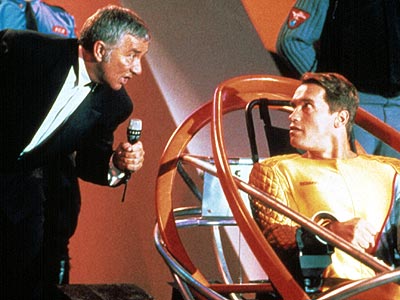
The Running Man -- truth, propaganda and reality TV


Director: Paul Michael Glaser, 1987. (R)

Three years after Arnold Schwarzenegger said “I’ll be back” in The Terminator, he says it again here, in this tale of two governors. Arnold and Jesse Ventura, both of whom went on from their storied acting careers to become politicians, appear on opposite sides of the divide. But this is also testament to the quality of this film’s acting. It might be an interesting action flick, but the acting is second rate.

It is 2017 and the world economy has collapsed. America has become a totalitarian society where everything is rigidly controlled by the state and its omnipresent police force. One of these cops is Ben Richards (Schwarzenegger). At the start we see him ordered to massacre an unarmed crowd of civilians. When he refuses, he is arrested and framed for the ensuing slaughter that he tried to prevent. Sent to prison and branded a butcher, he eventually escapes with the help of two fellow prisoners, Laughlin (Yaphet Kotto) and Weiss (Marvin McIntyre), members of the rebellion. But when he encounters Amber (Maria Conchita Alonso), a worker at the central TV network headquarters, she turns him in and he is re-arrested.

Into this mix comes Killian (Richard Dawson), the creator and host of the world’s most popular and successful TV show: “The Running Man.” Heinous criminals are offered the choice of going to prison or being on the show, where they are released into an abandoned part of Los Angeles to be tracked by stalkers, killers who hunt them down to kill them on air.

The premise reminded me some of the hugely popular fictional series, “The Hunger Games,” which itself is being turned into a major motion picture set for release in 2012. In both, people are thrown into an arena and forced to kill or be killed. The governments each of these stories control the elements of the arena and herd the participants into locations where the killing can occur in prime view of the watching public. And the TV forms the media for propaganda.

Indeed, propaganda versus truth is a central element of the film (as it is with “The Hunger Games”). The government controls the TV and news media and hence controls the spin of events. Truth is distorted until it disappears in a web of lies. “What is truth” Pilate once said, to another condemned criminal (Jn. 18:38). But that criminal was Christ and he had earlier unequivocally declared, “I am the way and the truth and the life. No one comes to the Father except through me.” (Jn. 14:6). Truth is real, and truth ultimately cannot be concealed forever. It will emerge.

When Ben is sent into the arena, so are his two friends. Moreover, Amber’s desire for truth and justice backfires when the government sees her as an enemy of the state for seeking truth. She is also condemned to the same fate, showing as the three heroes. While a blood-hungry audience watches them, Killian dispatches stalkers, one at a time, to hunt and kill. Football rushing champion Jim Brown plays fireball, whose weapon is a flamethrower. Buzzsaw and Subzero are earlier stalkers, and overseeing them all is retired stalker, Captain Freedom (Jesse Ventura), whose wrestling exploits mirror the actor’s real-life moves.

If anything, though, the film is a strangely prescient parody on TV reality shows. The Running Game is a reality show to the death. Nowadays, reality TV has become the name of the game, from the finding of love (“The Bachelor” / “The Bachelorette”) to the losing of weight (“The Biggest Loser”). People are happier to live life vicariously through watching someone else, a “normal person,” do unscripted things. The concept of seizing life by the horns has been supplanted by the idea of seeing life on the tube. This is not how God designed us. He wants us to live life to the full, and to do so in Jesus Christ (Jn. 10:10). First-hand experience trumps second-hand exposure every time!

Another criticism of modern-day society stems from this. Much of the populace has become dependent on the boob tube. Killian grasps this and tells Ben:
This is television, that's all it is. It has nothing to do with people, it's to do with ratings! For fifty years, we've told them what to eat, what to drink, what to wear... for Christ's sake, Ben, don't you understand? Americans love television. They wean their kids on it. Listen. They love game shows, they love wrestling, they love sports and violence. So what do we do? We give 'em *what they want*! We're number one, Ben, that's all that counts, believe me. I've been in the business for thirty years.
To him, he controls the people and in return is rewarded with ratings that translate into wealth and power for him.

Are we like this? Have we given up our minds to the god of television, allowing it to consume endless hours of our spare time and brainwash our minds? Are we like sheep without a shepherd, sitting lost on our couches until the newscaster or reality show host tells us what to do? We can rise above this. We can take back our lives. We can turn to Jesus and let him wash us with his blood (Rev. 7:14) and give us his mind (1 Cor. 2:16). If we are willing to give up control, better to give it to Christ than Killian. He offers an eternal reward for us, instead of seeking an ephemeral reward for himself.

Copyright ©2011, Martin Baggs

Wednesday, August 24, 2011

Dog Day Afternoon -- planning, pleasing and persons


Director: Sidney Lumet, 1975 (R) 

Bank robbery movies generally include masked robbers, gunshots, car chases and rapid action, with greed as the motivation for the heist. Not so with Dog Day Afternoon. Instead, Sidney Lumet (The Verdict) draws a character study of a bank robbery gone awry. And at the center is a character who wants to make people happy! Greed is replaced by a twisted form of altruism.

The actual robbery on which the film is based took place on August 22, 1972 in Brooklyn. John Wojtowicz held up the Chase Manhattan Bank on the corner of East Third Street and Avenue P, along with his partner in crime Salvatore Naturile. Here, the central character has become Sonny Wortzik (Al Pacino, Heat) and his nervous sidekick is Sal (John Cazale, The Deer Hunter). And during the dog days of summer, one hot August afternoon, they enter the bank to steal its money.

When Sonny and Sal enter, along with a third robber, they come in street clothes – no masks or disguises. They have planned no further than the next step or two. When their driver decides he can’t go through with it, they are down to themselves, and the robbery is already in jeopardy. Since it is the end of the bank’s day, the only people present are the manager and a number of female tellers. But when the manager gets an unexpected phone call, Sonny comes to find out that the police have seen him and he is trapped. From then on, police descend on the bank and surround it, laying siege to it, effectively leaving Sonny and Sal with a hostage situation. Outside Det. Sgt Moretti (Charles Durning) takes charge and begins negotiations with Sonny.

The first theme of the film and the robbery is clear – planning, or lack of it. When undertaking a task or project, even one as immoral as a bank robbery, it is critical to plan effectively and mitigate and foreseeable risk. Jesus even talked about this to his disciples: “Suppose one of you wants to build a tower. Won’t you first sit down and estimate the cost to see if you have enough money to complete it?” (Lk. 14:28). Of course, this was in the context of counting the cost of becoming one of his disciples (Lk. 14:33), but the principle remains the same.

As the standoff continues, the tension escalates and the beauty of the film emerges: the depth of character and the quality of acting. Al Pacino delivers another outstanding performance, one that earned him an Oscar nomination, as a complex character driven by a motive we find out late in the film. And John Cazale is totally believable as a robber who is on over his head and is ready to kill to escape. Although the film only netted one Oscar, for best original screenplay, its acting and directing are first-rate. Lumet even allowed some of the scenes to be improvised, including Pacino’s famous cries of “Attica, Attica!” to the watching crowds, referring to the riots in the Attica Prison in 1971 in which 43 people were killed.

Amid the stress, Sonny finds himself acting as facilitator and problem solver, working out how to keep the women happy, when they need to take bathroom breaks or eat, etc. He is constantly complaining that he has to work to solve these problems. He is no vicious and violent thug; he is a man forced to rob for a deeper reason.

Trying to make people happy is a laudable ideal, but one at which people are destined to fail. You can never make everyone happy. It is a failing proposition. There will always be someone who you can’t please. That is why the apostle Paul tells the church at Thessalonika, “We are not trying to please people but God, who tests our hearts” (1 Thess. 2:4) God is the one we should seek to please. As Paul says elsewhere, “If I were still trying to please people, I would not be a servant of Christ” (Gal. 1:10). We cannot focus solely on making people happy. It will lead us to an early grave brought on by stress and will leave us poor before God.

What makes this film most human, though, is the revelation that Sonny is gay. Despite the occasional homosexual slur, the focus is on Sonny as a person. He might be homosexual, but he is first and foremost a person, with a life and loves. His love life or gender preference may underscore the motives behind his actions but they are not placed in center stage.

Too often we focus on a person who is gay and decry his lifestyle, ignoring his personhood. He is viewed by the church as a sinner who must change. But we forget that we, too, are sinners in need of grace who have to change as well. We can become hypocrites as we look down on those whose sins are “worse than ours.” But the truth is we all stand guilty before God. Just as God condemns homosexuality (Rom. 1:27), so does he condemn heterosexual adultery (Exod. 20:14) and pre-marital sex (Gal. 5:19). The litany of sins of which most of us have committed one time or another goes on and on: “greed, malice, deceit, lewdness, envy, slander, arrogance and folly” (Mark 7:22), to name but a few. We need to understand that “all have sinned and fall short of the glory of God” (Rom. 3:23), whether homo or hetero sexual. The solution for us all is grace, for we ”are justified freely by his grace through the redemption that came by Christ Jesus” (Rom. 3;24). This is something we must choose to receive, by following Jesus Christ: “for the wages of sin is death, but the gift of God is eternal life in Christ Jesus our Lord” (Rom. 6:23).

In these dog days of our own summer, let’s focus on planning, helping people, and treating others with respect, regardless of their color, sexual preference or religious affiliation.

Copyright ©2011, Martin Baggs