Friday, April 29, 2011

Fair Game -- authority, truth and lies


Director: Doug Lima, 2010. (PG-13)

“The first casualty when war comes is truth.” Senator Hiram Johnson said this in 1917 when the United States entered the first world war. It is still true today. This becomes apparent in Lima’s true conspiracy thriller set in 2003 just as the United States was about to go to war with Iraq over Saddam Hussein’s WMDs (weapons of mass destruction).

Fair Game tells the true story of Valerie Plame (Naomi Watts), a covert CIA agent who is outed by a leak from a government source because her husband, former Ambassador Joe Wilson (Sean Penn), wrote an op-ed piece criticizing the government. Though the story is known and recent, Lima’s film is taut and riveting.

The movie begins with Plame on a mission in Kuala Lumpur, seeking to turn a businessman into a spy for America. Acting as a venture capitalist, her cover, she deceives him but puts him into a position where he cannot refuse her “offer.”

A subsequent scene shows her back home in a restaurant with her husband and friends. As the conversation turns to politics and the impending conflict with Iraq (this being just two years after 9/11), she can offer no opinion, “being” a simple businesswoman. Her husband, though, gets drawn into the political debate, to her chagrin. This simple scene defines the couple admirably. She is calmly deceptive, able to easily handle the lies that she must tell and the false front she must maintain. But he is hotly truthful, sharing opinions even when they hurt friends or his own marriage.

When the CIA learns that Saddam might be buying a large shipment of yellowcake uranium, a component of nuclear bombs, from Niger, Plame mentions that Wilson still maintains connections in that country from his time as an ambassador. Shortly thereafter, he travels on his own dime to research this, ultimately for the CIA. His report: the rumor was wrong; no sale was happening. He has the truth from firsthand experience.

Then the Bush administration goes to war to find the WMDs. To support this military campaign, they point to this sale of yellowcake uranium. Seeing this on TV, Wilson cannot believe they have ignored his report and turned their backs on the truth. Against advice from close friends, and without consulting his wife, he pens a first-person account to refute what the government is saying. In effect, he is standing up on his own to the full power of the political machine in Washington.

At its heart, this account is about the truth and the conspiracy to cover up that truth when it is inconvenient. We want to respect our leaders and our politicians. We look to them for accuracy on current affairs. After all, the government pulls the trigger on war. But when these leaders are lying, they lose our respect, breach our trust, and cross the Rubicon, as this administration did in 2003.

Yet when an individual goes up against the President and his advisers, the stakes are high, and the kid gloves are removed. With the implied backing of the Vice President, and with the full knowledge of Scooter Libby (David Andrews) his advisor, the government retaliates. A source leaks the “fact” that Wilson was sent to Niger by his wife, a CIA operative. In this one article, Plame’s career is derailed and her ethics are questioned. Moreover, as Wilson fights back through TV interviews, the government aggressively attacks Wilson by downgrading and defaming Plame’s career.

Here is the abuse of power that comes from people in authority who are not willing to face the truth. One hundred years ago Baron Acton said, “All power tends to corrupt and absolute power corrupts absolutely.” Here is absolute proof. Perhaps Wilson’s approach was wrong, but he did not have much to choose from. Certainly, the government’s response was wrong, even malicious. They moved the discussion from WMDs and truth to Wilson/Plame and personal ethics.

The authority of the government derives from the people. It serves the people and the people deserve the truth. Too often we have become immune to the truth, so satiated with lies force-fed us through the media that we no longer know what is true and what is not. Jesus said “Then you will know the truth and the truth will set you free” (Jn. 8:32). We can know the Truth in the person of Jesus (Jn. 14:6). He is the creator and sustainer of all that is, so derives authority only from his father, our creator God. He is the one leader we can be absolutely certain of, who we can follow with no qualms. He never lies (Tit. 1:2), for his nature is truth. Plame said, “You have to know when you’re lying and remember what is the truth.” Better to simply speak and remember the truth and live a transparent life that has no place for lying.

Even as the government is attacking Wilson and Plame, she is taking their children and leaving him. Their home has become a circus of reporters, so she abandons it, putting a large question mark over their marriage. Yet while their marriage hangs in the balance, Iraqi civilians wait for her promised help. Having pressured an Iraqi to return home to seek needed intelligence, Plame had promised to get this woman’s family out of Baghdad. But when Plame’s true job came to light, the CIA washed their hands of her, terminating this and other operations she had been leading.

Here is the cost of standing up for the truth. It takes its toll, on the person blowing the whistle (Wilson) and the family (Plame and children). The consequences ripple out to many others whose lives have been touched (the Iraqi spy’s family). Though it is the right thing to do, it may not be easy or painless. If the world does not want to hear the truth it will do its best to silence the speaker.

Jesus knew this. He came telling the truth. He blew the whistle on the twisted religion that Judaism had devolved to under the Pharisees and other leaders in the Sanhedrin (Matt. 23:13). He offered an alternative vision of the kingdom of heaven that would have removed these political leaders from power (Matt. 5-7). Instead of embracing him as their Messiah, they declared him a liar and servant of Satan (Matt. 12:24) and crucified him (Matt. 27:35). He told us, his followers, to be ready to speak the truth in front of governors and kings (Matt. 10:18), relying not on our own strength for words, but on the Holy Spirit (Matt. 10:20). One day we might face a situation like the one Wilson faced. And if we do, we must choose truth realizing that it carries consequences. This is the only way to live. Be like Wilson, not Plame. Truth over lies.

Copyright ©2011, Martin Baggs

Monday, April 25, 2011

Shutter Island -- guilt, monsters, and truth


Director: Martin Scorsese, 2010. (R)

2010 was a banner year for Leonardo DiCaprio. He starred in two thrillers, Inception and Shutter Island, that together netted over $1B worldwide. Not only were these financial blockbusters, but they were at the top of their genre. And there were similarities in plot. In both films DiCaprio played a protagonist troubled by dreams of his dead wife and who harbored a dark secret. This psychological thriller is not as scary as it seemed during the trailers, but it is deeper and more thought-provoking than many movies in this genre.

As in many of his films, Martin Scorsese has assembled a stellar cast. Alongside DiCaprio, who has teamed with the director three times before (in Gangs of New York, The Aviator, and The Departed), are veteran actors Ben Kingsley (Elegy), Max von Sydow, Emily Mortimer (Lars and the Real Girl), Patricia Clarkson (The Station Agent), Ted Levine, and Michelle Williams. Their performances are spot on.

Here DiCaprio is US Marshal Teddy Daniels. Together with his new partner Chuck Aule (Mark Ruffalo, The Kids Are All Right), they are sent to Ashecliffe Hospital on Shutter Island to investigate the mysterious disappearance of one of the patients. But these patients are prisoners, dangerous murderers, as Ashecliffe is a mental institution for the criminally insane. And it is 1954, when three differing approaches to treating mental illness are arising: repetitious pharmacology, respectful counseling, and radical lobotomy.

Visually, Shutter Island and Ashecliffe Hospital are stark and foreboding. There is something frightening about the place these two marshals must visit. The score is loud and discordant, echoing the twisted nature of the souls who live there. Together, the sounds and vision establish a menacing atmosphere.

Once they have arrived at the hospital, Daniels and Aule find a wall of silence. The doctors, staff and even the inmates seem unwilling to help the investigation. It as though there is a conspiracy covering up what has happened. When a hurricane-force storm pummels the island, knocking out power and communication lines, the two marshals find themselves stranded, trapped on an island that does not want to release them.

Meanwhile, Daniels is haunted by dreams and hallucinations of his dead wife, Delores (Williams), who tells him that the lost woman is still on the island. As well as this, he struggles physically with recurrent migraines and psychologically with guilt: guilt from the death of Delores in a fire started by an arsonist, and guilt from what he saw and did during world war 2. He was one of the soldiers who liberated Dachau concentration camp and experienced first-hand the results of the inhumanities committed by the Nazis: frozen bodies of men, women and children piled high beside the barbed wire fence.

Guilt is one of the themes. As a Catholic film-maker, it is not surprising that Martin Scorsese weaves this thread throughout his career. Guilt is the feeling that a person has violated a moral standard through action or inaction. Closely related is the concept of remorse, the emotional expression of personal regret for committing a shameful or violent act. Guilt is intended to drive us to God in repentance (Acts 20:21). When we do this, we will find forgiveness, the only thing that can trulyremove guilt. The forgiveness of God is freely given (Eph. 1:7) but must be graciously received (Jn. 1:12). It cost God his son, Jesus Christ (Rom. 3:25). We cannot erase our guilt in any other way, though, like Daniels, we may try.

Violence is a second theme, and again a recurrent one for Scorsese. The Warden, in a conversation with Daniels, brings this to the forefront: “God loves violence. . . Why else would there be so much of it? It’s in us. It’s what we are. We wage war, we burn sacrifices, and pillage and plunder and tear at the flesh of our brothers. . . . There’s no moral order at all. There’s just this: can my violence conquer yours?” Before this, the lead psychiatrist had said something similar to both marshals: “Men like you are my specialty, you know. Men of violence.”

The theology in view here is both right and wrong. God does not love violence. That is clear from his very nature: “God is love” (1 Jn. 4:16). Violence was not part of the created order but entered the world with the fall of Adam. His son Cain became the first murderer (Gen. 4:8). Yet after the fall, with the entrance of sin, we are all capable of violence, of terrible acts. The film points to the atrocities of the Nazis in the second world war but also points to ongoing inhuman and immoral actions that occurred in Russia and even occur in America. Moreover, we read of the brutal acts of violence perpetrated by serial killers, monsters in our society, and we understand this aspect of the truth in the warden’s comments.

Monsters emerge as a third theme of Shutter Island. Dr Naehring (von Sydow) brings this point into view: “Wounds can create monsters. . . And wouldn’t you agree, when you see a monster, you must stop it?”

We are all wounded, in one way or another. Daniels was wounded and harbored deep, dark secrets. Our wounds result from the consequences of sin. Some may be our own sin, and we become our own victims. Sometimes it is the sin of others. Then, like the poor Jews in Dachau, we feel the pain of wounds inflicted on us by others. If we focus on our wounds, turning inward, we can become bitter and turn into the monsters who inflict wounds on others. The cycle can only be broken by dealing with the root cause: sin. And we cannot do this on our own. When we try, like Daniels, we find ourselves in a prison of our own making, running from those who may or may not be our friends. No, the person who can save us is Jesus (1 Pet. 3:21). He dealt with sin, once for all, when he went to the cross for us (Heb. 9:26). We must receive his gift of life, and find in him a new identity and a new nature; we become a new creation (2 Cor. 5:21).

As the film progresses it keeps the viewer engaged, unwrapping secret after secret at the right moment. With horrors without and within, it offers insight into the torments of the human mind. And it is through this inner war, fought by one man, Daniels, against himself and those around him, that we also see that truth is not always clear. Though Jesus said, “The truth will set you free” (Jn. 8:32), we must look carefully for the truth, and discern wisely else we will be fooled, by ourselves and by our friends.

At one point Daniels says to his partner, “Which would be worse – to live as a monster? Or to die as a good man?” And this summarizes nicely the themes of violence, guilt, monsters and truth in one succinct line. Are we willing to live out our lives as monsters, even if this is only apparent to ourselves? We may fool others, but we know our inner depravity, if we really look at ourselves closely in the mirror. Or will we confess our sins, our monster nature, to God and accept his cleansing, his gift of a new nature, and become a good man? This may result in society ostracizing us, even putting us to death, but we will find forgiveness and truth.

Copyright ©2011, Martin Baggs

Friday, April 22, 2011

Love and Other Drugs -- empty sex


Director: Edward Zwick, 2010. (R)

Love and Other Drugs is billed as an unconventional romantic-comedy but is more of a sex romp with the occasional comic moment. There is so much skin shown, that it ultimately becomes offensive. What started as an interesting premise becomes a sad cliche-filled drug to avoid.

The premise, done before in Up in the Air, focuses on what happens when a superficial, sex-addicted man meets a woman like this and feelings get in the way. Or, as the tag-line questions, "Addicted to one-night stands or dependent on one another?"

The opening scene sets the tone. Jamie (Jake Gyllenhaal, Brothers), is a salesman in a Best Buy-like store. It is the mid-90s and boomboxes are in, cell phones are big (literally), and TVs are flat. He can sell anything to anyone, being full of charm and chatter. But his eyes are on the girls, including his coworkers. When his sexual liaison during a break is discovered, he is fired. Here are his values: empty sex and deep pockets. Greed and sex, the two vehicles that drive Madison Avenue and most of the American culture.

Getting a new job as a Pfizer pharmaceutical salesman, he is partnered with veteran manager Bruce (Oliver Platt). Together they call on Dr Stan Knight (Hank Azaria), a cynical GP who wants free samples and free sex. He is open to bribery, especially if it involves dinner, drinks and dessert of the feamle variety. Free drugs leading to free love. Eventually, Jamie sells Viagra and becomes the rep of choice by throwing samples out like candy, irresponsibly without caring.

When Jamie meets bohemian artist Maggie (Anne Hathaway, Rachel Getting Married), one of Knight's patients, he wants her number. Their opening "date" in the coffee shop where she works to pay the rent. Her dialog is a mirror image of his: "You want to close right? You want to get laid?" He is surprised, "Now?" But she makes it clear what kind of girl she is,
Oh right, right, right. I'm supposed to act like I don't know if it's right. So then you tell me that there is no right or wrong. It's just the moment. And then I tell you that I can't while actually signalling to you that I can, which you don't need because you're not really listening. Because this isn't about connection for you. This isn't even about sex for you. This is about finding an hour or two of relief from the pain of being you. And that's fine with me, see, because all I want is the exact same thing.
She is single and easy, wanting sex without emotional engagement. Dessert without the dinner.


Here is where the film does hit a correct note. There are many like Jamie who look to sex as a way out of the pain of living. In many ways, sex is just like a drug. It satisfies temporarily without any entanglements but it also becomes addicting. But like a drug, sex used in this way is damaging, to the users. Sex was not meant to be so superficial.

As Jamie and Maggie enter into this extended series of one-night stands, it becomes clear that both are afraid of relationships. He is enamored with career success and money. She, on the other hand, has early on-set Parkinson's disease and does not want to let anyone come close. She is afraid of pity. Neither are prepared for commitments. But as things progress, feelings appear until the dreaded words "I love you" force their way from Jamie's lips. Love, not sex, has surfaced.

This is one of the fallacies of the film's ethics. Sex is never intended to be the relational vehicle to lead to love. Sex was designed to be a beautiful expression of love, and in God's original intention it is experienced within the boundaries of marriage (Gen. 2:24). When a man and a woman are joined in holy matrimony their wedding night should be the beginnings of this physical aspect of their relationship (Heb. 13:4). When this is taken in the wrong sequence, sex before marriage, the act is reduced from its holistic nature to something simply physical. It rarely leads to a marriage that lasts. After all, if it's OK to sleep around before forming a relationship, why not sleep around with others after marriage?

Love and Other Drugs has a solid cast, including the late Jane Clayburgh in her penultimate movie, as Jamie's mom, and George Segal as his dad. But it fails to use them effectively. Most of them seem to exist merely to hover around the two principal protagonists. Josh, the geeky chubby brother, is especially annoying, having little to do with the plot except to provide some comic relief and to counter Jamie's "growth" in love by showing his own awareness of empty sex.

Unless you have trouble sleeping and have run out of sleeping pills or other drugs, you should abstain from  Love and Other Drugs. Its excessive focus on sex is simply too hard to swallow. Just say no. Love is not a drug. It is the very foundation of human relationship and the essence of God (1 Jn. 4:16). There are no side-effects.

Copyright ©2011, Martin Baggs

Monday, April 18, 2011

Welcome -- illegal immigration and inhumanity


Director: Philippe Lioret, 2009. (NR)

Welcome succeeds at creating a compelling drama centered on the inhumanity of French law related to illegal immigration. It does so by making it personal, focusing on a single young immigrant and telling his story. It is actually a tale of two men whose lives have been turned upside-down by lost love. In their collision, we see the cynicism of middle-age erode under the power of personal values encouraged by the sacrificial devotion of youth.

Bilal (Firat Ayverdi) has come to Calais on the French coast from his home in Iraq. A 17 year-old Kurd, he has come over two thousand miles by foot and by hanging under trains. After three months he has arrived at this port-town, that is a mere 20 miles from England. His driving mission: to reach his love, who now lives in London with her parents and family.

A rude awakening comes at Calais. He cannot legally cross the border into England. And there are hundreds like him seeking a way across the channel to their dream of a new start in England. The early scenes looking down on and over the dozens of cargo trucks moving slowly back and forth from the ferries convey powerfully the overwhelming sense of smallness of the individual; these immigrants are at the mercy of vast forces that they cannot control.

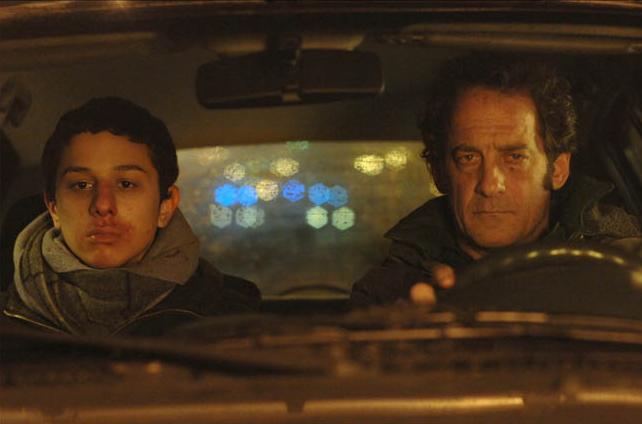
Bilal's desire forces him to reconsider his approach, and his determination sees only a few miles of water between him and his woman. Going to the local swimming pool to take lessons, he meets the instructor Simon (Vincent Lindon). Vincent is separated from his wife Marion (Audrey Dana) with a divorce impending. He is losing his love, and his life is becoming empty.

While Simon keeps his emotions and feelings hidden deep within, living passively, Marion pours hers out into positive action. She runs a soup-kitchen with her new boyfriend serving food to the illegals in the "jungle," the woods around the port where these homeless men gather.

Welcome is filmed in a minimalist style with a pungent documentary austerity that focuses on the main characters. And the three actors are up to it. Surprisingly, Ayverdi is not a processional actor. An unknown, he was cast to play Bilal after a long search among Kurdish communities in Europe. He has a naturalness and truth that comes across in his performance, which is balanced by veteran actor Lindon. Together, they create an emotional impact.

Lioret's point in this film is to highlight the absurdity of the French legal system. It is against the law for a French citizen to help these refugees. Though they are homeless and hungry, to offer any assistance including sustenance is to risk arrest, fine and even imprisonment. Lioret likened this in an interview to the occupation during world war 2, when French resistance families harbored Jews and risked death. The French authorities have become akin to the Nazis, according to Lioret.

Regardless of the legalities, social justice would demand meeting a fellow human's needs. Jesus told his disciples that when they served others they are serving him: " For I was hungry and you gave me something to eat, I was thirsty and you gave me something to drink" (Matt. 25:35). To turn a blind eye and walk away is to be guilty of the sin of omission (Jas. 4:17).
Initially Simon walks away from Bilal and his needs. But he later offers him help, hospitality and harbor. Whether this is from pure motives or driven by his desire to win back Marion is unclear. Yet in reality, motives are not totally transparent, even to ourselves, as there are usually various factors at play. The result, though, is the same: Bilal finds a friend of sorts who will help him in his attempt to swim the English Channel.

Bilal's determination to reach his love opens up Simon's eyes to life's mission and passion. Once a champion swimmer, his worldview had closed in on himself. His horizon has shrunk to the limits of his living room, a room empty of relationships and hope. Through Bilal, Simon's vision enlarged and his values grew. Even when Marion urges him to walk away, he can no longer make that choice. He has been touched and changed forever, for the good.

Helping people in need will have this effect. It forces us to see our blessings and causes us to re-evaluate our values and our lifestyle. We can become immune to statistics but when we actually meet one of the faceless numbers in person and see his need, feel his pain, it can cut through the hardness of our hearts. We become open to God; we can allow him to use us. In this way, we become the hands and feet of Jesus, serving a meal to a homeless person.

A beautiful scene stands out. Simon walks down to the "jungle" looking for Bilal. He sees him there without a jacket, cold and alone. He takes off his own coat and gives it to him without words. This is a powerful image of Jesus' words in the sermon on the mount: "if someone wants to sue you and take your tunic, let him have your cloak as well" (Matt. 5:40).

Unlike a Hollywood film, Welcome ends ambiguously. There are loose ends. But it is clear Lioret wants us to address our own loose ends. Will we offer a welcome to the illegal immigrants in our community? Or will we continue to walk away, showing the unwelcome sign attached to our backs? How would Jesus want us to answer this?

Copyright ©2011, Martin Baggs