Thursday, August 18, 2011

Dirty Pretty Things -- illegal activities and illegal immigrants


Director: Stephen Frears, 2002. (R)

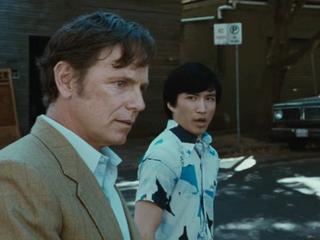
In the center of London sits the famous luxury Savoy Hotel off the Strand. Nearby are the seedier and unknown hotels. The fictitious Baltic Hotel is one of these. This West London hotel caters to the cheaper tourist. But it is here that illegal activity and illegal immigrants come together. Prostitution, drug dealing and worse, dirty things take place amongst the pretty chambermaids: dirty pretty things.

Stephen Frears (The Queen) filled this independent film with relatively unknown actors, perhaps underscoring the fact that the main characters, illegals, are unknown. The two leads are played by Audrey Toutou (Amelie), in her first English speaking role, and Chiwetel Ejiofor, who has gone on to various Hollywood movies, including American Gangster and Salt. Sergi Lopez is the antagonist, though, and he is known to European film buffs, playing the villain in films like With a Friend Like Harry and Pan’s Labyrinth.

Okwe (Ejiofor) and Senay (Toutou) both work in the hotel. Okwe is the night desk clerk while Senay is a daytime chambermaid. When she arrives their intersection allows her to surreptitiously pass off her apartment key to him. Unknown to the others, he is sharing her flat, living on her sofa. Both being illegals, their pay is limited and they are barely able to survive even on that.

To make ends meet, Okwe does double duty as a taxi driver by day, hotel receptionist by night, catching a nap on Senay’s couch. To stay awake, he chews weed, or some other form of drug. Nigerian by birth, his past remains secret for much of the film, although it is clear he is a trained doctor, now forced to work menial jobs in London. Senay, on the other hand, is a Turkish muslim refugee seeking asylum. Her status precludes her from gainful employment and so she has to avoid and evade the brutish police who are after her.

When Okwe finds a human heart in the toilet of a hotel room one night, he is faced with a dilemma. Taking this to the hotel supervisor, Sneaky Juan (Lopez), Okwe wants to see justice done and the police called. But Juan wants nothing of the sort. Too many dirty things take place under his watchful eye. And as Okwe begins to investigate on his own, he begins to turn over rocks revealing the underbelly of London society where illegals are exploited.

Confronted, Juan explains: “I make people happy.” He is a middle man and both those upstream and downstream seem to appreciate what he is doing. Yet, it is both illegal and immoral. Without any rights and without the ability to turn to the law, the illegal immigrants resort to such illegal activities to survive. Lack of options ensures their ongoing exploitation.

Injustice, oppression and exploitation of foreigners form a central theme of the Torah, the Israelite’s Bible. Moses wrote in Exodus 22:21: “Do not mistreat or oppress a foreigner, for you were foreigners in Egypt.” Further, “When a foreigner resides among you in your land, do not mistreat them.” (Lev. 19:33). And: “You are to have the same law for the foreigner and the native-born. I am the LORD your God.’” (Lev. 24:22) The reason for these commands is explained by Moses in Deuteronomy (10:17-19): “For the LORD your God is God of gods and Lord of lords, the great God, mighty and awesome, who shows no partiality and accepts no bribes. He defends the cause of the fatherless and the widow, and loves the foreigner residing among you, giving them food and clothing. And you are to love those who are foreigners.” Justice and mercy for the illegals (and the legals) is based on the very nature and character of God himself.

Juan eventually forces Okwe to make a tough choice: one path will have him break the law but help Senay, the other will keep the law (and leave his conscience clear) but will harm Senay. Which will he choose? For many illegals, morality is not as black and white as it is for Okwe. Life offers many shades of gray morality.

Dirty Pretty Things takes some time to establish characters. Once the heart is found, the film finds its heart and picks up pace. As the mystery unfolds, the secrets of the characters are slowly revealed, along with some sweet plot twists, until it reaches a satisfactory conclusion.

The underlying message of the film is highlighted in a scene where Okwe, Senay and Juliette (Sophie Okonedo), a prostitute, confront a sleazy businessman. The man asks them, “How come I’ve never seen you people before?” Okwe answers, somewhat defiantly, “Because we are the people you do not see. We are the ones who drive your cabs. We clean your rooms. And [do sexual acts for you]” How often do we see these invisible people? Are our eyes open to those who serve in menial positions? If we are not, now is the time to start seeing.

Copyright ©2011, Martin Baggs

Saturday, August 13, 2011

Unknown -- memories and identities


Director: Jaume Collet-Serra, 2011. (PG-13)

A man wakes up to find out he has no identification and no proof of identity. Clearly he is an American overseas. Is he an international assassin, like Jason Bourne? No, this is not the Bourne Identity, though the film draws parallels to that action adventure “classic”. Rather, he is Dr. Martin Harris, although to others he is simply unknown. Though the premise is somewhat clichéd, the film is surprisingly good, with action aplenty and some unexpected twists.

The film opens with Martin (Liam Neeson, Taken) and his wife Elizabeth (January Jones, X-Men: First Class) flying to Berlin. He is a bio-technology researcher presenting a paper at an international conference. When they arrive at their hotel, he realizes he has left his briefcase at the airport and promptly leaves her at check-in to return to the airport. On the way back to the hotel, a freak accident causes the cab to crash through a bridge and plummet into the icy waters of the river below. The cab driver, Gina (Diane Kruger, National Treasure 2), saves him from drowning but flees the scene as she is an illegal. Martin, comatose, is taken to hospital, where he regains consciousness four days later. Without a passport or wallet he is an unknown. But he remembers vaguely his name and his wife.

Fearing for his wife, Martin leaves the hospital and returns to the hotel. But without documentation he cannot get a room key. Seeing Elizabeth, he persuades security to let him talk to her. When she denies knowing him, his frustration grows. When another Dr. Martin Harris (Aidan Quinn) joins her and she acknowledges this man as her husband, Martin’s perplexity escalates and his sanity is called into question. Is he a madman? Does he know her? Why does she deny knowing him if his memory is accurate?

With no one else to turn to, he seeks out Gina. But a mysterious man tracks him with deadly intent. Driven from her apartment, Gina and Martin must unravel the enigma of Martin’s identity if they want to stay alive and elude their pursuers.

Before dealing with the main themes of the film, it is worth mentioning the subtheme of illegal immigrants. Gina is one and has no rights. So, when she loses her job as a cabbie she is powerless, much like Martin. Yet, even illegals should not face oppression and injustice. As the prophet Malachi declared, speaking for the Lord, “I will be quick to testify against . . . those who defraud laborers of their wages, who oppress the widows and the fatherless, and deprive the foreigners among you of justice” (Mal. 3:5).

Ultimately, though, it is the questions of identity that Unknown raises, without answering any of them. How do we prove who we are? When questioned, we usually turn to documentation first. We show our driver’s license or our passport. Sometimes we go back further to birth certificates, but without these we are left unknown and powerless. And, of course, these can be counterfeited so on their own they may not completely establish a person’s identity.

Better perhaps is to turn to those who know us, our spouses, our colleagues and friends. They can vouch for us. They are witnesses to who we are. But if they betray us, denying knowing who we are, we have almost no legal recourse. We simply cannot prove who we are. To the authorities, we sound confused even mad, just like Dr. Harris.

With nothing else left, we turn inwards, to our memories, to establish some level of anchor-hold. But if these become vague, perhaps due to temporary amnesia, they may not match reality and then we must listen to what we are told. Harris tells his medical doctor, “Do you know what it feels like to become insane, doctor? It’s like a war between being told who you are and knowing who you are.”

Are we who we are told we are? Or are we who we know we are? Which can we trust if they disagree?

Although our identity clearly rises above memory, memory contributes to making our lives meaningful. When a disease like Alzheimer’s hits we begin to lose touch with our past. Our memory fails and we become erased blackboards. Even worse is when those around us forget us as well. In the book of Job, one of his counselors refers to the fate of the wicked: “The memory of him perishes from the earth; he has no name in the land.” (Job. 18:17). King David echoed this in Psalm 9: “Endless ruin has overtaken my enemies, you have uprooted their cities; even the memory of them has perished.” Moreover, the psalmist tells us the greatest thing we can do for God: “I will perpetuate your memory through all generations; therefore the nations will praise you for ever and ever” (Psa. 45:17).

Without documents, witnesses or memory we are stranded in a world that is cold and heartless. Yet there is one who will stand up for us. God has said, “Never will I leave you; never will I forsake you” (Heb. 13:5). If we put our trust in him, all else may fail yet we will remain safe and secure. To the world we may be unknown, but we are known to Jesus (Jn. 10:28).

Copyright ©2011, Martin Baggs

Saturday, August 6, 2011

Harry Potter and the Deathly Hallows Part 2 --facing death and self-sacrifice


Direcor: David Yates, 2011. (PG-13) 

Ten years and 8 films later, the Harry Potter movie phenomenon comes to an end with the second half of The Deathly Hallows (book 7). And what a way to end the series: with this thrilling, action packed tense adventure. It is a satisfying conclusion even if the plot points are known from the book.

Even before the opening credits, the film is up and running, beginning exactly where part 1 left off (see review of part 1 here): revisiting the scene where Lord Voldemort (Ralph Fiennes) gets the most powerful Elder Wand from Dumbledore’s tomb. From there, it moves to the beach in the aftermath of Dobby’s death where Harry (Daniel Radcliffe), Ron (Rupert Grint), Hermione (Emma Watson) and several friends are mourning and burying the freed house elf. When the students at Hogwarts are shown being marched through the courtyard guarded by hovering dementors, it is clear the battle lines have been drawn. This is a classic good vs. evil culmination where familiar faces will face death, even some dying.

Part 1 of The Deathly Hallows had the famous trio searching for Voldermort’s horcruxes. The Dark Lord had used these to store portions of his soul in his attempt to find immortality. Three are left to be found in this film. Unlike the earlier movie, this one starts frantically and carries the pace throughout as the film spans a mere couple of days. It is non-stop action.

The film communicates this breathless nature even while adding some levity. An early scene has Hermione transfiguring into Bellatrix Lestrange (Helena Bonham Carter) via polyjuice potion to access her vault at Gringotts. There we experience a literal roller-coaster ride as the friends descend only to find their way barred by a dragon. Here is an actual dungeon and dragon!

Harry Potter and the Deathly Hallows - Part 2 Publicity StillAs the trio escape, the movie moves to Hogwarts for the final two acts. The last stand of good against evil occurs where the wizardry all began. Here the final battle takes place, with Voldemort’s minions, numbering thousands, taking on the vastly outnumbered and less mature students and teachers. There is more than a nod to the climactic battles in The Return of the King, the film that brought The Lord of the Rings trilogy to a close.

Despite the pace, director Yates, who himself has matured in his handling of the last four films in this series, finds time to bring some emotional revelations and some true heart. In particular, the death of Severus Snape (Alan Rickman), the perennial nasty prof and Judas-figure, delivers an unexpected disclosure (unless you’ve read the book).

But when all is said and done, this film is about the final confrontation between Harry Potter, the boy who lived, and Lord Voldemort, he who shall not be named. And the final duel does not disappoint. Rather, it underscores the true nature of these characters. It also reiterates the themes that have been present throughout the whole series: self-sacrifice, death, good vs evil.

During this confrontation Voldemort egotistically shouts, “Only I can live . . . forever!” His desire is apparent: power and immortality. Drunk on these, he seeks to subvert anyone and anything that stands in his way. In contrast, Harry stands as the humble Christ-figure who seeks nothing for himself.

Real-life has its own Dark Lord: Satan. He is alive and active on planet earth (1 Pet. 5:8), seeking to usurp God’s throne and domination (Isa. 14;13). He wants to live forever. But the end of the story has been written, and he does not attain eternal life. He is destined for the death in the lake of fire (Rev. 20:10). In contrast, all who follow Jesus will live forever in heaven with their Savior (Rev. 21).

Virtually all the characters come face to face with death here. Indeed, author J.K. Rowling has said that the series is fundamentally about how we respond to death. There are two main camps. The first are those that fear death and do anything to avoid it. Many death-eaters fall into this category. They don’t want to face the wrath of the Dark Lord and so submit to him. In our world, many people fear death and so avoid it by ignoring it; seemingly taking an ostrich approach, they put their heads in the sand and refuse to acknowledge death as if this will keep this spectre at bay. Then there are those who realize that there are values and goals that trump death. Harry and his friends will fight evil until the end, even if it means dying in the process. There are some in real life who adopt this philosophy. Usually they understand that death in this life is not the end; there is a life to come, whose eternal nature makes this life seem like a mere breath (Isa. 40:23-24), a short introduction to an epic adventure in the next life.

And then there is Harry. Having seen his friends face death and some die, he declares, “I never wanted any of you to die for me.” He is willing to face death himself, but does not want to put his comrades in danger. Motivated by a desire to save, he puts himself in the position of embracing the fullness of Voldermort’s power. What a display of love! Indeed, this illustrates Jesus’ point to his disciples: “Greater love has no one than this: to lay down one’s life for one’s friends” (Jn. 15:13).

At its heart this film and its predecessors emphasize the victory of love and self-sacrifice. Earlier installments played on the love of Harry’s mother that saved him and endowed him with his power and connection to Voldermort. But here it is Harry’s love and actual self-sacrifice that ultimately wins the day.

Harry Potter and the Deathly Hallows - Part 2 Movie StillHere is Harry as a Christ-figure. Jesus Christ humbled himself from a position of glory and greatness to become human (Phil. 2:6-7). And in his earthly life and especially death, he gave himself for others (Gal. 1:4). Sinless (Heb. 4:15), the Savior carried our sin to the cross that crucified him (1 Pet. 2:24). And when Satan thought he had won the battle, with Jesus buried in a dark tomb, God raised him from the dead (Acts 2:24). Jesus experienced victory over death itself and eventually over Satan. Today, Jesus sits at the right hand of God (Mk. 16:19), orchestrating the events of history, steering it towards his eventual confrontation with Satan which will bring history to a close (Rev. 20).

If you have never read one of the Harry Potter books or seen any of the other films, you should definitely skip this one. The backstory is assumed. But if you’re a Potter fan, this is the best film yet!

Copyright ©2011, Martin Baggs

Wednesday, August 3, 2011

Mao's Last Dancer -- dancing and cultural comparisons


Director: Bruce Beresford, 2009. (PG)

Mao’s Last Dancer juxtaposes the story of dancer Li Cunxin with a comparison of cultures: modern China and America. While the dancing works, the cultural criticism falls flat.

The film is based on the autobiography of Li, who at age 11 was taken from his parents in a poor village in rural China to be sent to Beijing to train with China’s pre-eminent ballet school. What is an honor for his parents is a heartbreak for Li, as he is parted from friends and family to essentially live in a community of dancers.

As he grows and develops, Li appears the only dancer who can think and dance apart from the rest of the communist class. When an American delegation from Texas comes to Beijing as part of a cultural exchange, it is Li whose chemistry with an Australian dancer catches the eye of the director Ben Stevenson (Bruce Greenwood).

Stevenson pulls strings to get the adult Li (Chi Cao) an opportunity to visit America to dance with the Houston Ballet company. There Li experiences American culture and American women, falling for one of the dancers.

Director Beresford has established himself with the Oscar-winner Driving Miss Daisy, but here resorts to a by-the-numbers tear-jerker more fitting to the Hallmark Movie of the week. Greenwood is the principal name actor and does a fitting job as the smarmy and self-absorbed dance director. Chi Cao does lovely work in his ballet performances.

Where the film fails is in its cultural comparisons. It paints a black and white picture that seems simplistic at best. The early portrait of China with the young Li shows a peasant experience dominated by Mao TseTung whose picture hangs above the classroom. But America is shown as a seductive place, full of consumerism and sexuality. The endless clothes given to Li by Stevenson appear almost obscene compared to the simple uniforms of his parents. The easy sex available in nightclubs (this is the late seventies of disco dancing) contrasts with the difficult lifestyle of his family.

The evils of the Chinese governmental system juxtapose against the evils of American society. Which is worse? Authoritarian control or libertarian freedom? Both have their own problems but freedom at least allows people to make their own decision. With this comes accountability. The Chinese police may have been able to routinely arrest and punish people for the “crimes” of others, such as their children, but the American judicial system makes people responsible for their own actions, a biblical concept.

Copyright ©2011, Martin Baggs