Sunday, July 11, 2010

World Cup Final


Today is the final of the World Cup 2010. It's time to say sayonara to the super soccer ball, the Jabulani (meaning celebrate in Zulu) specially created for this event by Adidas. It's time to salute an au 'voir to the vuvuzelas, the loud and exuberant omnipresent stadium horns. It's time to bid a fond farewell to the festival of football. Sixty-three games down, just the big one left to play out. How will we survive until Brazil 2014?

What memories, though. From the opening game with host nation South Africa against Mexico, through the England-US group-play match, to the surprising quarter and semi-finals where the power-house South American giants were felled by the Europeans. Who will forget the goal that never was, when Frank Lampard's shot for England landed at least a yard into the goal before bouncing out and play resumed (can anyone say "goal-line technology" please?). Or the notoripus hand-ball by Luis Suarez to save Uruguay in the very last minute of over-time and effectively knock out Ghana, dashing the hopes of the entire African continent.

Of course there are our favorite players. There was Cuauhtémoc Blanco (see right) of Mexico. From catcalls to cheers, this 37 year-old, chubby forward, who looked like he should be watchnig the finals plumped down on a soft couch rather than captaining his national team, became the first Mexican to score a goal in three consecutive World Cup Finals. Then there's Diego Forlan, the hair-band adorned Uruguayan goal-scorer, who netted 5 times and who seemed to be the only striker who could tame the Jabulani and score from a free-kick. Or Wesley Sneijder, the diminutive Dutchman who effectively knocked out favorite Brazil with a shot and a header. And there's the other mighty mite, David Villa, whose 5 goals so far have almost single-handedly kept Spain in the competition. Both he and Schneider have a game left to play in the final to break the 5-goal tie and become the winner of the golden boot for top-goalscorer in South Africa this last month..

While the Three Lions of England looked old and toothless, the young bucks of Germany seemed invincible, putting scoring four goals in a match three times, against Australia, England and Argentina. But Spain proved too much for them. The passion of the Iberians morphed into the patient passing play that was boring but brutally effective in choking Klose, the German scorer, and forcing a shut-out.

Netherlands Spain

Now it's down to two nations: Spain and Netherlands. We started with a blog post about favorite soccer movies. It's fitting that we end the tournament with a post on favorite films from these two countries. Here are mine; yours may be different:
By my count, that's Spain winning 5-1. With Spain's stingy defense, I predict a similar result on the field later today (like Paul the psychic octopus): Spain by a score of 2-1. But just so you know, I am still rooting for the men of Orange today. Go Holland!

Thursday, July 8, 2010

Knight and Day -- protecting our lives, discovering our desires


Director: James Mangold, 2010. (PG-13)

At 48 and 38 respectively, Tom Cruise and Cameron Diaz are hardly young pups. On paper they are too old for an action comedy-thriller. Most of us in this age-bracket are happy to be able to get out of bed in the morning without joint pain. Here Cruise leaps across roofs, jumps out of planes, and races amongst bulls on a motorcycle.

Cruise is Roy Miller, an agent on the run. Like Jason Bourne, he is a trained killer and can get out of most situations. Like Bourne, his own country is after him, sending assassins to kill him. Diaz is June Havens, a single woman who restores vintage cars. He can handle killers; she can handle carburettors. She has nothing to do with the CIA or FBI until Miller briefly bumps into her in an airport. She immediately comes into the microscopic glare of those trailing Miller. An unlikely pair.

Panned by many, this is one of the brighter of this summer's movies. It certainly appeals more to the older generation, who remember Cruise when he was one of the young guns, such as in Top Gun. Cruise and Diaz have wonderful chemistry together. Both adopt a tongue-in-cheek style and underplay their characters. And it works. Cruise delivers his dialog deadpan to give the film sharp comic relief. For example, in an early scene where Cruise kills the assassins on the plane. He tells June but she does not believe him. But when she sees the cockpit door ajar, she cries out, "The pilots are dead!" Roy: "Yeah, they've been shot." June: "By who?" Roy: "By me. No, actually, I shot the first pilot then he accidentally shot the second pilot. It's just one of those things."

Mangold (3:10 to Yuma) brings understated direction to this film and allows it to come across as a campy Bond-like spy thriller. Moving across continents as Bond does, Roy and June team up to save a scientist while evading both the bad guys and the good guys. The speed of the film and the fun it generates are enough to keep our disbelief in suspension. That is necessary because there are more plotholes than potholes in a Portland road. But we can overlook them because we want to see Roy and June succeed.

There are certainly some exciting scenes, as we would expect in an action flick: the early airplane fight, flight and crash is a thrill; the car chase through the streets of Boston; and the motorcycle ride during the running of the bulls in Seville, Spain. Throw in the beauty of the Azores and the majesty of the Austrian Alps, and Mangold gives us some spectacular eye candy.

The title of the film points to the first major theme: knight. Roy buys a metallic knight figurine in the airport. But he himself is in reality the knight, a white knight. He is a good-hearted protector. Even when he has to shoot an innocent civilian, he makes it a clean shot and stops to make sure he is OK. As June discovers, he wants to protect her. In one scene, she tells a crime boss, "Where there's a bad guy Roy is near."

If truth be told, we all deeply want a protector, a knight in shining armor who can ride up to save us when the chips are down.We may not bump into Roy, or a real-life version. But we can bump into Jesus, a real protector. He is a true knight,"who gave himself as a ransom for all men" (1 Tim. 2:6). Indeed, God "has rescued us from the dominion of darkness and brought us into the kingdom of the Son he loves" (Col. 1:13). When bad guys are near, Jesus is close by. He is even nearer than Roy, for Jesus lives with us, in us (Gal. 2:20). He has promised never to leave or forsake us (Matt. 28:20; Heb. 13:5). That is the kind of white knight I want!

Speaking of truth being told, in one scene toward the end the crime boss injects truth serum into June seeking information he believes she has. He does not get what he wants, but she gets something she was not ready for, but needed. This truth serum allowed her to speak the truth to him, and unwittingly to herself. It unlocked the subconscious doors for her to see herself and her true desires.

Jesus promised the truth would set us free (Jn. 8:32), and it does. But we do not need a truth serum injection to discover our desires. If we take time to meditate and pray to God, he will let us see our desires. More than this, though, he gives us a promise: "Delight yourself in the LORD and he will give you the desires of your heart" (Psa. 37:4). By moving beyond the self-deceptions that create a cozy but sheltered life, we can allow the truth to bring us face-to-face with our dreams and desires. And if God is central to our life and our heart is with him, he will make these desires real. It may be uncomfortable, as it was for June. It may be a challenging and stretching, but it will be worth it. Because we will be living in the vibrant reality that God wants for us.

Copyright ©2010, Martin Baggs

Enhanced by Zemanta

Monday, July 5, 2010

Bright Star -- love poetry, love psalms


Director: Jane Campion, 2009. (PG)

Light and slight, Bright Star presents a picture of first love, a first love that burns brightest and is steadfast, As the opening lines of John Keats' famous poem of the same name says, "Bright star, would I were stedfast as thou art".

Written, produced and directed by Jane Campion, who won an Oscar for The Piano, her 1993 period piece, Bright Star tells the true story of the three year romance between Fanny Brawne (Abbie Cormish) and the poet John Keats (Ben Whishaw). But it is a doomed romance as any cursory review of Keats' life will attest. He is in debt, a poor artist with no source of income. He has no way to support a wife. Though they come to love one another, finances and ill health ultimately form a chasm too wide to bridge.

Unlike most period pieces, which are sometimes excuses to parade pretty girls in lavish frocks, Campion's film is far more subdued. It feels fresh and faithful to the era. It relies on a sharp and intelligent screenplay with realistic dialog, and good chemistry between the two relatively unknown leads.

Fanny is literally the girl next-door. Keats lives with his friend Mr. Brown (Paul Schneider, The Assassination of Jesse James), a rude Scotsman who wants to protect Keats from any intrusion that might deter his muse. The opening scene makes this clear. Fanny, a fashionista, is discussing her opinions on fashion in the sitting room while her family and Mr. Brown are having tea. When she wants to take a cup to Keats, Brown will not have it. But Fanny's personality emerges: she is a rule to herself. She will not be disappointed, and delivers some tea to Keats. Not love at first glance, this is a love that simmers slowly until it reaches full bloom, a thing of beauty.
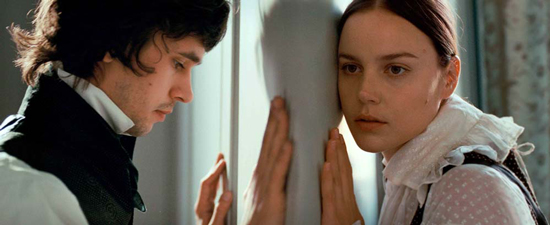
When Fanny asks Keats to teach her to understand and appreciate poetry he agrees. A marvelous scene educates her and us. She tells him, "I don't know how to work out a poem." Keats thinks a moment and responds,
A poem needs understanding through the senses. The point of diving into a lake is not immediately to swim to the shore but to be in the lake, to luxuriate in the sensation of water. You do not work the lake out, it is an experience beyond thought. Poetry soothes and emboldens the soul to accept the mystery.
Bright Star, more than many movies, touches the soul. I must admit that I am a bit of a Philistine when it comes to poetry. I have never really understood it, though I had to learn many of the classic English poems in school. But they did not do much for me. They were mere words on paper, often with seemingly forced rhyme and meter. But Keats' words here touched a nerve deep within me. A poem is deep not superficial. It is not a pithy proverb. Nor is it a rule or law. It is a hidden gem that must be experienced, reveled in even. Its purpose is to move the soul emotionally, not expand the head academically. I tend to focus on the latter and leave the former alone. But that is my loss. I need to be like Fanny, and open myself to the hidden pleasures of poetry.

The Bible is filled with poetry. The prophets and wisdom literature include portions of poetry. The Song of Solomon is a lengthy poetic description of a man's love for a woman.The longest book, in terms of chapters, The Psalms, is a collection of poems and songs. Many Christians claim this book as their favorite, since they can come to it time and again to find solace for their soul in times of trouble. Perhaps my lack of understanding of poetry is the reason I find the Psalms less appealing than the epistles or the gospels. As I open my mind to the experience of poems I hope that my love for the Psalms will grow with it.

Campion uses poetry effectively in the film. Quoting from many of Keats' letters and poems, we gain appreciation for his work."A thing of beauty is a joy forever. Its loveliness increases. It will never pass into nothingness." My favorite comes from a scene where they are lying on the grass looking up at the sky and trees. Keats recites, "I almost wish we were butterflies, and lived but three summer days. Three such days with you I could fill with more delight than fifty common years could ever contain."

Keats' words here echoes something the psalmist wrote centuries earlier: "Better is one day in your courts than a thousand elsewhere" (Psa. 84:10). As we experience God, our hearts and souls expand with love for the almighty, the one who created us to love. And this experience is life-transforming. It brings delight than cannot be described, only experienced.

David wrote in another psalm, "Taste and see that the Lord is good" (Psa. 34:8). Like that lake, God is someone we do not and cannot work out. We simply luxuriate in him, and allow him to reach into our souls to the very depths of our beings. As the Westminster Catechism said, the chief end of man is to glorify God and enjoy him forever.

If you don't like poetry you might want to skip this film. On the other hand, if you don't like poetry, maybe just maybe you need to see this film.

Copyright ©2010, Martin Baggs

Enhanced by Zemanta

Friday, July 2, 2010

Monsters, Inc. -- dependence, desensitization and delight


Directors: Pete Docter & David Silverman, 2001. (G)

There are monsters in the bedroom closet to be afraid of. We have probably all experienced that fear that descends like a blanket when the light is turned out and the strange noises begin. As we grow up, this irrational fear dissipates (unless we watch a scary horror movie, and then we want to sleep with the light on). But it is at the heart of this Pixar animated film.

Monster's Inc. spans two different worlds: the human world and the world of monsters. They intersect in the closet doorways, through which the monsters emerge into the world of boys and girls to scare them senseless. They scare because they care. They care about their own world and the energy that the human screams generate.

In Monstropolis, this monstrous city, "Monsters Inc." is the energy compnay that powers the city. Sulley (voice of John Goodman, Barton Fink) leads the monsters on the scare board. Like a rock star, he goes to work frightening little kids. This big, blue lovable furball is a tough guy at work, but a softy at home. His partner and buddy, Mike Wazowski (voice of Billy Crystal, The Princess Bride) acts as his "ringman," getting the doors ready and preparing the cylinder tanks to accept the screams. This giant eyeball with limbs, resembling a small Cyclops, is the wisecracker in the team. With rolling brown-outs impacting the city, Monstropolis has its own energy crisis.

All Pixar movies seem to attain top-notch technical prowess stemming from attention to even the smallest of details. Indeed, it took typically 11-12 hours to render each frame that contained Sulley because his 2 million hairs required careful animation. And the comedy is family-appropriate with subtle references that adults will catch. This film is no exception. Seeing this again, after several years, it felt as fresh as the first time. Though it lost the Oscar for Best Animated Movie to Shrek, it is certainly worthy of its nomination. Moreover, Pete Doctor went on to win his Oscar for last year's Pixar film, Up.

But all Pixar films include some deep themes to complement the comedy. The first here is the dependence on a dwindling energy supply. Monstropolis is suffering from a lack of screams and hence a limit on electricity. In 2010 we are facing a dwindling supply of fossil-fuel. Even as the newspapers carry stories of the oil spill off the Gulf of Mexico, we realize petrol and gas are getting in shorter and shorter supply. There will be a time, perhaps in the next 1-2 decades, when we can no longer rely on this energy-source. Meanwhile, we see seasonal electrical brown-outs, as in Metropolis. For a society dependent on electricity, with computer chips embedded in more and more devices and appliances, energy shortages equate to societal regression. It is a huge threat. Perhaps the number one global issue today is finding alternative energy sources that resolve these dependencies. As it was for the monsters, so too for us.

In Monstropolis, the reason for their energy crisis is that the scary monsters are no longer scary enough for the human children. And this is because of media over-exposure, thereby desensitizing them to the truly scary creatures that emerge from their closets. In a sense, they have seen too much. They are harder and harder to shock and scare.

This is another social commentary. Kids, teens, even adults are becoming over-saturated with violence and sex. Advertisements, bill-boards, magazines, radio and TV shows, films, all present so much information and visual imagery that we become desensitized to what we see and hear. What was shocking in the 20s, a glimpse of stocking, is now so tame it borders on boredom. The R-rated movies of the 60s and 70s look like Disney PG-13 films. We need more and more titillation to become entertained. And in so doing we deflate the value of what we see. By the time we reach adulthood we will have seen literally thousands of deaths and murders, so much so that we become immune. Then when we see a story of major loss on the news, such as in Haiti, we react with little emotion, because we are desensitized to death and horror. We need to guard ourselves, and our hearts, so that we remain sensitive to the pain and suffering that others in the world experience. Otherwise, we will turn away as the newscaster turns away, and simply forget and ignore. Instead, with a sensitive heart, we can use the resources God has blessed us with, financial or other, to provide help to other human beings in need.

As Monsters Inc. continues, we meet the antagonist, Randall (voice of Steve Buscemi, Fargo), a chameleon-like monster who is only a few points behind Sulley and wishing for more. When he tries to cheat to gain more points, Sulley gets involved and inadvertently lets a 2-year-old girl, Boo, into the monster's world. In Monstropolis, humans are considered highly toxic and deadly to the touch. They are to be avoided like the plague.

Boo's antics cause chaos in the city as the monsters look on this little one as we would look on Godzilla -- with fear. When Sulley takes her home to avoid the CDA (Child Detection Agency) operatives, a SWAT team of monsters, Wazowski envisions imminent death. But the two of them ultimately warm up to Boo, who calls Sulley "kitty". Together, they have to figure out a way to get Boo back to her own home through the correct closet door, while both evading the evil wiles of Randall, and finding a solution to the energy crisis. What they find is laughter is better than screams.

The final theme from Monsters Inc. resounds with biblical teaching. Fear raises the anxiety level putting bad stress on the body and the heart. In contrast, when we laugh we are reducing stress and usually bringing joy and happiness into our lives. The writer of Proverbs declares, "A happy heart makes the face cheerful, but heartache crushes the spirit" (Prov. 15:13). Moreover, "A cheerful heart is good medicine" (Prov. 17:22). Although thrillers and suspense movies often make more money and win more trophies than comedies, when we exit the cineplex we are tense, sweaty-palmed with knotted muscles. But when we leave a comedy we are loose and relaxed. Which is better? Sulley will tell you.

Copyright ©2010, Martin Baggs
Enhanced by Zemanta