
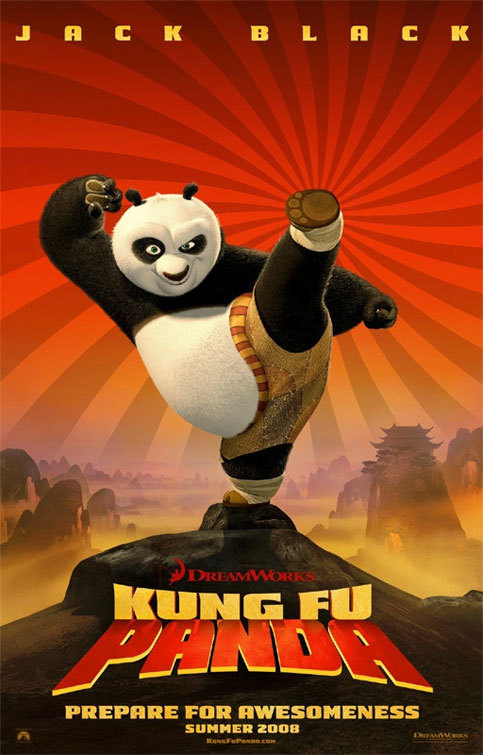

Directors: Mark Osborne & John Stevenson, 2008.
Like the Olympics, there is a top tier of animation studios, led by Pixar, Disney and Dreamworks. Three recent movies from these studios highlight the hierarchy: WALL-E was clearly the best animated movie of 2008. Bolt, the recent release from Disney was its best in years, but not in the Pixar realm. Kung Fu Panda from Dreamworks is a close third to Bolt but not as good as its earlier (and best) release Shrek.
 When Po tells his dad, Mr. Ping the noodle maker, that he had the dream, he misinterprets this as the sign: "You are almost ready to be entrusted with the secret ingredient of my secret ingredient soup. And then you will fulfill your destiny and take over the restaurant just as I took it over from my father." Destiny is one of the themes. But Panda's lineage is in question as his father is a goose. And destiny is in question as Panda wants nothing more than to be a kung fu master.
When Grand Master Oogway, the old turtle, announces that it is time to appoint the new Dragon Warrior, Po just wants to watch the ceremony. Little does he realize that events will conspire to make him this warrior.
Against the wishes of Master Shifu and the fabulous five, who each wanted this great honor, it falls to Po. The pudgy panda must learn to be the wise warrior. In so doing, he must fulfill his destiny, this destiny, and so save the region from the evil snow leopard Tai Lung, a former apprentice of Shifu who turned to the dark side.
 Drawing heavily from Star Wars, Kung Fu Panda plays out to a formulaic finale, with good battling evil, Panda vs Leopard. Shifu is a version of Yoda, even looking a little like the wizened Jedi master. Tai Lung is the dark Darth Vader, once the most promising student now wanting total power. And Po is an unlikely Luke, diminutive in spirit if not girth.
Kung Fu Panda has an excellent voice cast, led by Jack Black as Po and Dustin Hoffman as Shifu, and supported by Angelina Jolie (Tigress), Ian McShane (Tai Lung), and even kung fu star Jackie Chan (Monkey). Its animation is good. But its script is clichéd and pseudo-philosophic. For example: "Yesterday is history, tomorrow is a mystery, but today is a gift. That is why it is called the present." Or, "One often meets his destiny on the road he takes to avoid it."
 The film splits time between the training of the heroes and the three major fight sequences: the first between the five and Tai Lung, the second between the master and the grown padwan, and the finale between Tai Lung and Po. In the training, one of the lessons of the film emerges. While Shifu tries to make Po a warrior in the same way he has done before, he fails miserably. But when he realizes Po is different and is motivated differently, he tailors his training to Po's unique personality. When he does this Po immediately responds. It is almost instinctive. When we treat everyone alike we are making cookie cutter characters. When we find their distinct styles and tastes, and customize the motivation to these distinctives, we can help them become the people they were made to be.
 That brings us to the major theme of the movie: destiny. Oogway says, "There are no accidents." No accidents, no coincidences, only destiny. And we don't control destiny, we simply discover it and follow it. There is some biblical truth in this. God is sovereign. He is in control. There are no accidents. He is moving humankind through a history, some of which is still being written, to a finale of good and evil where good, in the person of Jesus Christ, wins out finally over evil, in the person of Satan. As followers of Jesus, we must discover his path for our lives and follow it. Serving him, we help restore the created order.
But this all takes faith, belief. Shifu demonstrates a lack of faith early in the movie. When Oogway tells him he has no control, but must believe in the chosen one, Po the "Dragon Warrior," he finds this hard to accept. "No, you just need to believe," Oogway tells him. He is called to faith in a "Savior" that does not fit his expectations. He imagined a famous warrior and he found a fat weakling. He looked at the externals. This was similar to the coming of Messiah. People expected a great warrior and they saw a lowly carpenter. Outward appearances can be deceiving.
Finally, there is the issue of self-acceptance. The only reason Po endured the hours of painful training, he tells Shifu, is "because I thought if anyone can change me, can make me not me, it was you!" He wanted to unbecome, to become someone else. He was not happy. His destiny was to be a pudgy noodle-maker, and he did not like that. He did not like himself. But the message that changes it for him comes not from Shifu but from his dad: "To make something special you just have to believe it's special." This simplistic message works in the film but is not true to life. We cannot simply believe we are special and we are so because we believe. That is magical thinking. It has no foundation. Yet, it is true that we are all special, uniquely created by the loving creator. We are all loved for who we are. But we can be special in this sense because of the underlying reason -- God made us this way. And he is in the process of changing us from within to become like him, beautiful beyond imagination! That is, if we let him. So, believe that you are special, not as an act of magic but based on biblical truth.
Copyright ©2008, Martin Baggs


 The movie begins with scenes from an old home movie: a young boy in the country. This is the young Antoine Sforza (Nicolas Cazalé). Without explaining this scene, the film moves to Paris, the big city. There Antoine, the hero, is now 30 years old and still trying to figure out what he wants to do or be. He is always "between jobs" never quite able to hold down a steady job. Part of this is his attitude: he has a chip on his shoulder.
 When he does decide to go back, he takes with him Claire (Clotilde Hesme), a beautiful young neighbor he has a crush on. She, too, is trying to find herself after an immature marriage and early divorce, and is applying for college in her mid-20s.
 The problem that caused Antoine to leave home is never described. It is simply there, like the elephant in the room that everyone knows is there . . . except Claire. To her, it is a family feud that has embittered Antoine and the others. François, too, has his own secrets. Both brothers have abandoned their parents, but in their own ways. Antoine has gone physically, wanting little or nothing to do with them. François is present but withholding the truth from them, living a lie.

 With M's judgment in question, and potentially surrounded by traitors, even Bond is viewed with suspicion. Before he sets off to Haiti on a mission, M tells him: "I thought I could trust you. You said you weren't motivated but revenge." Is he after revenge? Does he simply want to find and kill the person whose deception led to the death of his one love, Vespa? Or is it true what he says, "I am motivated by my duty"?
 Camille, in turn leads him to Dominic Greene, the real villain in this film. Played by Frenchman Mathieu Amalric, fresh from his outstanding performance as a paralyzed playboy in The Diving Bell and the Butterfly, he has no gimmicks to make Greene evil (no crying-blood like Le Chiffre). Instead, he is more evil in being "normal." But as CEO of an eco-friendly organization he is rich and powerful and craves more. He is also part of this mysterious Quantum organization.
 Bond has not forgiven. Indeed, does he even know how to forgive? His heart is cold. But he is still human, and seeking that quantum of solace in his relationships. Despite a perfunctory and totally unbelievable romp with the red-headed Strawberry Fields, a throw-away babe, Bond has not moved on from Vespa. He needs some form of closure.
 The main theme of Quantum of Solace is revenge and forgiveness. Bond needs to forgive those who hurt him. More than this, he needs to forgive himself. Apart from this, he will continue to be driven by a cold desire for vengeance. We, too, must look at what is driving us. Do we have room for forgiveness in our hearts? Jesus calls us to forgive, even when it means leaving justice to others (Matt. 18:21-22). Are we big enough to do this?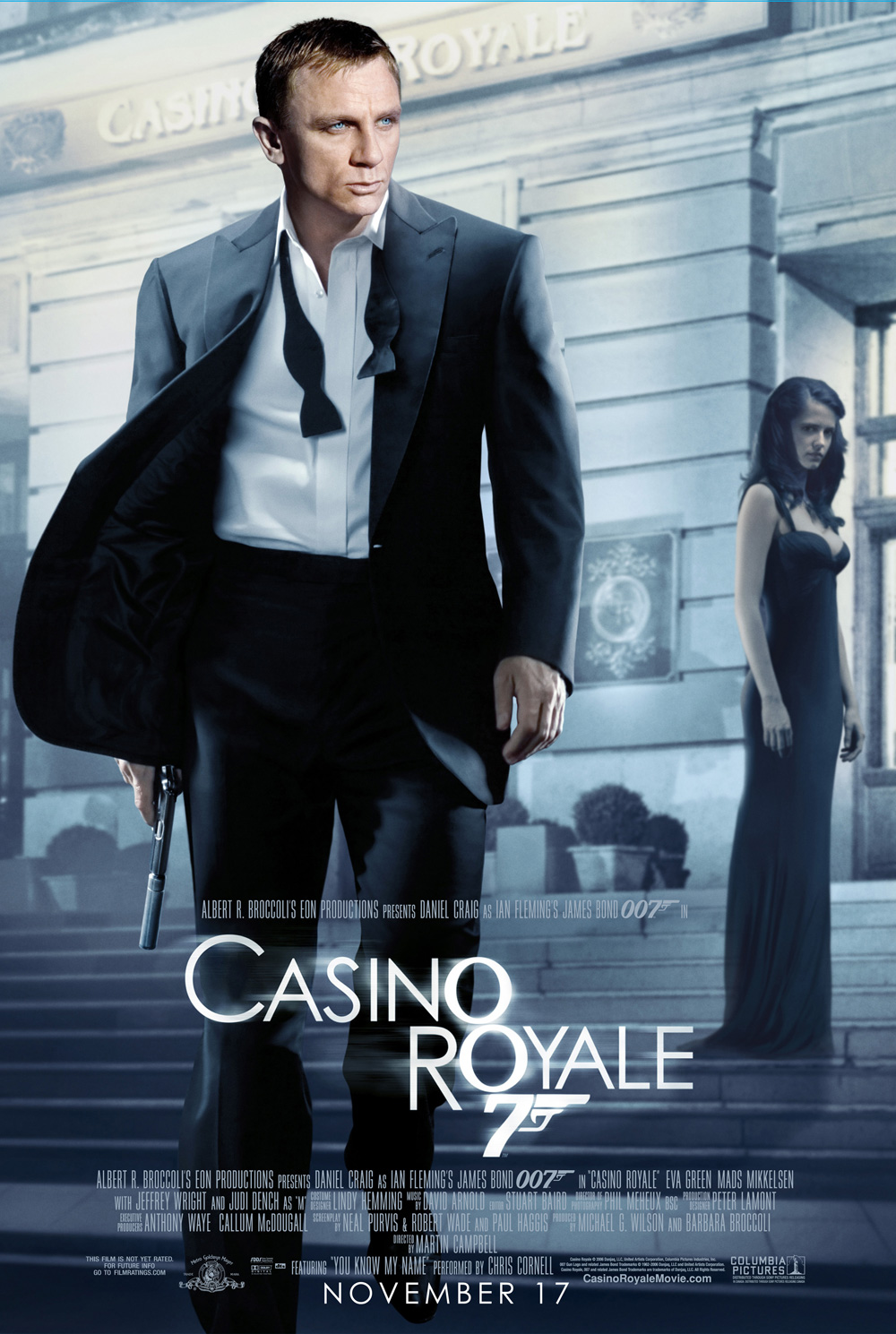

 The plot for Casino Royale soon enough becomes clear. The main villain, Le Chiffre (Dane Mads Mikkelsen, previously seen as the pastor in
  While the poker itself is as dry as Bond's famous martini (named Vesper here, it must of course be shaken not stirred), the action more than makes up for this. Gone is Q; gone are the gadgets. In their place are technology and technicians at HQ. But back are the classic set-pieces in exotic locations, including the Bahamas, Venice, Miami and London. This is what we want in a Bond film. Few friends, many enemies, fast cars (even a classic Aston Martin), fist fights, it is an exciting entry for Craig.
 And though he has the good looks of a Bond, he focuses on the job. There is little sex here. There are only two Bond babes. Even as Bond rolls on the floor with the first, Solange, he leaves her when he learns that what he wants is in Miami. Duty over delight.
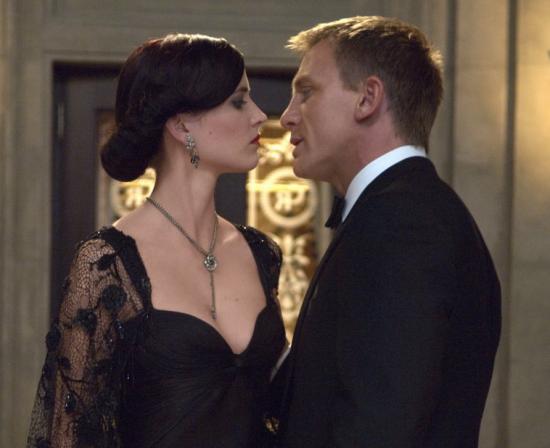 Bond's biggest issue is his trust. He trusts few people. He loves no one. He has an armor around his heart that would protect Fort Knox. He lets no one in. That is, until he falls for Vesper. He resigns and goes with her to Venice to plan a new life. But trust is a fragile thing, easily shaken. And once broken, difficult to rebuild. The finale in Venice is top-notch, Bond at its best.