

Wednesday, January 9, 2013
CT's Most Redeeming Films of 2012


Sunday, January 6, 2013
The Bourne Ultimatum -- back to the beginning


Director: Paul Greenglass, 2007 (PG-13)
The Bourne Supremacy ended in New York with Bourne (Matt Damon) calling Pam Landry (Joan Allen) and telling her, “Get some rest, Pam. You look tired.” With this, we all thought the series was over. Bourne had found out who he was, or at least what he was. But Bourne is a product of Hollywood, and where there’s a cash cow there’s more gold to be milked. (Just as we thought that The Bourne Ultimatum was the end of the Bourne films, only to be surprised by this year’s The Bourne Legacy that does not even feature Jason Bourne!) So we get another Jason Bourne film that is similar to the middle installment but perhaps the best of the three.
To make this happen, returning director
Greengrass sets the first two acts of this one before that earlier phone call and
builds up to a radical reinterpretation of those closing lines.
After escaping from Moscow following the car
chase, shown in Supremacy, Bourne
comes to Paris to visit Marie’s surviving brother much like he visited a
surviving orphan in Moscow. These scenes show his heart and compassion, but
that is all we get for this film. After this, he is all focus. That’s because he reads an article by an
English reporter (Paddy Considine, Hot Fuzz) that focuses on Treadstone and
Bourne.
Travelling to London, he asks Ross, “Who’s
your source? What’s his name?” But CIA agents are on to Ross, triggered by the
code name Treadstone. “Look, what’s going on? Why are these people after me?”
Ross replies. “Because you found something. You talked to someone inside
Treadstone, someone who was there at the beginning.” It was Blackbriar, a Treadstone upgrade.
 In the first film, The Bourne Identity, Bourne woke up without a memory. He needed to
answer the question, “Who am I?” And he did. He discovered he was Jason Bourne,
an American assassin. In Supremacy,
still plagued by his pas, he wanted to answer the question, “Who was I?” And he
did. He realized he was someone other than Jason Bourne, a David Webb. But he
knows nothing of his life as Webb. Now, in this final film, he has to go back
to the beginning, to answer, “How was I reborn?”
In the first film, The Bourne Identity, Bourne woke up without a memory. He needed to
answer the question, “Who am I?” And he did. He discovered he was Jason Bourne,
an American assassin. In Supremacy,
still plagued by his pas, he wanted to answer the question, “Who was I?” And he
did. He realized he was someone other than Jason Bourne, a David Webb. But he
knows nothing of his life as Webb. Now, in this final film, he has to go back
to the beginning, to answer, “How was I reborn?”
As before, the movie features full-on fights
and fast-paced chases. Like before they are filmed with hand-held cameras to
give a shaky, you-were-here feel. From Paris to London, from London to Madrid,
from Madrid to Tangier, international locations abound. But we cut back and
forth to New York to see the CIA heads who are pulling the puppet strings.
Where Identity and Supremacy had two bad agents, Conklin and Abbott, here we
get Noah Vosen (David Strathairn, Lincoln)
and Director Kramer (Scott Glenn, The Silence of the Lambs). Returning are Pam Landry and Nicky Parsons
(Julia Stiles), the only person other than Bourne who is in all three films.
The scooter chase in Tangier culminates in a
foot chase across rooftops. If we think this is white knuckle stuff, improbable
as it might be, the car chase in New York, which replicates the Moscow chase is
a total thrill ride.

We, too, discovered who we are, in the post
on Identity. We are God’s creation,
made by him in his image. We looked at who we were, in the review of Supremacy. We are now enemies of God.
But how did that happen? How were we twisted from our original image? And what
can we do to be reborn?
To answer these questions, we have to go back
to the beginning, not to Blackbrier the off-books op, but to Eden the in-book
narrative. After God created mankind, Satan visited the original pair of humans
in his black op undercover mission. Taking the form of a serpent, he twisted
God’s words, giving misinformation to Eve, causing her to disobey God’s word
and violate her mission (Gen. 3). Having tasted the forbidden fruit, she
persuaded Adam to do likewise. These two joined the enemy’s team through this
original sin. Cast out of Eden, God cursed all three. Where life existed, death
now reigned. The image of God was marred, not totally destroyed. But marred
enough that we no longer recognize God. David Webb was gone; Jason Bourne took
his place.
In that original cursing, though, God offered
a glimmer or hope: the so-called protoevangel. To the snake, he said: “And I
will put enmity between you and the woman, and between your offspring and hers;
he will crush your head, and you will strike his heel” (Gen. 3:15). This is a
foretelling of Eve’s offspring through Mary: Jesus. The son of God, the second
person of the Trinity, he would one day leave the throne-room of heaven and
come to earth as a human. His covert mission was to walk as one of us, live as
one of us, and then die as one of us. But his death was not his alone; it was
for us. He sacrificed himself on that cross, dying in our place for sins he did
not commit (1 Pet. 2:22).
While he was alive, he told Nicodemus, “I
tell you the truth, no one can see the kingdom of God unless he is born again”
(Jn. 3:3). The only way we can be brought back into relationship with God is to
be reborn. This can only occur by faith: “Yet to all who received him, to those
who believed in his name, he gave the right to become children of God” (Jn.
1:12).
Like David Webb we can only take on this new
identity voluntarily. It cannot be coerced. We must be re-Bourne!
Copyright ©2013, Martin Baggs
Thursday, January 3, 2013
The Bourne Supremacy -- Who was I?


Director: Paul Greengrass, 2004 (PG-13)
The Bourne Identity closed with
a pseudo happy ending. Jason Bourne (Matt Damon) and Marie (Franke Potente)
reconnected on a Greek island. This positively utopian picture of relational
bliss carries over to the sequel. Now Bourne and Marie are enjoying the almost
idyllic life of a couple, living on the beach in Goa, southern India. But
Bourne is haunted by fragments of memories that show up in his dreams, which he
records in a journal. One page of this journal summarizes the key theme of this
installment: Who was I? His past won’t come into focus. He knows who he is:
Jason Bourne, but not really who he was.
This life is shattered when a killer, Kirill
(Karl Urban, Star Trek) comes after Bourne. Senses heightened for
self-preservation, Bourne notices and a car chase ensues. When Marie is killed,
Bourne’s life of passivity is over. He is back in the saddle, once more chasing
and being chased. He is after the killer while the CIA is after him.
An early scene has a CIA operation in Berlin,
supervised by Pam Landry (Joan Allen), go badly wrong. With two agents down,
and Bourne’s fingerprints literally all over the kill, the Americans think
their rogue agent is back with a vengeance.
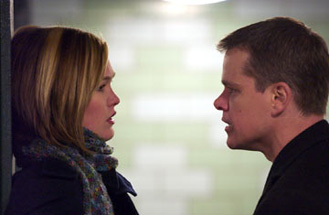
Who was he? You’ll have to see the film to
find this out. But the question resonates as a follow-on question to that asked
in the first film, Who am I? We all want to discover our identity. To find out
who we are, we must first find out who we were.

If we, like Bourne, find out who we were and
realize we dislike what we see, what can we do? Do we, simply try to bring
closure to one or more events in our past and then move on? Do we reconcile
ourselves to a life lived in fear, always looking over our shoulder for the
enemy? Or is there a solution to our dilemma? Can we make peace with God and
with ourselves? We may find the answer in The
Bourne Ultimatum.
Copyright ©2013, Martin Baggs
Tuesday, January 1, 2013
The Bourne Identity -- Who am I?


Director: Doug Liman, 2002 (PG-13)
A man floats corpse-like on a stormy
Mediterranean sea. A fishing trawler reels him in. He has two bullets in his
back and a laser pellet in his hip that projects a Swiss bank account number.
Clearly, this is no ordinary man. This is a John Doe who is suffering from
disassociative amnesia, a memory loss that lets him remember skils like how to
tie knots or fight cops, but not his name or his background.
“Who am I,” he asks at one point in the film.
And this is the primary theme for the first of the Bourne movies.
Having healed aboard the ship, the mystery
man sets out for Zurich once they land in France. In Zurich he discovers he
knows martial arts, as he disarms and KOs two cops in a fight lasting seconds.
But the biggest surprise of all awaits him in the bank vault. His bank deposit
box contains multiple passports, a large amount of cash and a gun. Of the
various aliases, one is American: Jason Bourne (Matt Damon, The Adjustment Bureau). This is the one he
will go by until he can find out who he is. With the Bourne identity surfacing,
flags trigger in the databases of the CIA and suddenly he becomes a hunted man.

Paris is the scene of some excellent action,
including another fight and a terrific car chase. It is also where he hears of
Treadstone, a super-secret black ops run by his handler Conklin (Chris Cooper, Married Life)
and his CIA boss Abbott (Brian Cox, RED). This sets up Bourne’s mission: to learn
more about Treadstone so that he can find out who he is. Along they way to the climax, we
meet the Professor (Clive Owen, Duplicity), another CIA hit man, and Nicky Persons (Julia
Stiles), the CIA logistics agent at the safe house. Although not a central
character, she will show up in the whole series.
Who am I? This key question centers on
identity. We all will ask this of ourselves eventually, some sooner, some
later. The Bible offers answers. We are creatures made in the image of God
(Gen. 1:26). God created us for relationship with him, as Adam had in the
garden (Gen. 2:15). But like Bourne, we find ourselves floating in a sea of
darkness. We suffer our own form of disassociate memory loss. We have forgotten
who we really are. We have lost sight of God and of our own identity.
How can we find out who we are? We must look
back before we can look forward. For that, we must turn to the Bourne Supremacy.
Copyright ©2013, Martin Baggs
Subscribe to:
Posts (Atom)