Wednesday, January 23, 2013

Hope Springs -- relational stagnation and its resolution


Director: David Frankel, 2012 (PG-13)


“You Can Have the Marriage You Want.” This is the book that propels the plot in this so-called geriatric romantic comedy. And it is a title that will force us to reflect on our own marriages to reflect on exactly what marriage we really do want.

In this first pairing of Oscar-winners Meryl Streep (The Deer Hunter) and Tommy Lee Jones (Lincoln), Streep plays Kay who has been married to Arnold (Jones) for 31 years. They are a perfectly normal middle-aged couple whose marriage has frozen into a rut. Gone is the romance of younger years. In its place is routine and relational stagnation.

Every day begins with Kay cooking bacon and eggs for Arnold, who buries his nose in the paper barely acknowledging Kay’s presence. He goes off to work with a peck on the cheek and hardly a word. He returns to find dinner waiting, golf on TV where he falls asleep in his recliner. And then scale the stairs to depart into separate bedrooms. No touch, no hugs, no sex.
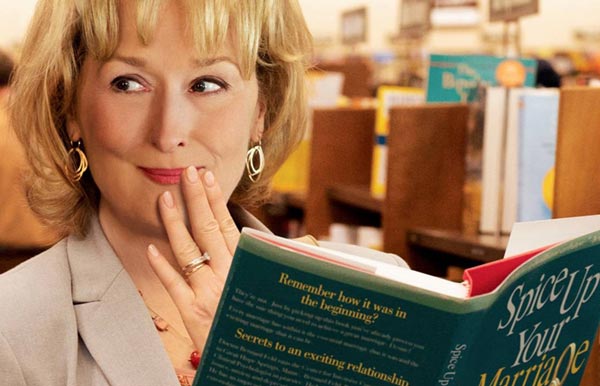
Early in the film, one of Kay’s coworkers tells her ”marriages don’t change.” Kay clearly wants more. She is ready to change. But Arnold is satisfied with the status quo, despite the distance that the currents of parenthood, busyness and business have created.

When Kay discovers the book mentioned earlier, she researchers the author, Dr. Feld (Steve Carrell, Date Night). He offers an intensive week-long couple’s counseling session. This takes place in his hometown of Great Hope Springs up in Maine. When Kaye cashes in her own CD to pay the $4000, hope springs in her heart. But tax accountant Arnold, ever a cynical tightwad, complains and refuses to go. But the money is spent, so he decides to make the best of it.

The movie really takes off when the couple take their places on the counselor’s coach. While Carrell plays his role dead-pan, with minimal emotion, Jones and Streep give their characters believable and accessible feelings. She is lonely. He is angry and afraid. We can understand her loneliness, but we never discover why Arnold is so angry and crabby.

Dr Feld quietly challenges them to face each other again, to reflect on what brought them together in the first place. He soon discovers a lack of physical relationship, and begins to give them sexual challenges that escalate from touching to oral sex. There are some awkward scenes in the movie, but what detracts the most is the loud manipulative soundtrack that seeks to flag the emotional mood swings even while the veteran actors are trying to show through their craft.

I imagine all marriages devolve to some degree into routine, perhaps mediocrity, some even into monotony. How do we handle the emotional drifts of time? Frankel’s film seems to offer some solutions. Clearly, sharing our feelings and opening the communication channels is critical. What this does is makes us vulnerable to the other partner.

Without vulnerability, intimacy is impeded or even voided. Arnold was not willing to do this. He was comfortable with his life and had retreated into a shell of his own making, like a hermit crab. That may be what he wants, even what we want, but what does his spouse want?

Kay summarizes her situation to Dr Feld: “He is everything. But I’m, I’m really lonely. And to be with someone when you’re not really with him can … it’s … I think I might be less lonely … alone.” How sad. To be in the same room, even the same relationship, as your life-partner and not really be there at all. Loneliness becomes the dagger that pierces the heart of many a marriage that fails.

How do we disarm this dagger? We practice the art of being present. We determine to take time to talk, and not just about the trivialities of our days. We commit to communicate the depths of our hearts. We vow to make the other more important to us than anything else we might treasure. As Jesus said, “For where your treasure is, there your heart will be also” (Matt. 6:21). Make your spouse your most-treasured relationship.

Of course, the film focuses on sex, and sex is indeed an important part of marriage. Both men and women need physical intimacy. When the heart grows cold sex gets old. The Apostle Paul knew this, and gave this advice to married couples, talking about sexual union: “Do not deprive each other except by mutual consent and for a time, so that you may devote yourselves to prayer” (1 Cor. 7:5). The Bible also says, “Marriage should be honored by all, and the marriage bed kept pure” (Heb. 13:4). Pure here does not mean absent. Sex was created by God to be enjoyed by married couples and there seems to be no time limit. Age may slow things down and bring on changes but it doesn’t have to bring cessation. That is the path to separation.

As a fully-fledged card-carrying member of AARP, with more than a quarter century of marriage behind me (to the most wonderful wife I can imagine) I find myself putting myself in Arnold’s shoes. No, my wife and I don’t sleep in separate rooms. And we do enjoy the physical dimensions of marriage. But I wonder how vulnerable I am, how much I really share of my inner feelings. Could I give more to my wife and my marriage?

When Arnold is about to give up, Dr Feld challenges him with the question, “Have you given it your best?” How about you? If you haven’t, then what kind of marriage do you really want? The best marriage requires that we give it our best in all areas. When we do this, hope will spring eternal for you.

Copyright ©2013, Martin Baggs

Thursday, January 17, 2013

The Hobbit: An Unexpected Journey -- adventures and ordinary life


Director: Peter Jackson, 2012 (PG-13)

After Peter Jackson’s stellar movie adaptation of J.R.R. Tolkien’s "Lord of the Rings" trilogy, the bar was set high for The Hobbit. Sadly, Jackson  fails to reach these heights with part one of this new trilogy. But that is not to say that the film does not entertain. It does. But not as much as before. This is partly due to his decision to make a trilogy of a simple book (rather than three books); and partly due to his decision to make this less like the children’s story that it is based on and more like a prequel to his Oscar-winning Lord of the Rings.

As before, Jackson gives us a short story from Middle Earth as a prologue to the film and to set the context. The Dwarf Kingdom of Erebor thrives with activity, as dwarves mine gold and precious jewels. All is well until the king’s love of gold becomes “a sickness of the mind” and he pursues more and more gold simply to possess it. Greed has gone wild. And as his vast resources of gold expand, the fearsome dragon Smaug discovers this treasure and destroys the underground palace and takes up residence in the mountain. The dwarves are forced out of their kingdom, becoming homeless vagrants whose pride turns inward into anger as they roam over mountain and vale, eking out a barren existence.

This prolog itself offers an initial point of ethical consideration. The love of gold here is described as a sickness. In the New Testament, the Apostle Paul says something similar: “For the love of money is a root of all kinds of evil” (1 Tim. 6:10). Here it is not so much a sickness as a root of sin. When this love takes hold, our hearts become dark and prone to sin. Greed leads to loss of perspective, as was the case for the dwarf king, and loss of morality. Indeed, greed is listed by Jesus as one among many sins that includes sexual immorality, theft, murder and adultery (Mk. 7:21-23). It can end in no good, as in Erebor.

For the hobbit, though, the film begins exactly where The Fellowship of the Ring began: in Bilbo Baggins home at Bag End in Hobbiton on the eve of Bilbo’s 111th birthday. Ian Holm briefly reprises his role as the older Bilbo, writing the story of his adventure, before we go back 60 years to actually witness his adventure.

The first act has Gandalf the Gray (Ian McKellen) showing up at the door of the young Bilbo Baggins (Martin Freeman). He tells Bilbo, “I’m looking for someone to share in an adventure.” The hobbit seems an unlikely choice, as he prefers nothing more than his cozy home, his books and his food. But Gandalf goes on: “You’ll have a tale to tell when you come back.” Bilbo asks, “You can promise that I will come back?” Gandalf replies, “No. And if you do, you will not be the same.”

Here is the second and crucial theme for this film: adventure. Bilbo loves his life at home too much. Gandalf even tells him, “When did your doilies and your mother’s dishes become so important to you?” He is in a comfort zone of predictability and safety. He does not desire the danger of the unknown. But this adventure is going to change him, to allow a part of Bilbo that is latent to emerge so that he might become stronger, deeper, more courageous.

How often do we retreat into our Hobbit-homes when adventure comes knocking? If we are honest, I think we all have our comfort zones where we can retreat and cocoon. But we don’t grow in comfort; we stagnate. Adventure brings with it trials. And the Apostle James had this to say about trials: “Consider it pure joy, my brothers, whenever you face trials of many kinds, because you know that the testing of your faith develops perseverance. Perseverance must finish its work so that you may be mature and complete, not lacking anything” (Jas. 1:2-4). Adventure can craft character. Like a sculptor working on a block of marble, God can use such adventure to chisel away our unbelief and leave us strong and mature in our faith. We must welcome adventure like an old wizard friend!

But this first act is long and weak. It brings a baker’s dozen dwarves to Bilbo’s door, led by exiled king Thorin Oakenshield (Richard Armitage). These thirteen are tough to keep track of, even though so much time is spent on their initial impromptu party at Bag End. By the time Bilbo has agreed to become the final member of their fellowship, and they are off on their ponies, an hour has passed.

Once they are on their way, the film picks up. The final two acts breaks into segments almost exactly the same as The Fellowship of the Ring. Act two has them riding through the glens of Middle Earth, encountering trolls and orcs, concluding in Rivendell where the Elves proffer some advice and counsel to the band of wanderers. The third act features a battle of stone giants before the group descends into the bowels of the Misty Mountains where they encounter goblins.

Jackson turns the mood somber in these two acts. The gaity and merriness of the feasting at Bag End transform into dread. While the book contained a certain lightness, the film mirrors the Lord of the Rings. A darkness has settled on the land, and it is evident in the film. Indeed, one would not know that this was a children’s tale from the movie. There is simply too much fighting, too many goblins and orcs. It is not as if we had not seen this before. As remarkable as The Fellowship of the Ring was, this feels like a copycat makeover. Even the fighting becomes repetitive and somewhat boring.

The best scene occurs deep below the Misty Mountains. While the dwarfs are fighting the goblins, Bilbo comes face to face with Gollum (Andy Serkis), that most pathetic of creatures who covets his “Precious,” the ring that will form the heart of the later trilogy. Bilbo’s life-and-death battle of wills with Gollum demonstrates his growth. And when he subsequently spares Gollum’s life, an act of volitional mercy that will intersect Frodo’s life later, we realize there is maturity in Bilbo that not even Thorin possesses.

In the face of so much evil permeating Middle Earth, why did Gandalf bring Bilbo? This is a question that the Lady Galadriel (Cate Blanchett) asks Gandalf and he gives her a specific answer: “Saruman believes it is only great power that can hold evil in check, but that is not what I have found. I found it is the small everyday deeds of ordinary folk that keep the darkness at bay... small acts of kindness and love. Why Bilbo Baggins? That's because I am afraid and it gives me courage.”

Gandalf reminds us that even though great adventure can result in great victories, it is in the ordinariness of life that we most often come face to face with evil. We can respond to the unkindnesses of men and inequities of life with bitterness and cynicism. We can seek revenge, an eye for an eye. Or we can return evil with good. We can show love and mercy to those who would not expect it. Jesus told us to “love our enemies and pray for those who persecute you” (Matt. 5:44). In so doing, we keep the darkness at bay. Paul gave similar advice: “ ‘If your enemy is hungry, feed him; if he is thirsty, give him something to drink. In doing this, you will heap burning coals on his head.’ Do not be overcome by evil, but overcome evil with good” (Rom. 12:20-21). Who knows who might be alongside watching you, seeking courage from your simple and ordinary acts. Treat each day as an unexpected journey that might lead to a new adventure but will certainly lead to opportunities to en-courage others through acts of kindness and mercy.

Copyright ©2013, Martin Baggs

Tuesday, January 15, 2013

CT's Critics' Choice Movie Awards of 2012

Last week it was Christianity Today's top 10 "most redeeming" films of 2012. This week it is the "Critics' Choice", their list of the top 10 films of 2012 (according to their movie critics). Their top 3 films are depicted in the graphic here, and there is some overlap.

Two of the top three films show up in both lists. You may have some different selections in your list, but I would imagine Lincoln shows up in your top 10. Snubbed at the Golden Globe Awards, this film is sure to emancipate a number of silver trophies in Hollywood next month.

Saturday, January 12, 2013

Win a Free Copy of "The Utter Relief of Holiness" by John Eldredge

John Eldredge, author of the bestseller "Wild at Heart," just published his latest book, and I have a copy to give away. Here's an excerpt from the jacket:
Ask the raging person what it would be like to be free of rage or the alcoholic what it would be like to be completely free from addiction. Take the things you struggle with and ask yourself, 'What would life be like if I never struggled with his again?" It would be an utter relief. An absolute relief. . . . Here is a book that explores the beauty of the genuine goodness available to us in Jesus Christ, and guides us through the process whereby God makes us whole and holy by his love. You will be relieved. Utterly.
If you want to enter to win a copy of this book, just enter a comment below sharing why you want to read the book. It can be a sentence or a paragraph, it doesn't matter. Just make sure I have an email address so I can contact you if you win. I will make a random drawing from all who submit a comment and notify the winner by email who can then provide a mailing address where the book can be sent.

Submissions are open till noon Pacific time next Friday, January 18th.

Good luck! I am excited to read your reasons for wanting to read the book. And my review will be posted around the drawing date.