


Director: Yôjirô Takita, 2008. (PG-13)
What do flying geese have in common with a dead octopus? Both function as a metaphor in this slow but moving masterpiece which won Japan's first ever Oscar (it picked up Best Foreign Picture in 2009). Departures is about dreams dashed and passions rekindled. It offers a portrait of a man who has found meaning in his life. Fundamentally, though, it is a tale about death, and with it, life.
Daigo Koboyashi (Masahiro Motoki) is a professional cellist in a Tokyo orchestra. After completing Beethoven's 9th Symphony to an almost empty house, the orchestra is informed it is dissolved. That night the octopus his wife Mika (Ryoko Hirosue) is preparing for dinner moves -- it seems to be alive. But when they cast it into the Tokyo Bay to freedom, it simply floats lifeless atop the water. The tossing of the dead octopus represents the dreams that Daigo has to cast off. He had dreamt of showing his wife the big cities of the world with his music. Now that dream is gone. When he sells his expensive cello to recoup some of the cost, he realizes "What I'd always thought of as my dream maybe hadn't been one after all." It is the final nail in the coffin.
With no job in Tokyo, Daigo and Mika leave the big city and return to Yamagata, his hometown, where his deceased mother has left him an old home. Rent-free, all he needs now is a job. When he responds to a newspaper advertisement asking for a person to help with "departures" he thinks it has to do with travel. Really it has to do with death.
 Daigo's new job is as a "Nokanshi," or professional encoffineer. In Japan families no longer prepare the bodies of their loved ones for the final journey. Neither do the undertakers. This task has become a niche career. The Nokanshi go into the homes of the grieving and ritually disrobe, wash, re-clothe, and make-up the bodies. It sounds morbid, but it is actually an act of beauty in the hands of a caring professional.
For Daigo this undesired job becomes a journey of personal discovery as he learns lessons of life alongside the master, Sasaki (Tsutomu Yamazaki). He does not realize at first that the job has its own occupational hazards. The smells of rotting corpses are enough to bring up lunch. And these smells stick to his clothing and body, enough for others to notice. But there are blessings, too. The careful and solemn ritual is an act of grace given to those living. Daigo grows into the job until he understands this is his calling, his purpose in life.
Though not a Christian film, we can see in Daigo a person who has found his vocation, his ministry. Like the cleaners in Sunshine Cleaning, those who come to clean up after death or make up the dead to look beautiful are performing an act of ministry that others will not or cannot do. They are serving those who are in deepest need.
Director Takita brings a sense of grace and gravity to the funeral rituals. With long lingering cinematography and a remarkably emotive original score, the film is beautiful to watch, eschewing trivial sentimentality. Though death is central to the film, it is not heavy and somber. Rather, he portrays these rituals as celebrating the life of the one who has gone. And in doing so, it is both respecting the dead and giving hope to the living.
 Food features prominently in the film. It is true that Nokanshis get very hungry after performing a funeral ceremony. It takes intense concentration and that generates immense hunger. We see Daigo eat a number of meals here, from romantic dinners with his wife, to thoughtful musings with his boss. In the latter, the wise Sasaki tells him, "The living eat the dead. Unless they're plants. Unless you want to die you eat." Eating is part of life and Nokanshis eat with gusto and enjoyment. Eating a large and delicious meal after a ritual seems appropriate, as a way of endorsing the value of life, having been in the midst of death.
 There is another occupational hazard of a Nokanshi: shame. People look down on them. It is a profession no one wants, but everyone needs. When Mika eventually finds out what he does, she asks, "Aren't you ashamed of having a job like that? . . . Touching dead people?" And when he goes to touch her, she recoils in disgust, "Don't touch me. You're filthy!" Rejected by friends, he is now rejected by his wife.
Daigo presents a portrait of the stigma carried by certain people in the Bible. Lepers were shunned, avoided due to their physical condition. They had to cover their faces and shout out, "Unclean! Unclean!" (Lev. 13:45) whereupon people would retreat from the leper's presence. But they had no control over this disease; it was not their choice. Closer to Daigo is Simon the tanner (Acts 10:6). He dealt with dead bodies and was considered unclean. His was a shameful profession. What jobs carry this kind of stigma today? Probably undertakers and morticians. Dealing with the dead has always been a societal opprobrium. No one, it seems, wants to see or touch the dead. But other jobs also carry similar disesteem: refuse collectors, janitors, people who perform the tasks we sweep under the carpet. Seeing Daigo work this stigmatic job as a ministry reminds us of the inherent dignity of these jobs and more.
Takita chooses the cello as Daigo's instrument carefully, even though creating an orchestral score for cellos is difficult to do. The cello is a large instrument with a wide range of sound, something like the depths of the human voice. More than this, though, its shape resembles the feminine form, with curves. Playing the cello resonates with the act of encoffining, where both the instrument and the corpse need to be cradled gently with care and affection. Daigo's attention to detail in his work reignites the memory of the cello he has left behind
In finding his purpose in living, Daigo rekindles his passion for music. This brings us back to the geese. When he finds his childhood cello, he begins to play again, now for fun not for funds. We see him playing outdoors, amidst nature, both in the cold of a harsh winter and the cherry blossoms of a new spring. When he sees the geese take off flying free, we recognize this as a metaphor for the freedom he now finds in his music. No longer is it constricting, holding him to dreams that would prove dead. Now music once more enables him to experience and enjoy life. His purpose promotes his passion. They go hand in hand, as much of life seems to do.
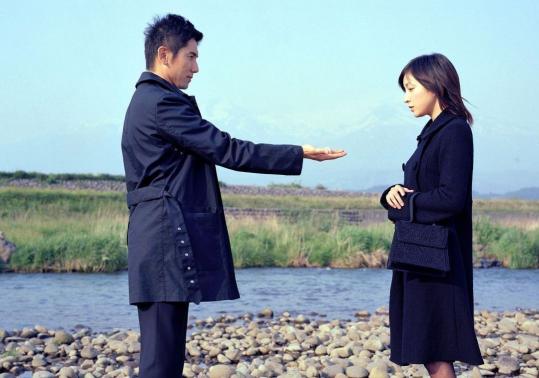 Few films take on the subject of death. It is too tricky and not usually a good commercial enterprise.We tend to avoid it in common conversation, because it makes us face our own mortality. It took 15 years from the conception of the film's idea until it became reality. But death is slowly creeping up on all of us
Life, though, is tied to death. Daigo tells Mika, "Everyone dies. I will and so will you." He is one of the gatekeepers on the deceased's journey to the next life. Toward the end, another funeral worker says, "I've often thought . . . that maybe death is a gateway. Dying doesn't mean the end. You go through it and on to the next thing. It's a gate." Both he and Daigo have it right.
Life encompasses death, and death is indeed a gateway to the next life. We all will pass through that gateway. But we can prepare ourselves now for that future journey even while we are living. Jesus says "I am the gate; whoever enters through me will be saved" (Jn. 10:9); he is the gate to life. If we put our faith in him, then we can be assured that when we die we will move into his presence. Later we will brought into a new life in the new earth which will be his eternal kingdom (2 Pet. 1:11). Death will then be a gateway to that future life with King Jesus.
Nobody wants to think about death, as it is seen as filthy and disgusting. But, as Departures shows, by facing death we look at life differently. We cannot live an authentic life if we avoid death. Are you ready for your departure yet?
Copyright ©2010, Martin Baggs


 When Cobb's initial mission of "corporate espionage" fails, he is ready to go on the run again. We learn something of his background over the course of the film, but it is enough to say he is a wanted man in America, where he has left his children. His wife is dead, but she keeps showing up in his dreams to haunt him and hinder his "work." Ready to evade his employer, Saito makes him an offer he cannot refuse: he will, with one phone call, clear the slate and allow Cobb to go home. But in return Cobb must do the impossible: inception. He must plant an idea into the mind of Robert Fisher Jr. (Cillian Murphy, Scarecrow in Batman Begins). Fisher's father lies dying and Saito wants his multinational empire broken up. This straw Cobb cannot refuse.
 Cobb brings together a talented team. Ariadne (
 One of the finest scenes is set in Paris, as Ariadne is learning to create worlds. Sitting with Cobb in an outdoor cafe, she sees the world suddenly and balletically explode. This is not a typical Hollywood explosion. This is the world rupturing and coming apart in a carefully choreographed sequence with glass and tables and road tiles blowing past their heads in slow motion as they sit and watch in wonder. Picking up the concept, Ariadne makes the same location suddenly defy the laws of physics as it wrap over on itself. The buildings of Paris are both beside her normally and above her upside down. Creative is an understatement.
 Yet with each level they descend into, Mal (Marion Cotillard) appears wreaking havoc with their plans. It becomes obvious to Ariadne alone, that Cobb is harboring his own secret. And he must descend into his own dreams to face his deepest secret, a secret that involves grief and guilt.
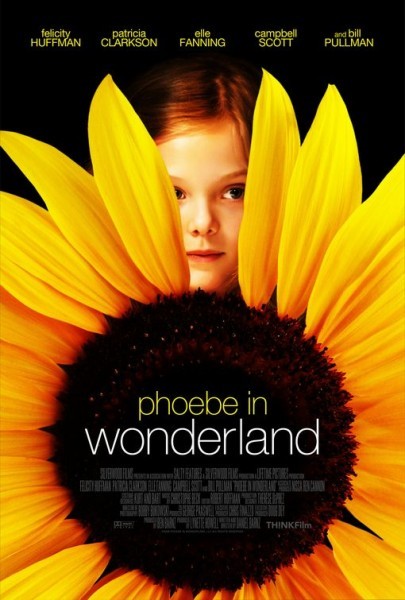

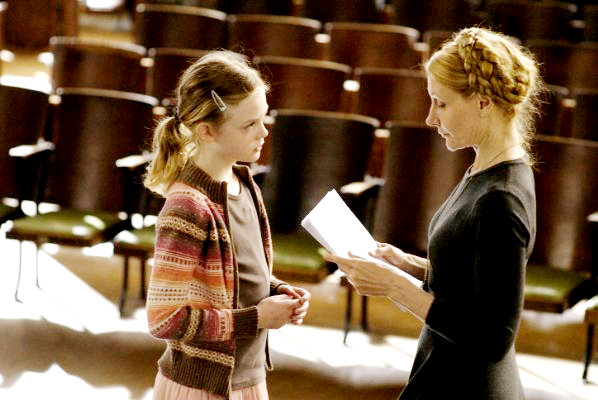 As the movie develops it becomes apparent that there is something strange about Phoebe. Her parents are both writers. Her dad Peter (Bill Pullman) is always working on a book. Her mom Hillary (Felicity Huffman) wants to be working on her book, a revision of her dissertation on Alice. However, she has writer's block and blames it on her two girls. She cannot write even a sentence a day. With such distracted and inattentive parents, it seems of little surprise that Phoebe, an Alice fan, resorts to living in her dreams.
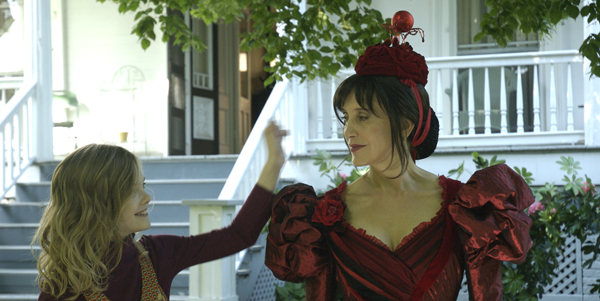 Rules form the core theme of Barnz' film. Unchanging rules form a sort of prison for Phoebe. She explains this to her shrink, when she describes her "conversations" with the Red Queen. When asked what they discuss, she replies: "Wonderland. How nice it is to have a place where things aren't fixed. It's all the opposite there, you know. It'd be nice if . . . if it were the same here."
.jpg)

 The third factor is the marvellous score composed by John Williams. Anyone who has seen the film can hardly forget the ominous notes of the bitonal "dum-dum-dum-dum" which begins to increase in speed and volume as the shark approaches. Williams won the Oscar for Best Score for this composition, and it is indeed almost a character in itself, so effective is it in contributing to the suspense.
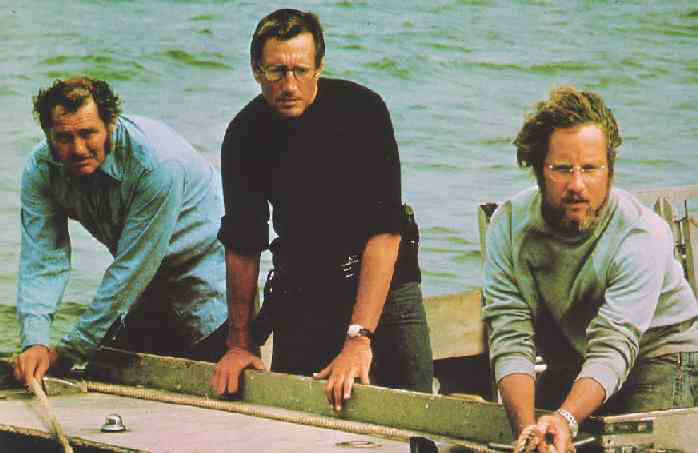 In the second half of the film Chief Brody and Hooper join Quint on his boat, the Orca, as they go out to hunt this killer. Quint and Hooper bear the scars of former engagements with shark, but Brody harbors his inner fear of water. Brody is the one who has to courageously face up to his fears to act on behalf of his family and his community. Quint is merely a mercenary, making the most of a bad situation. Hooper is a resourceful scientist who has found Amity a closer place to research sharks than Brisbane. Though all must put their lives on the line, as the third act elaborates, Brody is the only one who is truly vested in the community.
 Vaughn is greedy for the dollars brought by the tourists. The town's economy is driven by the summer visitors. Without them it would fail. And that would blow his chance of future re-election. Greed is self-promoting. Vaughn is less concerned about those at risk. He cares less for the truth. He is willing to sacrifice the odd tourist or two, and cover up their deaths, if it means the survival of his town and his political career.