Thursday, February 14, 2013

Silver Linings Playbook -- dealing with mental illness


Director: David Russell, 2012 (R)  


Silver Linings Playbook, the latest film from the director of the 2010 hit The Fighter, presents a moving and powerful portrait of a different kind of fighter. Pat (Bradley Cooper) is no boxer fighting other men, although he spends much of his time exercising. No, Pat is fighting something invisible – mental illness. Bipolar disorder is a much tougher and trickier opponent, one too easily dismissed because it cannot be seen.
As the movie begins, Pat is wrapping up 8 months in a Maryland mental health institute where he has gone to avoid jail after an explosive and violent incident in his home that involved his wife Nicki. Now that his court-mandated period is up his mom, Dolores (Jacki Weaver), is taking him home to Philadelphia where his dad, Pat Sr. (Robert De Niro), is blissfully unaware of his son’s impending freedom.
Pat Sr has his own problems – OCD behavior, violence of his own, and compulsive gambling. He lives for his beloved Eagles football team, and considers Pat Jr a good-luck charm for the NFL games. Now a bookie, he gambles on these games the money he is saving for his family restaurant business.
When he runs into his best friend Ronnie (John Ortiz), Pat is invited for dinner with Ronnie’s wife Veronica (Julia Stiles) and her kid sister Tiffany (Jennifer Lawrence). The dinner gives the first of many deeply funny scenes. But the comedy is acidic, almost caustic, since it is raw and touches deep nerves. While Ronnie and Veronica are trying to set the thirtysomething Pat up with the twentysomething Tiffany in a socially acceptable way, these two show how crazy they are. They cut across politically and socially correct behavior to talk about their current and past medications and their spouses. You see, Tiffany’s husband died and Pat is pining for his wife. In another scene, he declares, “Nikki’s waiting for me to get in shape and get my life back together. Then we’re going to be together.” This is delusional thinking, as she has a restraining order on him and has exited their former home. If we had any doubts about the type of humor and movie we are in, they are removed as Tiffany and Pat stand up and leave the dinner before finishing the main course. They are gone. And after he walks her home, she casually invites him in for sex, a man she met no more than an hour ago.
On paper, the film strikes no chords. It is about living with mental illness. The dialogue is replete with more curse words than a Naval barracks, although to be fair this is probably how such families talk. And there is violence, both within Pat’s family and between ethnic groups. Yet, it comes together to form a sparkling romantic comedy/drama. There are some very funny scenes. There are some very touching, almost sentimental moments. And there are some very tense interactions. But, hey, this is grounded in the reality of a family impacted by mental illness.
Perhaps what makes this succeed is the combination of the script, which has enough turns that make the second and third acts a joy to watch, and the acting. Russell has brought together two generations of actors that are at the top of their games. We all knew De Niro could act, winning his first of two Oscars back in 1975 (for The Godfather Part 2), but recent movies, like Meet the Parents and its sequels and Righteous Kill, have seen his work go into cruise control at best, relying on reputation. But here he has a real character to work with, and he brings it back. Then there are today’s stars Bradley Cooper and Jennifer Lawrence. This is Cooper’s first Oscar nomination and perhaps his best work to date. Lawrence showed her potential in 2010’s Winter’s Bone which garnered her a nomination, and she gave a powerful portrayal as Katniss Everdeen in The Hunger Games. But here she shows both a greater depth than either of these films. Indeed, of its 8 Academy Award nominations, Silver Linings Playbook is the first film in three decades to gain nominations in all four acting categories since Reds (1981). It is also the first film to get nominated in the “big 5” categories (Best Picture, Best Actor, Best Actress, Best Director, Best Screenplay) since Million Dollar Baby in 2004.
In the second act, once Pat and Tiffany have met, we find Pat needing to get a letter to Nikki and Tiffany is the only person who can manage this. And she offers to do it. But there is a catch. She needs something and only Pat can deliver. At this point, Pat is forced to play her game. To go into the details would be to give too many spoilers away. Suffice it to say, that this forces Tiffany and Pat to work together even as Pat Sr wants Pat to spend time, particularly Sunday afternoons, with him. Conflict is sure to arise ,and it does.
The film does depict a realistic representation of living with mental illness. Pat is in denial. He thinks he can handle his illness through personal exercise and his practice of his magic word “Excelsior”: a process of looking for the silver lining within any situation. But in avoiding his medication, he is deluding himself. His parents know this. His therapist knows this. His friends know it. But he ignores this. Indeed he seems to be running from this.
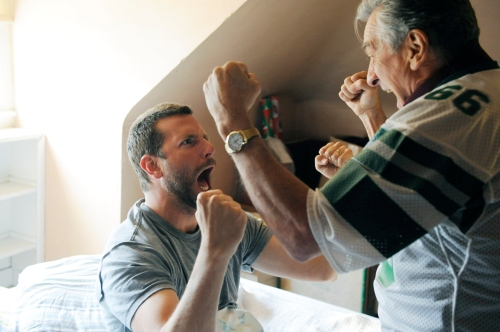
THE SILVER LININGS PLAYBOOKMany scenes show him running the streets. He is running from his problems, and trying to run back to his wife. But instead, he ends up running into Tiffany time and time again.
Although it may be positive and healthy to look for silver linings, they are not always there. Trials and difficulties come. They are part of this life. The Apostle James tells us: “Consider it pure joy, my brothers, whenever you face trials of many kinds, because you know that the testing of your faith develops perseverance. Perseverance must finish its work so that you may be mature and complete, not lacking anything” (Jas 1:2-4). We may look ahead to the character growth that such trials brings, but they may not always produce circumstantial results that are positive. As has been said, bad things do happen to good people.
As much as attitude can be important, when medical issues prevail medication becomes preeminent. Some illnesses cannot be beaten by sheer willpower or mindpower. Prayer can help, certainly (Jas. 5:16). But we should not turn away from therapies that include prescribed drugs.
The most unbiblical and potentially disturbing issue is that of superstition. Several times Pat is told to “read the signs” as though these are magically going to point him to his future. Pat Sr is convinced that his Sunday rituals involving remotes, handkerchiefs and ultimately his son bring victory to the Eagles. And a key scene has Tiffany rewrite his playbook, but with a new set of superstitions. It is her way of pushing his buttons and getting him on her team.
The Bible denigrates superstition. In one passage, the prophet Isaiah speaks for the Lord against his people: “They are full of superstitions from the East; they practice divination like the Philistines” (Isa. 2:6). By extension, superstition is placed alongside divination and then sorcery or witchcraft (Deut. 18:10; 1 Ki. 9:22; Gal. 5:20). When we place our trust in ritualistic behavior, we are turning from the one who has control over history to symbolic actions. We are turning away from the living God to idols. Superstition is hence a form of idolatry, a way we can control events that should rightly be beyond our control.
There is a silver lining in this playbook. Despite this unbiblical worldview, the positive attitude approach of Pat’s Excelsior and the genuine chemistry of the leads make us root for them all the way to the Christmas climax. Clearly this is not your typical romantic comedy, not even of the quirky independent film genre. But unless you have a sensitive ear or a delicate constitution, in which case you might choose to skip this film, Silver Linings Playbook will have you smiling and dancing all the way home.
Copyright ©2013, Martin Baggs

Sunday, February 10, 2013

Amour -- true love in old age


Director: Michael Haneke, 2012 (PG-13)


Stephen Covey, in his best-selling book “The 7 Habits of Highly Effective People,” pointed out as one habit, begin with the end in mind. Haneke does this here. A Parisian apartment is being broken into by rescue workers, only to find an elderly woman lying serenely in death, adorned with beautiful flowers in her hair. Thus, we know there will be no happy ending. The story is how we arrive at this point.

Haneke’s latest film won the coveted Palm d’Or at the Cannes Film Festival and is up for the Best Picture Oscar. It is a story of love. But you could have figured that out from the French title. But this is no Hollywood love story, with spritely and sensual lovers. Most modern love stories focus on young people. Not kids, although Wes Anderson’s Moonrise Kingdom centered on adolescents experiencing love. Usually, the hero and heroine are in their twenties, sometimes their thirties. Beyond this and it is usually a dramatic comedy of extended virginity or parental problems. But Haneke takes a different tack. He addresses love at the other end of the spectrum: geriatric love, if you will. Powerful, but austere. Sensitive, yet sympathetic. Emotional without being sentimental. And he does it all without a true musical score. There are no violins to trigger a tear or two. Instead, we can hear what is happening as though it were our apartment. The only music we hear comes from a CD player in the living room or the piano when someone plays it.

After the credits, we find ourselves looking at an audience (from our own audience seat). A crowd of Parisiens is watching and listening to a piano concerto. Unless we are aficionados of French cinema, we probably cannot recognize any faces, and are not sure who to look at. But Haneke, as in many of his films, is giving us a voyeuristic view, one that he will use as we slowly invade the home of George (Jean-Louis Trintignant) and Anne (Emmanuelle Riva), the elderly couple in their eighties who are somewhere in the audience.

George and Anne are cultivated and cultured. Retired music teachers, they can appreciate the good things in life, such as this concert by a former pupil. How will their life and their love handle the tests of end time struggles?

Once we get to their apartment, that is where the film stays. At breakfast one day, Anne drifts off. She is unaware of George and anything else for several minutes. This is the first of several small strokes that begin the process of health degeneration that leads through paralysis to death.

The very ordinary moments of life become the means for George to demonstrate his love. With each step of deteriorating health, his love gets the opportunity to ascend correspondingly.

The atmosphere is somber. There is no magic pill, no medication that can help Anne improve. As she descends into the prison of her own immobile body, with communication becoming increasingly difficult, George faces conflict from his daughter, Eva (Isabelle Huppert). She wants a nurse to help or to have Anne put in a hospital or care home. George’s love, which comes out in his decision to care for her himself as much as possible, is misunderstood. And this shows clearly how hard it can be when others you care about think your path is the wrong one.

The film centers on love, a love that has lasted a lifetime. But it also centers on loss, a natural part of love and life. If we love, we will face loss at some point. It is almost inevitable. How we do so will likely be very personal, probably misconstrued, perhaps even unappreciated.

Some scenes stand out. The moment when the attacks begin was mentioned before. The first instance of bedwetting, leading to adult diapers is a clear transition point. The frustration that Eva feels when she cannot understand a word that Anne is trying to say.

Perhaps the most poignant snapshot involves a pigeon who has entered the apartment. The first time this happens, George is able to easily shoo it out. The next time, it is in the entry way, and evades George’s attempts to throw a blanket over it. But when he finally manages to do so, we wonder what he will do. Will he, in frustration harm it (as happened in Haneke’s earlier film, Cache)? But his gentle cooing in its ear, despite his immediate actions, convey the love that is still present even in the imminence of death.

Amour considers love in old age as valuable as love during the marriage. In contrast to the faithfulness George displays towards Anne, Eva mentions her husband’s infidelities, and says she still loves him even as she knows his dalliances continue.

There is no mention of religion in the whole movie. God is absent absolutely. But love is authored by God (“God is love” -- 1 Jn. 4:8). And the marriage relationship, created from the very beginning (Gen. 2:24) to bring man and woman into a loving communion that mirrors that of Christ and his church (Eph. 5:22-33), can only be sustained by self-giving love. George demonstrates this love, a form of agape love, even when it becomes sacrificial.

Despite the subtitles and the apparent lack of action, this film proves rewarding for the viewer ready invest some focused attention. It is worthy of its Oscar nominations. And Riva, now the oldest person ever nominated for a Best Actress Oscar (in the same year as Quvenzhane Wallis became the youngest person ever nominated in the same category at age 9 for Beasts of theSouthern Wild), gives commendable work in a role where she has to really work form within.

If you want a completely different perspective on what love is, find a screening of Amour.

Copyright ©2013, Martin Baggs

Wednesday, February 6, 2013

Beasts of the Southern Wild -- resilience, legacy and hope


Director: Benh Zeitlin, 2012 (PG-13)  


Beasts of the Southern Wild has garnered acclaim and trophies, from British Film Awards to prizes at the Cannes Film Festival. These were capped with four Oscar nominations, including best actress, best director and best picture. Yet, for all this, I didn’t really like the film. Too slow, with too little plot, it failed to grip my attention.

The movie centers on Hushpuppy (Quvenzhane Wallis, a newcomer), a 6 year-old girl and her father Wink (Dwight Henry). They live in “the Bathtub,” a self-contained community in the southern Delta of Louisiana. Isolated by levees, they are virtually at the edge of the world.

Hushpuppy lives in a trailer while her daddy lives in his own domicile, a home of sorts made from whatever can be scrounged, adjacent to hers. Her mama is gone, we are never told from what. Life is hard and harsh, yet simple. Hushpuppy spends her spare time dreaming and talking or listening to various animals. Technology has not crowded out imagination and wonder.

Quvenzhane Wallis as "Hushpuppy" and Dwight Henry as "Wink" in Beats of the Southern Wild.
Into this routine comes a storm, one akin to Hurricane Katrina, that dumps water and destroys homes. Those that stay, like Wink, Hushpuppy and a few others, find themselves surrounded by water, mud and muck.  Into this routine, too, comes another form of destruction: disease. Wink is dying. Finally, into this routine comes aurochs, huge wild beasts from ancient mythology. This turns the film, at times, into a work of magical realism.

One of the strengths of the film is the acting. First-time feature director Zeitlin (also the writer) elected to use locals for his actors. Young Wallis won the key role over 4000 over kids, and does capture the heart throughout. Wink is a local baker who at first refused to be in the film, but finally signed on when the director agreed to do rehearsals around his baking schedule! You won’t find an actor here you recognize, although Wallis is sure to get more roles in bigger films in the months and years ahead.

Three key themes seem to emerge from Beasts: the resilience of humanity; the dream of a legacy; and the hope of a future.
When all are leaving, abandoning their homes and hopes, some like Wink and Hushpuppy remain. They evidence a resilience, that recoils despite the tragedy. They are unwilling to give up on their culture and their community. They survive with what is at hand.

Humans, despite all their faults, have this resilience of character. Survival hovers in our gene pool. We have been created at the top of the pile, the king of the animals. We are made in God’s image (Gen. 1:26), and we don’t give up easily. This has been demonstrated time after time, throughout the centuries and the ravages of war and disaster. We rebound, we fight back, we eventually make it through. We don’t give up.

One of the things that keeps us going is hope. One form of hope is the dream of our legacy. At one point in the film, Hushpuppy, this young girl barely out of diapers, tells her motivation: she wants people to remember that “once there was a Hushpuppy, and she lived with her daddy in the Bathtub.” Even at this tender age, she wants to leave a legacy.

We all want to be remembered. But what will we be remembered for? In our lives, have we made a difference? I am not talking about fame and stardom. Few of us will ever be celebrities or movie stars, Nobel Prize winners or CEOs. But we all touch lives. We impact our families, our neighbors, our co-workers. We make a difference, either for better or for worse. Are we deliberately living generously, to encourage and impart love and joy in others? Or are we living passively, caring little for how we relate to others? Worse still, are we living selfishly, using others to better ourselves? We can craft a legacy by how we choose to live. Will we actively seek to make a difference now?

Hope, though, forms the anchor. The Bible calls it the anchor for our soul (Heb. 6:19). Sadly, Beasts offers little in the way of hope. The film is humanistic, providing no room for God. Hushpuppy hopes to see her mama, and a surreal boat-trip across the gulf to a converted oil-well turned brothel, gives a glimpse of what might have been. But this is a fleeting and fickle hope.

Beasts offers no hope of a savior, either for Wink or Hushpuppy; nor even for the community. They will make or break on their own. Even the aurochs provide no shelter; they are too busy running and trampling, or eating one of their own.

The human heart wants, even needs, hope. True hope comes only through Jesus Christ, the Savior God-man who delivers us from disaster and death. Such hope inspires endurance in this life (1 Thess. 2:19), and a keen anticipation of the future life that will be inaugurated with the return of this savior (Tit. 2:13). Whether we live in the Bathtub or the Penthouse, death will eventually come knocking on our door as it did for Wink. Our only hope is to take refuge in Jesus. He is our Savior of the Southern Wild.

Copyright ©2013, Martin Baggs

Friday, February 1, 2013

Django Unchained -- inner moral code and justifiable violence

Leonardo Dicaprio Jamie Foxx Christoph Waltz in the official poster for Quentin Tarantino's DJANGO UNCHAINED


Director: Quentin Tarantino, 2012 (R)


Quentin Tarantino certainly does nothing in half measures. He is all in, and is not afraid to tackle tough or even taboo topics. His previous film, Inglourious Basterds, resulted in a violent and radical revisionist version of World War 2 history, as he addressed the Holocaust. This, his 8th film, tackles slavery in the antebellum south. Not so much a full on western, this movie combines comedy and violent action with aspects taken from the buddy, revenge, and caper genres. The result is a long but surprisingly entertaining film, if you can get past the gory violence that so often characterizes his films.

The movie opens with a retro feel. The title captions pop up on screen like an old spaghetti western, while the title song underscores that feel. A line of slaves, chained together, is being marched through a forest led by two horsed cowboys. Django (Jamie Foxx) is one of the slaves. But Dr. King Schultz (Christoph Waltz, an Oscar winner from Tarantino’s prior film), driving his dentist wagon, stops them during the night. He is looking for Django, a slave who can identify the Brittle brothers. With over-elocuted forumality, this erstwhile dentist offers to buy Django, and ultimately gets his way. But not before blood and bodies lay strewn on the landscape. Hence, the tone is set right up front.

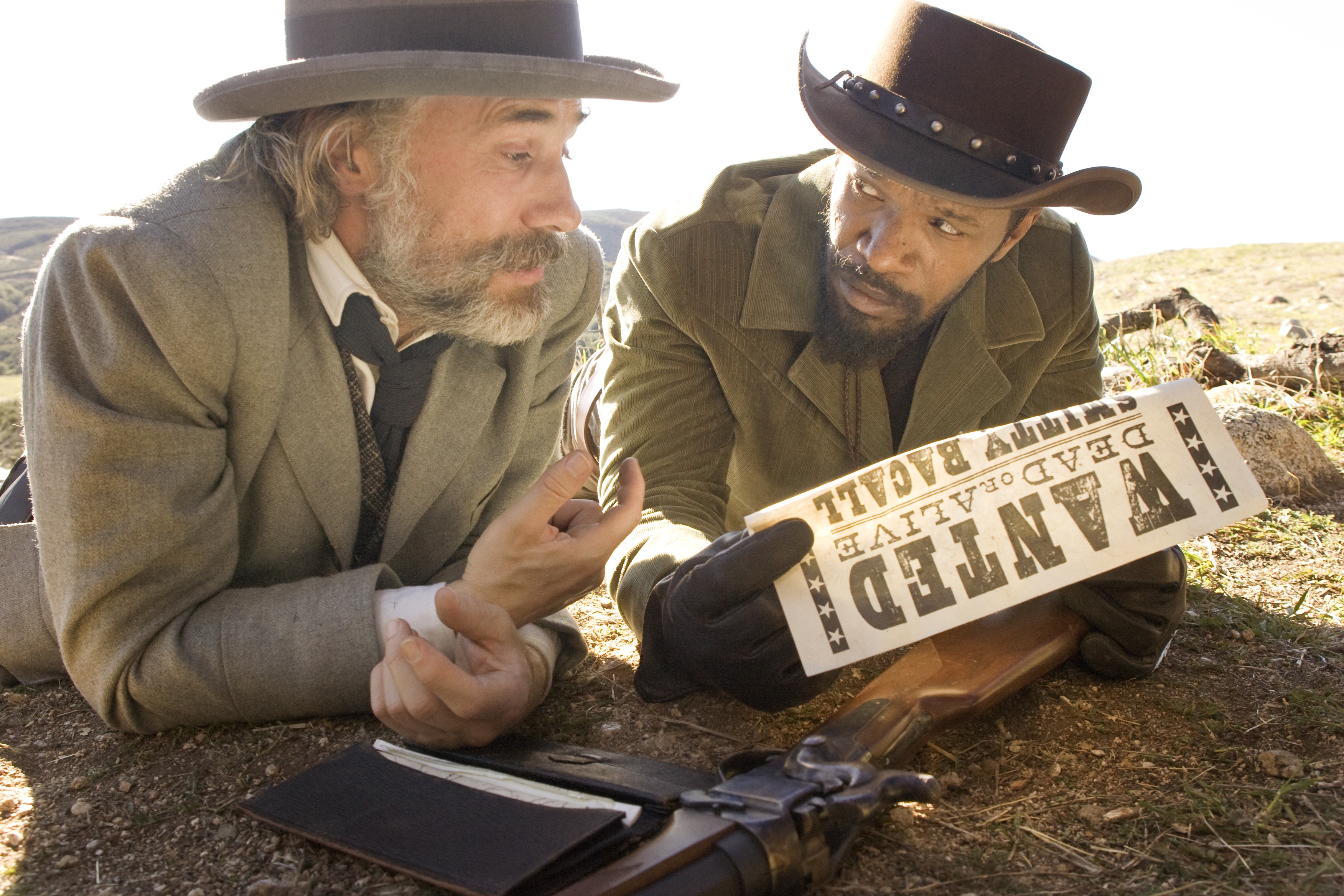
Schultz may be a dentist by education, but he is a bounty hunter by trade. That is where the money is. As he tells Django, the men he hunts are wanted dead or alive. He prefers dead, and then trades corpses for cash with the US Marshalls. Killing for profit. Rewarding but risky.

Blood-soaked tale of slave's revengeThe first act of the film introduces the two main characters and their quests. Schultz simply wants to hunt killers. Django is his key to identify three brothers. But Django proves a skilled hunter and soon gains his freedom and becomes Schultz partner. Django, in turn, wants to find his wife Broomhilda (Kerry Washington), a German speaking slave, buy her freedom and be reunited in love. Of course, elements of revenge enter, for whippings and other degrading acts done to her.

By the second act, the pair are on their way to Candieland, a huge plantation owned by Calvin Candie (Leonardo DiCaprio), a Francophile slave owner who dabbles in mandingo fighting. To enter the viper’s nest, Schultz concocts a plan, a con game where these two hunters pose as mandingo slave buyers. Here is the caper. To get in, pull off the ruse, and exit with the spoils.

The acting is top notch. Jamie Foxx, already an Oscar winner for his portrayal of Ray Charles, does fine work as a slave with a mission. We empathize with him, even as we deplore some of the tactics. Waltz is a wonder, again, as a German in America. He can thank Tarantino for the fame that has come to him. DiCaprio plays almost over the top as a monster hiding behind the veneer of a Southern gentleman. Don Johnson appears in the first act as another plantation owner. But it is Samuel L. Jackson who almost steals the show as Stephen, Candie’s butler, a black man whose speech is patronizingly black but whose sensibilities and desires are undeniably white. Not surprisingly, Tarantino himself shows up in an extended cameo at the end. Although is acting is workmanlike, his presence is more of a distraction than a benefit.

Django and Dr. Schultz share a pint and discuss the movie. Picture courtesy of TWCTarantino creates any number of terrific scenes and sequences. He balances the action with comedy. An early scene has Django and Schultz drinking beer in a bar totally alone, while the whole town is waiting to shoot them when they emerge. Another comic scene centers on a hunt for these hunters. With a lynch mob on horseback, these proto-Klu Klux Klansmen spend 5 minutes whining and complaining about the hoods they are wearing. None can see out of the poorly placed eyeholes. Perhaps the best and goriest is an extended shootout toward the end. Blood ends up repainting the insides of the house, in a realistic portrayal of the violence.

There are many ethical themes embedded in Django which could be unchained. Slavery is center-stage, but this has been discussed in another 2012 film that focused on that subject: Lincoln. Revenge weaves it ways throughout, but was treated at length in Basterds. Better yet, though, is the idea of a man’s internal moral code and the conflicts, which arise. These include conflicts over slavery and revenge, as well as the use of violence.

Each of the main characters, Schultz, Django and Stephen have a moral code that is conflicted. Candie alone stands as a singular minded man, bordering on caricature. He is the foil for each of these three, so we can wrestle, like mandingos, with the subthemes present. As John Eldredge, in his new book “The Utter Relief of Holiness,” says: “This is human nature: to find a morality that is comfortable and convenient and let it suffice for holiness.” Each of the three characters have found a morality, an inner code, that at first is comfortable but increasingly becomes itchy and uncomfortable if not contradictory.

Early in the film, Schultz tells Django that he despises slavery but he is willing to use it to his advantage by leaving Django figuratively in chains. In this way, he can control Django, his slave even while he offers the hope and promise of freedom. It is convenient to him to keep Django as a slave, at least for a while. He subverts his own internal moral code pragmatically for his own benefit. This is a false morality, a prostitution of principle.
Like Schultz, Stephen has his own conflict of principle over slavery. Himself a slave, he has risen within the ranks to become the chief among slaves in Candieland. White haired and leaning on a cane, he speaks as a slave would be expected to speak, but in private he drops these airs. A terrific scene has him sitting in the drawing room with Candie himself, sharing brandies, speaking openly, like two equals would. It is he who spots the grand deception, not Candie. But he, too, is a deceiver. He has compromised his principles for the sake of a more convenient life.

Slavery is indeed abhorrent. Its physical expression is on display here, where one man owns another like chattel property. But slavery is as much an inner dwelling, as the apostle Paul makes clear: “Don’t you know that when you offer yourselves to someone to obey him as slaves, you are slaves to the one whom you obey—whether you are slaves to sin, which leads to death, or to obedience, which leads to righteousness?” (Rom. 6:16) We all are slaves if we obey sin, and we do. We can only be unchained by the freeing blood of Jesus, who put himself on the whipping post for us (Rom. 8:2).

More than this, though, Stephen has violated his inner moral code of race. He has put himself in a position where he, a black man, supports the oppression of other blacks by the white slavers. He is more white than some of the red-neck cowboys used as hired hands by Candie to wrangle the slaves.

Then there is Django, the protagonist and hero. His internal conflicts revolve around revenge and violence. On revenge, in the first act he gives way to his desire for revenge on those who have hurt his beloved. Taking matters into his own hands, he executes the lex talionis law, repaying eye for eye (Exod. 21:26). Yet later, when faced with Candie’s gangsters, he is willing to hold this in check, seeking the better prize of freeing his wife.

Violence and killing, though, produce initial conflict for Django. Early in his “career” as a bounty hunter, Django lies on the ground scoping a farmer plowing his land. This farmer is a man wanted for murder. But with his head in the sights of his rifle, Django is not ready to pull the trigger. He feels conflicted. Yet, after the first time he kills in this way, his conscience is seared (1 Tim. 4:2), and he is able to become proficient at killing. Indeed, by the end, almost a battalion of bodies lies at this feet.

Perhaps this is the most important question that emerges from Tarantino’s film: is it morally justifiable to use violence and kill others if not done in self-defense? The early kills are clearly from afar, for pay not protection. Django and Schultz could have captured not killed, and still earned their pay.

Jesus gives us some guidance here. While on earth he was a pacifist. “Peace I leave with you,” he told his disciples just hours before his death (Jn. 14:27). When Matthew cut off a servant’s ear trying to defend Jesus, he told him: “Put your sword back in its place for all who draw the sword will die by the sword” (Matt. 26:52). Yet, he was not afraid to stand up to injustice. Earlier in his ministry, “he made a whip out of cords, and drove all from the temple area, both sheep and cattle; he scattered the coins of the money changers and overturned their tables” (Jn. 2:15). At the end times, Jesus will come back mounted on a white horse leading the armies of heaven, himself now bearing a sword (Rev. 19:11-21). He will come in violence to do war with the wicked. And he will win. Death itself will be ultimately defeated. So pacifism is not permanent. Violence is morally justified in certain circumstances.

However we find ourselves, we must seek to be unchained by Jesus. Once freed, we must seek to live whole and holy lives, holding to an inner moral code manifested to us by the Holy Spirit. We have the requirements of the law written on our hearts (Rom. 2:15) and we now have a new heart of flesh to replace the one of stone (Ez. 36:26). In Jesus, we are freed from sin and condemnation, and made free to live conflict-free!

Copyright ©2013, Martin Baggs