Saturday, April 28, 2012

OSS 117: Le Caire, nid d'espions (Cairo, Nest of Spies) -- naivety, political incorrectness and alcohol


Director: Michel Hazanavicius, 2006. (NR) 

Before James Bond there was Hubert Bonisseur de La Bath, alias OSS 117. The star of a large series of French books by Jean Bruce in the 1950s, he was transformed into a spy movie star in the late 50s and early 60s, long before Sean Connery took on the 007 role for Hollywood. Some 40 years later, Michel Hazanavicius has resurrected the hero in a hugely funny film that spoofs the 50s films without quite parodying them.

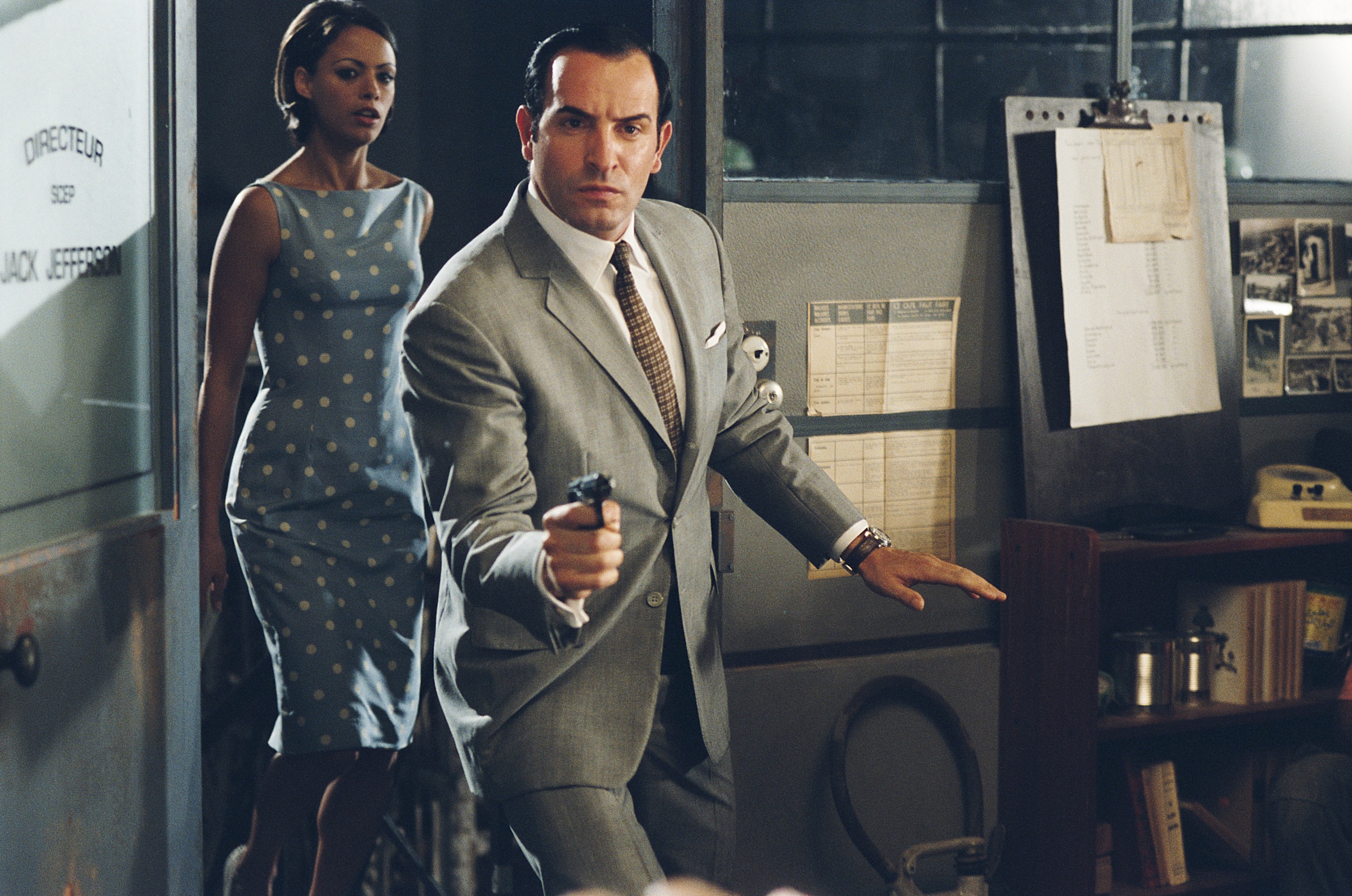
Hazanavicius, who won the best director Oscar this year for last year’s silent black and white film The Artist, combined with his Oscar-winner from that movie and his wife. Jean Dujardin plays OSS 117 with a French mustache and manly build. Indeed, he looks just a little like the early Sean Connery Bond. Opposite him as Larmina, an Egyptian coworker and operative, is Berenice Bejo, the director’s wife who also was in The Artist.

When Hubert’s friend Jack (Philippe Lefebvre), who is a French spy, disappears in Cairo, Hubert is sent there to investigate. As background cover, he takes over a chicken firm run by Jack and is aided by Larmina. Set in 1955, it is the height of the cold war, France is in its fourth republic with a dying colonial empire, and political correctness is unheard of.

Cairo is a nest of spies, with people following people following other people. There is a beautiful femme fatale (Aure Atika) who wants to both seduce and assassinate OSS 117. Paranoia runs rampant. But OSS 117 is unaware of much of what is going on. A naive idiot.

Much of the fun of the film is in the comedic timing. Dujardin displays a wonderful sense of timing, and has marvelous control of his facial and bodily expressions. He can convey whole sentences with a raising of an eyebrow or a guffaw. It is clear that all the actors are enjoying themselves thoroughly. Hazanavicius has captured the atmosphere of the period and pays homage to several film classics, such as Hitchcock’s The Man Who Knew Too Much.

There is little in the way of plot. Various characters and groups show up, including a terrorist Muslim organization, a secret group of Nazis and some Russians. But the plot is superfluous really. The fun is in the journey. With hotel fights, chicken fights, cat fights, and silly alley chases, the action keeps the film moving. But it is OSS 117’s flawed misogynistic character that is the heart of the film. In the middle of a foreign city he displays cutting condescension to the “foreigners” (i.e. non-French people) there, without even realizing what he is doing.

One of the funniest sequences shows flashbacks of him playing on the beach with Jack in headier days. Throwing his head back, mouth wide open and laughing deep belly laughs, he looks like a young Errol Flynn. But his cavorting in the surf with Jack hints at homosexuality in an era when this was frowned upon in the movies. Yet Hubert is homophobic and heterosexual.

His political incorrectness and superiority is most clear in his ignorance of Islam, though he is in an Islamic country. Awakened by the call to prayer, he cries out for the muezzin to be silent and takes matters into his own hands. Then when Larmina refuses a drink, he exclaims, “What stupid religion would forbid alcohol?” And he means it, coming from an atheist.

This insensitivity towards a host country’s religion is shocking today, but less so in the 1950s. Yet, it highlights how important it is to understand culture to refrain from offending. OSS 117 tramples all over such trifles. But as Christians, we are called to “become all things to all people so that by all possible means we [I] might save some” (1 Cor. 9:22). That means finding common points of contact, like Paul did with the Greeks in Athens (Acts 17) rather than alienate them by stepping on their traditions or religion.

Yet it also raises a question about religion. Is a religion that forbids alcohol stupid? Well, alcohol is known to add fuel to the fire of violence when taken to excess. It can lead to addiction and is a cause of accident and death when people drive drunk. But a religion that forbids alcohol is by definition a religion based on morality and rules, and not on grace and love.
Does Christianity forbid alcohol? Many Christian denominations frown upon the partaking of alcohol. I was in a church where members were looked down upon if they imbibed. But Jesus speaks clearly about wine, even turning water into wine at the joyous celebration of the wedding in Cana (Jn. 2). Some argue that this is grape juice, but that is a misreading of the text. The context calls out for this to be alcoholic wine. The apostle Paul even instructed his mentee Timothy to “use a little wine because of your stomach and your frequent illnesses” (1 Tim. 5:23). This, too, is alcoholic.

Yet, the Bible also vigorously warns against the excesses of alcohol: “Wine is a mocker, strong drink a brawler, and whoever is led astray by it is not wise” (Prov. 20:1). And, “Do not join those who drink too much wine or gorge themselves on meat” (Prov. 23:20). Proverbs 23:29-35 paints the picture of a drunken man reeling from the night’s revelry. Paul in the New Testament commands, “And do not get drunk with wine, for that is debauchery, but be filled with the Spirit” (Eph. 5:18). It is a matter of balance, of avoiding excess. Restraint, not restriction, is the right call in Christianity, which itself is a relationship of love with Jesus not a religion.

So, laugh at OSS 117 and let him have his incorrectness. But learn from him and be sensitive to those you are trying to love, trying to touch. His naivety creates his character. Similar naivety today discredits our character.

Copyright©2012, Martin Baggs

Wednesday, April 25, 2012

The Girl with the Dragon Tattoo -- gratuitous violence with depravity 2


Director: David Fincher, 2011. (R)

Having watching the Swedish version that came out in 2009, and recently read all three of Stieg Larsson’s Millenium trilogy, I was ready to watch the English version of the first book, the mega-million seller. At the end of my review of the earlier film, I commented “hopefully that will leave more to the imagination than this one”. It does, but not by much.

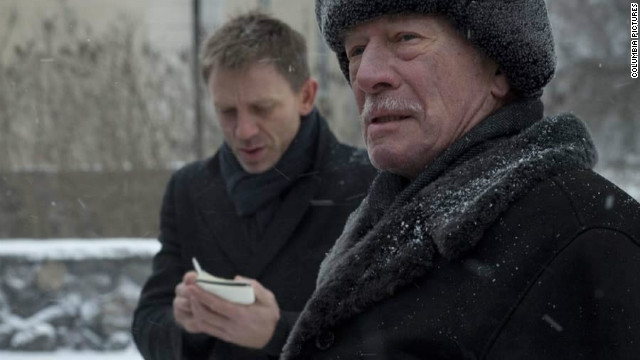
The two main characters, left-wing investigative reporter Mikael Blomkvist and antisocial hacker Lisbeth Salander are played by Daniel Craig (the current James Bond) and Rooney Mara respectively. They anchor the film, while Christopher Plummer, the oldest Oscar-winner in history (picking up his best actor prize at age 82 in 2011 for Beginners), and Stellan Skarsgard offer strong performances as Henrik and Martin Vanger, the former and current CEO of the Vanger family business. And Robin Wright (The Princess Bride) plays Erika Berger, Blomkvist’s lover and co-founder of Millenium, the newspaper he runs and writes for.

When Blomkvist is found guilty of libel he is offered a strange job by Henrik Vanger: to come to remote family island and write his biography. Really, he wants Blomkvist to find the killer of his niece. He believes it is one of his strange family members. The murder happened 40 years earlier and so the cold case needs magic to find a new approach. Blomkvist brings that magic and when he discovers a string of murders, he needs an assistant. Vanger’s lawyer suggests Salander, the woman who investigated him and found things even Blomkvist had forgotten. Together, they dig deep enough to become targets themselves.

Salander is an interesting character. Tatted out and wearing rings in any place possible, she exudes sociopath. She seems to be dumb and crazy. Crazy she might be, but dumb she is not. She is antagonistic towards authority, and leans both ways sexually. Little of her backstory is told, but we do find out more about her guardianship. Institutionalized at 13, she is now a ward of the state. When her newest guardian sexually assaults her and then later ties, rapes and tortures her, we understand something of her hatred.

Fincher’s version plays closer to the source material. We do see more of Salander’s past including her former guardian, the one she is close to. But he also conflates some material from the second book to explain more of her teenage problems. Berger is more of a character here, and that is important as she becomes more prominent in the subsequent two books.

Yet, it feels like he left a lot out. The story, long at 158 minutes, seems to fly by leaving much of depth of the book out. However, where the Swedish version ends at the solving of the murder mystery, this version continues with the book to bring closure to the subplot of Blomkvist’s libel.

Like the earlier version, there is much violence, too much so. The rape scene is a little more restrained yet still feels gratuitous. Watching it made me feel dirty, as though I was there and let it happen.

I have explored the key themes of the film in my earlier film response, and I won’t repeat in detail my comments. As with that film, depravity is on display dead-center. Not only does it come across in the rape of Salander, but also in the torture of the female victims and the misanthropic dealings of the Venger family. And there are ethical considerations behind hacking.

All in all, I found this version a little less grisly and a little more complete than the Swedish version. Best of all, though, was the book. It’s a long book but certainly a good read, if you can stomach this kind of mystery.

Copyright©2012, Martin Baggs

Tuesday, April 24, 2012

Films that take Faith Seriously

Here's a great blog post on films that take faith seriously. How many have you seen? What others would you add? I have seen 17 and posted reviews of 7 on this site.

Sunday, April 22, 2012

Tinker, Tailor, Soldier, Spy -- spies, servants and masters


Director: Tomas Alfredson, 2011. (R) 

It’s been almost 40 years since John Le Carre’s book “Tinker Tailor Soldier Spy” was first published. The early 1970s saw the cold war well underway, and the book focused on this espionage drama. In contrast to the flamboyant James Bond spy stories (and movies) which exhude action, gadgets and girls, Carre’s novel is slow and thoughtful, lacking the violence and sex. Its main character George Smiley (Gary Oldman, The Book of Eli) is a gray-haired who is so silent and withdrawn that he could be a tortoise.

I read the book three decades ago and remember it as a terrific novel, full of deep characterization and an elaborate plot. I saw the six-hour BBC mini-series adaptation which was enjoyable and penetrable. However, this 2-hour film is dense and confusing. Filled with at least a dozen crucial characters, the opacity of the plot left me puzzled at the end, wondering exactly what had transpired. It is simply too much story in too little time.

That is not to say the convoluted movie is a total disaster. The director has established a terrific atmosphere, capturing the dinginess of London in the 1970s, with dirty streets and smoky rooms. The cast is a whos who of top British talent, including Oldman, John Hurt, Mark Strong, Toby Jones, Colin Firth and Ciarin Hinds. Indeed, Oldman earned an Academy Award nomination for this role in which he says little and retains a stoic, almost expressionless face. Without disrespect to this talented actor, this was not his best role. The costumes and sets are visually exquisite, too. But these cannot illuminate the mystery of the plot.

The film begins with Control (Hurt), the head of the British Intelligence Service, sending Jim Prideaux (Mark Strong, Sherlock Holmes) to Budapest to negotiate a defection. But things go terribly wrong, Prideaux is shot, and Control is forced to resign. Along with him goes Smiley, his right hand man. That leaves a cadre of four men in suits to run the Circus (the nickname for the agency): Percy Alleline (Toby Jones, Flickerman's cohost in The Hunger Games), Toby Esterhase (David Dencik), Bill Hayden (Colin Firth, The King's Speech), and Roy Bland (Ciarin Hinds, The Debt). And Alleline’s newest operation, code-named Witchcraft, is bringing untold gems of intelligence from the Soviets but he has not shared the source.

After a year in retirement, Smiley is approached by a senior government official and told that there is a mole at the top of the Circus and is asked to investigate. Working with assistant Peter Guillam (Benedict Cumberbatch), they find that Control had suspected the top four, code-naming them Tinker, Tailor, Soldier, Spy.

There are two major themes in the film. The first is introduced when one of the four says to Smiley: “Things are not always what they seem.” This could be said of life itself. We see the physical world all around us but are blind to the invisible world of spirits, angels and demons. Yet, there is a war going on, a cold war between these spirits of light and darkness (Dan. 10:12-13). Moreover, “Satan himself masquerades as an angel of light” (2 Cor. 11:14). He comes to us as an agent of goodness, of light, when in fact he wants our destruction (Jn. 10:10). Like Smiley, we find ourselves engaged in this cold war, and we need to avail ourselves of the spiritual armor of God (Eph. 6:10-20). Using these defensive and offensive weapons we can stand firm when the devil attacks.

The second theme emerges from another interaction between Smiley and one of the four. “You survived this long, I suppose, because of your ability to change sides, to serve any master,” says Smiley. The potential spy retorts, “What’s this about, George?” And Smiley answers, “It’s about which master you’ve been serving.”

The survivor has acted like a chameleon, changing masters as needed, never showing true loyalty. The spy, on the other hand, has shown loyalty, but switched this loyalty. He has sold out one master to serve another, for political or pragmatic reasons. Jesus talks about serving two masters: “No one can serve two masters. Either you will hate the one and love the other, or you will be devoted to the one and despise the other. You cannot serve both God and money” (Lk. 16:13). We must choose whom we will serve. If we sell out for money, we are serving Mammon and we have chosen against God. We are all serving something or someone, but we can make it a conscious choice rather than subconscious choice. In doing so, we can make it apparent who or what sits on the throne of our heart. We must not be like the survivor or the spy, but like the saint, who is devoted to the one true God. Smiley knew which master he was serving, do you?

Copyright©2012, Martin Baggs