Tuesday, January 1, 2013

The Bourne Identity -- Who am I?


Director: Doug Liman, 2002 (PG-13)


A man floats corpse-like on a stormy Mediterranean sea. A fishing trawler reels him in. He has two bullets in his back and a laser pellet in his hip that projects a Swiss bank account number. Clearly, this is no ordinary man. This is a John Doe who is suffering from disassociative amnesia, a memory loss that lets him remember skils like how to tie knots or fight cops, but not his name or his background.

“Who am I,” he asks at one point in the film. And this is the primary theme for the first of the Bourne movies.

Having healed aboard the ship, the mystery man sets out for Zurich once they land in France. In Zurich he discovers he knows martial arts, as he disarms and KOs two cops in a fight lasting seconds. But the biggest surprise of all awaits him in the bank vault. His bank deposit box contains multiple passports, a large amount of cash and a gun. Of the various aliases, one is American: Jason Bourne (Matt Damon, The Adjustment Bureau). This is the one he will go by until he can find out who he is. With the Bourne identity surfacing, flags trigger in the databases of the CIA and suddenly he becomes a hunted man.

Liman directs a taut action thriller that is high on fights and chases and low on gadgets and gimmicks. Bourne is no Bond. He uses what is at hand, even if it is just his hands. And there is a girl, Marie (Franke Potente, Run Lola Run), but she is no Bond girl. After a US Embassy fight/chase sequence in Zurich, she helps him escape to Paris in her mini.

Paris is the scene of some excellent action, including another fight and a terrific car chase. It is also where he hears of Treadstone, a super-secret black ops run by his handler Conklin (Chris Cooper, Married Life) and his CIA boss Abbott (Brian Cox, RED). This sets up Bourne’s mission: to learn more about Treadstone so that he can find out who he is. Along they way to the climax, we meet the Professor (Clive Owen, Duplicity), another CIA hit man, and Nicky Persons (Julia Stiles), the CIA logistics agent at the safe house. Although not a central character, she will show up in the whole series.

Who am I? This key question centers on identity. We all will ask this of ourselves eventually, some sooner, some later. The Bible offers answers. We are creatures made in the image of God (Gen. 1:26). God created us for relationship with him, as Adam had in the garden (Gen. 2:15). But like Bourne, we find ourselves floating in a sea of darkness. We suffer our own form of disassociate memory loss. We have forgotten who we really are. We have lost sight of God and of our own identity.

How can we find out who we are? We must look back before we can look forward. For that, we must turn to the Bourne Supremacy.

Copyright ©2013, Martin Baggs

Monday, December 31, 2012

The Bourne Trilogy -- reviews coming in 2013


I mentioned in a previous posting that my brother-in-law has a Christmas movie tradition of watching Scrooged. Well, my family has a movie tradition also. We watch a trilogy each Christmas break. We’ve seen all the great ones over the years: The Godfather series; The Lord of the Rings (extended versions); Star Wars (both trilogies); the Man with No Name spaghetti westerns; and last year was Mission Impossible. This year we selected the Bourne trilogy (not including the new film with Jeremy Renner, which I may watch later, since Bourne does not technically appear in the film).

With this in mind, I am planning on posting three reviews in the first week of January about the Jason Bourne films starring Matt Damon. Since they are interconnected in a number of ways, each having a single predominant theme, the blogs will essentially piggy-back on one another, especially in the biblical interaction that I respond with. So, look for these coming soon to this website. (And my review/response to The Hobbit will appear in early January.)

Who knows, next year's trilogy might be the "Three Flavors Cornetto" trilogy, featuring perhaps my favorite film (and certainly most quoted in my home), Hot Fuzz (blue cornetto), along with Shaun of the Dead (red cornetto), and the upcoming green cornetto, The World's End, releasing in late 2013.

Saturday, December 29, 2012

Prometheus -- alien beginnings, atheistic musings


Director: Ridley Scott, 2012 (R)


Three decades ago, Ridley Scott directed Alien, featuring Sigourney Weaver as a cold-as-ice, kick-ass heroine who went one on one with a killer alien discovered on a distant planet. Over the years sequel upon sequel followed, with James Cameron’s Aliens being perhaps the best of the bunch. But none quite matched the innovation and sheer suspense of the original. But here Scott returns to his creation, to bring us a prequel of sorts. Sadly, it does not measure up to the original. Yet, it does raise a number of questions, some of which it even attempts to answer, but with deeply unsatisfying answers.

Like Alien, the star of the film is a female: Noomi Rapace (The Girl with the Dragon Tattoo) plays Elizabeth Shaw, a scientist, who with fellow scientist and lover Charlie Holloway (Logan Marshall-Green), discover archeological writings on cave walls.  They deduce what they are: “Not a map. An invitation.” From whom, they are asked. “We call them Engineers. . . . They engineered us.” Apparently, these beings created us.

To follow up on this momentous discovery, Peter Weyland, a reclusive billionaire, funds an interplantery voyage about the spaceship Prometheus, to the planet that the cave-drawings point to, where seemingly these Engineers are from. He has his own agenda, though. And he reveals it early, to the band of travelers:
“There's a man sitting with you today. His name is David. And he is the closest thing to a son I will ever have. Unfortunately, he is not human. He will never grow old and he will never die. And yet he is unable to appreciate these remarkable gifts for that would require the one thing that David will never have. A soul. I have spent my entire lifetime contemplating the questions: Where do we come from? What is our purpose? What happens when we die?”
So, Ridley Scott through Peter Wayland, wants to give us an origins story, a cinematic cosmology. And we will come back to discuss his views a little later.
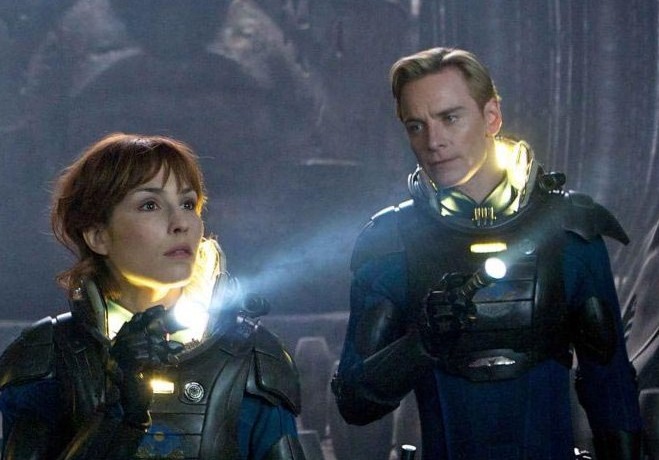
Like Alien, the crew includes a robot, David (Michael Fassbinder, Inglourious Basterds) in this case. There is also an ice-queen, though this time it is a suspicious superior, Meredith Vickers (Charlize Theron), rather than the heroine. But Shaw is no Ripley, though she tries. And the villain is an alien, or rather two aliens.

There is so much similarity to Alien, but that is not surprising. The planet they land on is the planet from the earlier movie. As in Alien, Scott takes his time getting to the alien, choosing to build the tension slowly. Where Alien had the memorable birth scene in the ship, this has a novel cesarean-section alien abortion, which is not for the faint-of-heart. But, whereas in the former film he was merely creating a film, here he seems to have an atheistic agenda, even if his heroine has a faith of sorts, as evidenced by her ornamental cross.

On the planet, in the dark caverns an oozing primordial sludge moves with reptilian parasites. Scott may be alluding to the Darwinian sludge from which most evolutionists purport that humankind came from. Moreover, when the Engineers are found, we come to realize they are not the original creators. Like the metaphysical cosmological argument, we must look beyond for the Prime Mover. If these Engineers really made us, but are likewise creatures, we are left asking who created them. The chain continues ad infinitum into eternity past. There was a beginning for the Engineers, and they were not the idyllic gracious loving creators they were thought to be. Scott’s anti-religious framework emerges.

In contrast, the Bible gives us an account of creation: “In the beginning God created the heavens and the earth” (Gen. 1:1).  This is a fundamental tenet of theism in general and Christianity in particular. More than this though, Christianity posits that Christ was pre-existent, the actual Prime Mover: “In the beginning was the Word, and the Word was with God, and the Word was God. He was with God in the beginning. Through him all things were made; without him nothing was made that has been made” (Jn. 1:1-3). In these two biblical books, Genesis from the Old Testament and John from the New, we find a cosmology worth believing in.

If Scot has rejected biblical creation in answering Weyland’s first question, he reiterates this in answering his second question, namely, what is our purpose? In an interchange with the robot David, Charlie begins, “What we hoped to achieve was to meet our makers. To get answers. Why they even made us in the first place.” David asks, “Why do you think your people made me?” Charlie answers, “We made you because we could.” David replies, “Can you imagine how disappointing it would be for you to hear the same thing from your creator?” And Charlie understands, “I guess it’s good you can’t be disappointed.” For Scott, there is no purpose to mankind’s creation. If we consider creation, we can only be disappointed as there is no purpose, only random chance.

What is our purpose? The Westminster Shorter Catechism asks this as its first question (What is the chief end of man?). It gives us this answer: “Man's chief end is to glorify God, and to enjoy him for ever.” This is a win-win: we glorify our maker and in doing so we enjoy him forever. This purpose is discovered in the New Testament, especially in the writings of the apostles.  Paul tells us, “with one mind and one voice you may glorify the God and Father of our Lord Jesus Christ” (Rom. 15:6). Likewise, Peter commands us, “Live such good lives among the pagans that, though they accuse you of doing wrong, they may see your good deeds and glorify God” (1 Pet. 2:12). Clearly, we have a purpose, if we choose to accept it.

Choice and faith also crop up in Prometheus in the form of Shaw and her cross. At various points she has, loses and then regains the cross, symbolizing a faith of sorts. Indeed, when asked about religion she replies, “It is what I choose to believe,” indicating a choice that perhaps might be personal but also might be wrong.

Faith and belief are different. Faith comes from God and is rooted in Jesus, “the author and perfecter of our faith” (Heb. 12:2). Indeed, Paul tells us that there is a “measure of faith God has given you” (Rom. 12:3). If faith is given to us, belief is then choosing to act on that. Faith is the cause, belief is the effect.

The third and final question that Weyland asks (“What happens when we die?”) is never answered in Prometheus. Apparently, Ridley Scott has no answer to one of mankind’s fundamental questions. But Christianity certainly does. And the answer returns to choice and faith.

Jesus gives us the answer in a parable he told in his Olivet Discourse (Matt. 24-25). He contrasted the sheep and the goats, those who followed the Shepherd (Christ) and those who didn’t. The latter will be told, “Depart from me, you who are cursed, into the eternal fire prepared for the devil and his angels.” (Matt. 25:41). Jesus concluded, “Then they will go away to eternal punishment, but the righteous to eternal life” (Matt. 25:46). Thus, the two ultimate destinations are heaven and hell. Entry to heaven is determined by choice to believe and follow Jesus. Entry to hell is determined by choice to disbelieve and ignore Jesus.

In Greek mythology, Prometheus was a titan, a trickster who created man from clay and brought fire from the gods to man. The film Prometheus is likewise a trickster, that tries to lay out Scott’s non-Christian agenda. Discerning viewers must be on their guard against this parasitic alien invasion!

Copyright ©2012, Martin Baggs

Tuesday, December 25, 2012

Scrooged -- ghosts of Christ and Christmas


Director: Richard Donner, 1988 (PG-13)

One of my brothers-in-law has a Christmas tradition: he watches Scrooged on Christmas Eve after the family gathering at the patriarch’s home. I don’t have this particular tradition, but wanted to watch this old film to put perspective into Christmas this year. Let it be said, I have not read the Charles Dickens classic, “A Christmas Carol,” upon which this 20th century adaptation is based. But like everyone, I recognize Ebenezer Scrooge as one of the modern villains of Christmas, much like the Grinch.

In Scrooged, TV executive Frank Cross (Bill Murray, Fantastic Mr. Fox) is putting on a live TV version of the Dickens classic on Christmas Eve. But Cross is a personification of Scrooge himself, firing a coworker hours before Christmas because he disagrees with him, ripping down a kid’s drawing because it showed Mrs Claus with 11 fingers, despite the fact that it is the child of his secretary. Part of this is due to his upbringing. When we see his past, his dad Earl (Brian Doyle-Murray, one of three of Bill Murray’s brothers in this movie) tells him as a four-year-old: “All day long, I listen to people give me excuses why they can’t work . . . ‘My back hurts,’ ‘ my legs ache,’ ‘I’m only four!’ The sooner he learns life isn’t handed to him on a silver platter, the better!” And he learned, and passed on this humbug lesson to those around him.

Like in the book, Frank is visited by a ghost who tells him he is going to be visited by three more spirits: the ghosts of Christmas past (David Johansen), of Christmas present (Carol Kane) and of Christmas future. After the first of these, Frank calls an old flame, Claire (Karen Allen, Raiders of the Lost Ark), one he has not thought about or spoken to in a decade. She is chalk to his cheese. While he is controlling the world, she is saving it, working in a downtown rescue mission. His past comes out in his present advice to her: “Scrape ‘em off. You wanna save somebody? Save yourself!” What an attitude, on Christmas Eve even. He has no Christmas spirit.

No literary classic, this is still a funny film. Murray is perfect as the self-absorbed president who cares more for revenues than relationships. Allen is girl-next-door pretty, a good foil for Murray. Johansen is over the top as the first ghost, but Carol Kane steals the show as ghost of Christmas present, putting Frank in his place through careful use of fists and toasters.

Watching this film, I pondered the three ghosts and reflected what it would mean if they were of Christ not Christmas.

The ghost of Christ past points us back initially to his pre-existence. He was with God before the world was created (John 1:1-2). But after humanity fell (Gen. 3), God’s rescue mission kicked in, and Jesus Christ was born in Bethlehem (Lk. 2:4-7). Giving up his position in the godhead, he humbled himself and took on humanity’s flesh (Phil. 2:4-8). Born, he grew until he could fulfill his mission to die on a cross in our place. Then echoing Frank’s words the crowds (Matt. 27:40), the soldiers (Lk. 23:36) and even another crucified criminal (Lk. 23:39) told him, “Save yourself”. But to do so would negate his purpose to save the world (Jn. 3:16). Death, though, did not hold him, and he resurrected on that first Easter day.

The ghost of Christ present reminds us that he lives with us even now. To all who would follow him, he calls into his family (Jn. 1:12). To these he gives the Holy Spirit (Jn. 14:26), the third member of the Trinity. This is the mystery of our age: “Christ in you, the hope of glory” (Col. 1:27). We may forget him more often than we desire, but he does not forget us. He remains in us, an ever-present help (Psa. 46:1).

And then there is the ghost of Christ future. Unlike for Frank, where this ghost appears as the grim reaper carrying lost souls in torment, Christ will appear as the King of kings (Rev. 19:16), glorious in white. He will bring the armies of heaven with him (Rev. 19:14), and will defeat death and cast it into the lake of fire (Rev. 20:14).

At the end of Scrooged, after Frank’s interactions with his ghosts have transformed him, he declares to the cameras and hence to viewers all across the country: “It's Christmas Eve! It's... it's the one night of the year when we all act a little nicer, we... we... we smile a little easier, we... w-w-we... we... we cheer a little more. For a couple of hours out of the whole year, we are the people that we always hoped we would be!” Why does it have to be like this for only two hours once a year? Can’t we act nicer through the whole year? If we follow Christ, we can. He can make us to be the people he always planned for us to be, bearing the fruit of the Holy Spirit (Gal. 5:22). He will make us Christ-like (Rom. 8:29). Let’s let him do that this Christmas.

Merry Christmas to one and all!

Copyright ©2012, Martin Baggs