Tuesday, November 20, 2012

Argo -- freedom, captivity and responsibility


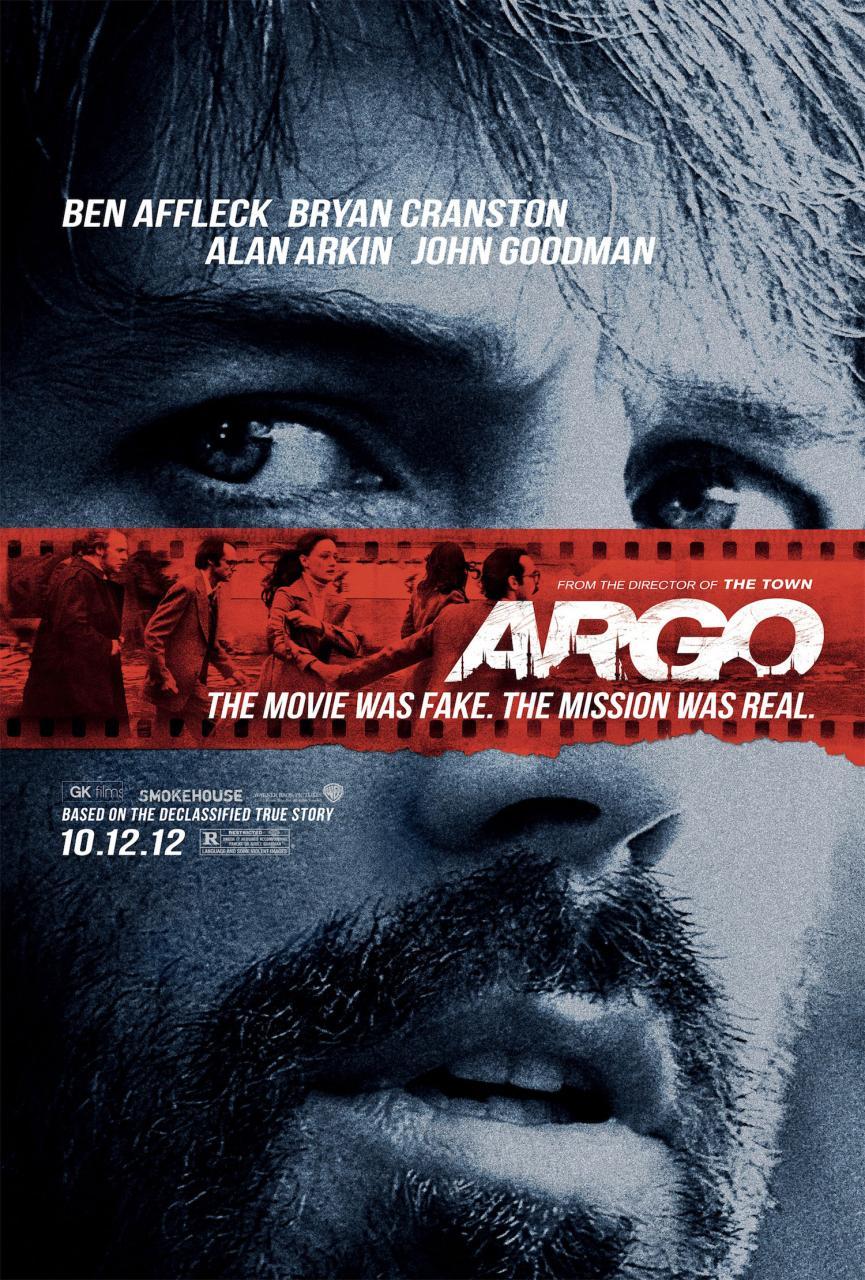
Director: Ben Affleck, 2012 (R)

In November 1979 a mob of revolutionary Iranians stormed the American Embassy in Tehran, took over 50 hostages and began the 444 days of captivity we all remember. But 6 Americans escaped that day and found shelter in the Canadian Ambassador’s home. Argo tells the now-declassified, true life tale of how we brought these six home.

Ben Affleck has made some poor choices in his acting roles (consider Jersey Girl and Gigli), but he has crackerjack selections as a director. His debut, Gone Baby Gone (starring his brother Casey Affleck)was one of the best films of 2007. The Town (starring himself), his second, continued his run of top-flight films. And now, he is once more at the top of his game. This compelling political thriller features terrific actors, engaging script and excellent cinematography that puts slap bang in the middle of the crisis.

The film opens with a short storyboard history of Iran, from biblical times to the post-Shah Iranian Revolution. And moves to a tense set-up with the mob taking over the embassy. It never lets on the tension. But Affleck counters the tension with well placed humor, mostly from John Goodman (The Artist) and Alan Arkin (Sunshine Cleaning) and a pacing that is pitch-perfect.

After 66 days with Canadian Ambassador Ken Taylor (Victor Garber, The Music Man), daily facing the possibility of discovery and death, the Canadians want the Americans gone. Back in Washington, various agencies run through plans to get them out. But CIA exfiltration expert Tony Mendez (Ben Afleck, directing himself once more) comes up with the “best of the bad ideas”: to pose as a Canadian film crew scouting locations for a film. He would be a producer, while the six would be his crew. He would fly in alone and fly out with them. Risky, certainly. Possible, yes.

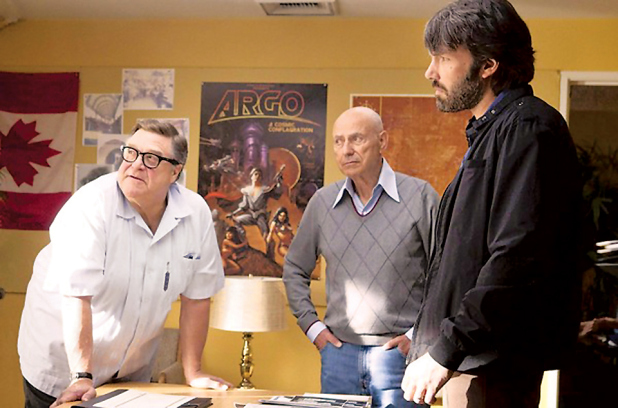
With the plan green-lighted, Mendez needs to be convincing. And he turns to old pal John Chambers (John Goodman), a Hollywood make-up artist. Chambers, in turn, brings producer Lester Siegel (Alan Arkin) into the mix. But to create a plausible backstory, they need a script, a poster, and an office. They come up with Argo, a sci-fi film.

The scenes with Goodman and Arkin, introducing Mendez to the fakeries of Hollywood are hilarious. They provide excellent counterpoint to the reality of the hostages. But it also shows how even these cynics get behind the cause and the nation’s need.

One scene in particular stands out early in the film. Affleck weaves three sets of speakers together into one montage. We see President Carter speaking on TV about the hostages. Another shot shows a female revolutionary in Iran declaiming the evils of America. And back home in Hollywood, Siegel has a group of actors reading the script of Argo in a press event. This surreal scene brings the reality of the fictional film’s purpose into focus.

Once Mendez gets to Iran and meets the six, he finds them fearful and frustrated. Their lack of trust in his plan complicates things and forces some self-disclosure. Indeed, this focus on fear and faith, captivity and freedom has been explored by Stacey Tuttle in her review for the Shepherd Project. In that review she compares (almost equates) the CIA to Christianity and explains how our jobs or vocations are cover stories for our real job of freeing those held captive by Satan. Her review and insight is well worth reading.

Back in Iran, when Mendez’s CIA boss Jack O’Donnell (Bryan Cranston) calls to tell Mendez that the CIA has called the plan off, the crisis hits deep and rocks Mendez. He has put his life on the line for the six Americans, and he says, “We are responsible for these people.”

Aside from captivity and freedom dealt with by Stacey Tuttle, responsibility is the other key theme. Mendez realized the responsibility of the American government and that he had, too. These six had worked hard for the government and deserved more than to be discarded. They needed him. He was responsible for their escape.

How about us? Who are we responsible for? Who is dependent on us? Obviously, our family members, spouses and kids. But what about friends, church members, co-workers? How about the strangers we encounter along the paths of our days? How does our Christian faith inform us in this regard?

Certainly, the apostle Paul tells us we should provide for our families first (1 Tim. 5:8). There lies a primary responsibility. But John commands us to “love one another” (Jn. 13:34). Love requires responsibility. So, in a sense, we are responsible for others in the family of Christ. And Matthew’s command, “Therefore go and make disciples of all nations“ (Matt. 28:19), lays on us a responsibility for others.

So, like Mendez, not only must we look at our lives as opportunity to help others find freedom from sin’s captivity (Col. 1:13), but we must we accept the responsibility for others. We can accept this responsibility with grace, and demonstrate it with love: “Greater love has no one than this: to lay down one’s life for one’s friends” (Jn. 15:13). Jesus laid down his life for us (1 Jn. 3:16). We must face the question he asks us, ““Will you really lay down your life for me?” (Jn. 13:38)

Copyright ©2012, Martin Baggs

Wednesday, November 14, 2012

The Best Exotic Marigold Hotel -- outsourcing as a grand adventure


Director: John Madden, 2011. (PG-13)


Outsourcing has become a stalwart strategy for many American companies. But can we apply it in our personal lives? In particular, can we outsource our retirement? Madden (Shakespeare in Love, The Debt) raises this question in this charming if offbeat comedy.

The premise is simple. Seven British retirees decide to outsource their retirement to the Best Exotic Marigold Hotel in Jaipur, India. Expecting a resort, they get a dump, a dilapidated palace that has seen better centuries.

The seven are an odd bunch. Evelyn (Judy Dench, Chocolat) is perhaps the central character and heart of the film. She has just lost her husband of 40 years, a man who controlled their marriage. With debt forcing her to sell her home, the allure of a cheaper place in India beckons to her. Graham (Tom Wilkinson, In the Bedroom), a high court judge, on whim announces his retirement at a retirement party. His decision to go to India is rooted in lifelong shame and a search for an old love. Then there are Douglas (Bill Nighy, Hot Fuzz) and Jean (Penelope Wilton), a married couple who have lost their retirement savings in an ill-advised investment and now cannot face the beige bungalow that their meager funds can afford. India offers more. Muriel (Maggie Smith, Harry Potter series) needs a hip replacement and doesn’t want to wait the months that it will take under the National Health System in UK, so goes for the quick and cheap Indian hospital approach. That leaves Norman (Ronald Pickup), a sex-starved scallywag looking for a fresh piece of skirt, and Madge (Celia Imrie), a much-married divorcee looking for a new rich husband abroad.

Madden has the cream of gray-haired British acting engaged here, and they are on form. Each dives into the character, bringing their own particular styles to bear, from droll (Nighy) to emotional (Wilkinson) to sarcastic (Smith). Coupled with Dev Patel (Slumdog Millionaire), the naïve but idealistic owner of the hotel, they bring beauty to the intelligent and witty script. And this acting beauty matches the cinematic beauty and color of the region.

A nagging criticism, though, is that there are perhaps too many characters; it is hard to keep so many plotlines in the air. Some characters get left for too long. Eliminating one or two might have made for a tighter film. Still, this is nit-picking.

Muriel and Jean capture perfectly the older British style of foreign vacations. Where one looks down on the natives with a racial superiority and intolerance, the other withdraws, choosing not to see the beauty and wonder, only the difference. To her, the differences are to be avoided. She wants grilled chicken and white rice, rather than spicy curry and dahl. No adventure for some.

Evelyn and Graham offer the contrasting approaches. Evelyn is willing to reluctantly step out of her comfort zone to experience life anew, afresh, as if for the first time. And Graham returns to old haunting grounds, navigating the familiar even as he finds it changed and somewhat unfamiliar.

The film centers on retirement, obviously. This is the period when work or service is over, and the last quarter (or less) of life remains. Death stares us in the face. The film really asks us how we should approach retirement. Can we enjoy this period, fraught as it may be with medical issues, like Muriel’s? Can we change?

One interchange between Evelyn, our protagonist and Muriel, gets to the heart of this. Evelyn says, “Nothing here has worked out quite as I expected.” Muriel insightfully replies, “Most things don’t. But sometimes what happens instead is the good stuff.” This is the crux of adventure. It is unexpected, unplanned, but often can be seen as good.

Life is a grand adventure. God made it that way. Too often, though, we put off the experience of that adventure until retirement. And by then we are usually too set in our ways to be open to new encounters. But we can change if we choose to. It is a mindset, an attitude. When we are willing, we can taste the adventure and it is sweet and exotic, something to be embraced. When we are unwilling, it simply tastes different and foreign, something to be avoided. The former signifies growth and life, the latter signifies stasis and death.

Retirement can introduce a whole new chapter into our lives, a chapter of exploration even service. We can be of use to others; we can develop ourselves. Many choose to enter into mission or volunteerism to share from their knowledge and wisdom with others perhaps younger than themselves. (This reminds us of the writers of Proverbs, who boil down their life experiences into pithy aphorisms to share with the next generation.) Or retirement can initiate the conclusion and epilog to our lives, as we see our characters set in stone. We are of little use to others; we sit and wait for the grim reaper to make his unwelcome call. But in waiting, we make no effort to help others; instead we become shallow and withdrawn, embittered and cynical. It’s a choice we must eventually face.

Back, though, to the original question. Can we outsource our retirement? No, not in the sense of today’s outsourcing of jobs. In that regard, we move activities to other people, like manufacturing jobs from the USA to China. Our retirement is our retirement. It cannot be experienced by another. But we can choose to outsource it in the sense of relocation to a cheaper venue, which is the point here. And if we do so, we must approach it with an open-mind, else it will be a grand disaster.

As Sonny says several times, “Everything will be all right in the end . . . if it’s not all right, then it’s not the end.” If we approach it correctly, our retirement will be all right in the end, regardless of where we end up. If we want to actively outsource it, it will work. If we passively outsource, the end will come sooner than we imagine.

In closing, when the end comes, we will be all right if we can look Jesus in the face and know that we know him as our friend (Jn. 15:15). Under these conditions, our death will be an exit from this world into an eternal retirement that will certainly be a wonderful adventure.

Copyright ©2012, Martin Baggs

Tuesday, November 6, 2012

Looper -- nature vs nurture, assassination and sacrifice


Director: Rian Johnson, 2012 (R)

If you could go back in time and assassinate Adolf Hitler to prevent WW2 and the resulting Holocaust, would you? Despite the paradoxes that it might bring, would this murder be ethically acceptable? This is more or less one of the ethical questions that Looper raises. Though it doesn’t really give us an answer, it does cause us to think deeply, particularly about the paradoxes that emerge from careful consideration.

As a time travel movie, Looper has many twists and turns, and it would be wrong to share any that would reveal too much of the plot. So I will do my best to make this, as much as possible, spoiler-free.

This intense, exciting and somewhat violent film is set in a future Kansas City, somewhere around 2044. The main character Joe (Joseph Gordon-Levitt, Inception), sets the scene at the very start: “Time travel has not yet been invented. But thirty years from now, it will have been.” Joe goes on to explain his job, and how it is impacted by time travel: “I work as a specialized assassin, in an outfit called the Loopers. When my organization from the future wants someone to die, they zap them back to me and I eliminate the target from the future. The only rule is: never let your target escape . . . even if your target is you.”

Joe is nothing other than a mob hit-man. In that future year of 2074, implanted trackers make disposing of a body impossible, so sending it back to the past from the future takes care of two problems: no corpse left in the future, and no in the past is aware of the murder except the looper, who doesn’t know the identity of the victim. The looper waits for the hit to appear out of thin air, masked and trussed up. He shoots the victim with a “blunderbuss,” a huge shotgun of sorts, and then collects the ingots of silver taped to the victim’s back. It’s foolproof, at least until someone in the future, known enigmatically as “the Rainman,” starts sending the loopers themselves back to be killed by their younger selves. This is known as “closing the loop.” The looper knows he has killed his older self because the silver is replaced by gold, his final payout. A pension of sorts, the looper is retired from his job to live out the next 30 years in luxury until the Rainmaker’s men come to capture him and send him back to his destiny.

Writer-director Johnson does a fabulous job with the film. He has shown his abilities before in the con-flick The Brothers Bloom, and here takes the time travel subgenre of sci-fi and subverts it, giving us a real thrill ride. Unlike other films of this ilk, such as Source Code or In Time, Johnson takes time to develop character as well as plot. It is not superficial. It all plays together. Drawing from earlier sci-fi films like Blade Runner, the future displays a bleak dystopia of disintegration and decay, and of division between the haves and the have-nots. Vagrant districts exist alongside urban nightclubs, where the clubbers are willing to run-down the vagabonds without care. And the clubbers live for dancing, drink and drugs, the latter taken via eye drops.

Yet alongside this urban squalor, the countryside appears expansive, looking hardly different from today. Apart from a few robotic enablers, farmers like Sara (Emily Blunt, Salmon Fishing in the Yemen) work in the fields manually.

The first act of the film takes time to explain the set-up, introducing us to Joe, the young looper. He drops drugs, visits prostitutes, and kills people. His life is aimless, but he seems to want more, to be a better person. His friend Seth (Paul Dano, There Will be Blood) is the first to let his older self run. And we see the consequences imposed by Abe (Jeff Daniels, Traitor), the criminal who runs Kansas City, himself a traveller from the future. Johnson cleverly and graphically depicts the impact of two versions of one person being in the same time and city, but it brings paradoxes about multiverses and single timelines to mind.

Seth’s situation leads us into act two, where Joe’s older self, played by Bruce Willis, is sent back to die but escapes. He has come back on a mission: to find and kill the young Rainmaker. Like Hitler, the Rainmaker will grow up to desire, and indeed exercise, global control via a vast criminal organization. Old Joe has a vested interest in carrying out the deed, so for him it is not so much altruistic as self-seeking.

There are two standout scenes. The first is the best diner/restaurant scene since Pacino sat across from De Nero in Heat. Here young Joe meets old Joe in their favorite diner. Sitting across from one other, the old sees the young as naïve and full of crap. The young Joe sees the old as a has-been, one whose time has passed, who should be killed. Both share memories, but neither respects the other, though they are the same person. Talk about mind-blowing.

The second scene raises the first ethical issue. Young Joe is driving his sports car from the club with other loopers, drugged out with drops. As he turns a corner he has to slam on the brakes to stop from hitting and killing a young vagrant kid. Looking him in the eye, Joe sees himself, a younger version, lost and abandoned. He was sold into slavery by his mother, and escaped into a life of vagrancy and crime.

Lost boys permeate the script. Abandonment is a sub-theme. What does it mean to be lost? The dictionary defines it as “having gone astray or missed the way” or “no longer possessed or retained.” This parallels the biblical concept of lostness. Jesus gives three key parables about lostness in Luke 15, culminating in the parable of the lost (also known as the prodigal) son. Like the prodigal son, we have all gone astray (Isa. 53:6), each of us has turned to his own way, and we find ourselves lost. We are lost in actual sense of not knowing where we are. And we are lost in the sense of no longer being possessed or in relationship to our creator. We find ourselves abandoned, separated from the God who formed us, now living as vagabonds. Only when he reaches down through Christ are we brought into the family of God (Jn. 1:12). In the words of the hymnist John Newton, “I once was lost but now am found.”

With two versions of Joe on the loose, both being chased by Abe, each has a different mission. Old Joe wants to find and kill the Rainmaker. Young Joe finds himself on Sara’s farm and wants to protect her and her young son Cid (Pierce Gagnon). And these opposing missions collide in the third and final act in the middle of the Kansas corn fields.

The cast delivers strong acting. Gordon-Levitt, with the help of old fashioned prosthetics, looks remarkably like a young Bruce Willis. Willis plays the cynical old man to a tee, even giving us a glimpse of his Die Hard persona. Blunt shows she can pull off an American accent and handle a shotgun as a realistic farmer. But it is the young Gagnon who stands out. He plays off Gordon-Levitt perfectly. One scene has Gagnon staring with malevolent eyes and we see lostness and abandonment personified, if for a brief instant.

A key theme throughout, and a strong ethical question, is nature vs nurture. Although the film does not offer an answer, it poses the question of whether we are made the way we are or we become that way through our upbringing and choices. In other words, how do our choices today impact our character and self tomorrow?

The Bible addresses this concept. Many people ask, are evil people (like Hitler) born evil? The Psalmist David declares, “Surely I was sinful at birth,
 sinful from the time my mother conceived me” (Psa. 51:5). Although we would not necessarily equate evil with sin, evil begins with sin. And we are all sinful (Rom. 3:9), and so all have the capacity for evil. Does that mean nurture has no effect due to our inherent sinful nature (Rom. 7:5)? Not at all. Our upbringing does form us. Our nurture influences us. Certainly most of us refuse to let sin run rampant and thus don’t become the next Stalin or Rainmaker. But unchecked, the sinful nature can make monsters out of men. And though these are one in a million, their very existence points to the potential of evil. To put it differently, nature is primary, but nurture has a secondary effect.

And that brings us back to the primary ethical question: is it wrong to try to kill a potential monster, a latent terrorist? Before we jump to a conclusion, we should ponder current global events. According to the Tribune St Louis Obispo earlier this year, the US Attorney General Eric Holder said the government was justified in killing a US citizen who posed a potential terrorist threat. And with the new Stanford/NYU study on deaths due to US drones in Pakistan, reported in the UK newspaper The Guardian, this ethical question has immediate relevance. Of course, time-travel apart, the practice of killing potential enemies is nothing new. New kings in Bible times would kill other relatives or contemporaries to remove competitors to the throne (e.g., Athaliah’s actions of destroying the whole royal family in 2 Kings 11:1). Further, King Herod had all the boys two years old or younger in the vicinity of Bethlehem killed to try to eradicate the predicted king, the young Jesus (Matt. 2:16-18). Having considered all this, Jesus would answer yes to our earlier question. He would seek a peaceful solution. He stared the monster in the eye, both in the desert (when he faced the devil; Lk. 4:1-13) and in the palace (Jn 19), and took no action. He would not kill the monster, and neither should we. Instead, Jesus took a different kind of action: sacrifice.

Indeed, sacrifice is the final theme in this provocative movie. Early in the film, Abe questions Joe, “Ask yourself, who would I sacrifice for what’s mine?” He is pointing to other-sacrifice, i.e., betrayal or murder. But that is no sacrifice. Later, Joe reflects: “Then I saw it. A mother who would die for her son, a man who would kill for his wife, and an abandoned child headed the wrong path.” Here is self-sacrifice.

Looper points to self-sacrifice as an answer to killing of potential terrorists. But the true answer comes from Jesus’ self-sacrifice. The son of God, the third person of the Trinity, the creator of all that exists, chose to sacrifice himself to deal with the issue of evil and sin. He willingly allowed himself to be led, like a sheep, to the slaughter (Isa. 53:7). He let himself be nailed to a cross, to hang there till he gave up his life. And he did this for the lost boys, the abandoned men and women of this world. He did it for you and me.

We might not go back in time to kill a young Hitler. But we can look back in time to the death of Jesus. And looking back, we can see the sacrifice that allows us be found. We see the death that gives us life. And when we place our trust in Jesus, choosing to follow him in this life, we find our loop closed . . . but in the positive sense. We die to ourselves, and find we are living for Christ (Gal. 2:20).

Copyright ©2012, Martin Baggs

Wednesday, October 31, 2012

Sweeney Todd: the Demon Barber of Fleet Street -- close shaves, lust and revenge


Director: Tim Burton, 2007 (R)

 I recently saw Portland Center Stage’s production of this musical.  It was thoroughly entertaining in a dark way. But I wanted to compare it with the film version, since Burton is the master of dark cinema. And the two compare favorably: where the PCS stage version is campy and darkly comic, Burton’s movie is just dark. It’s Gothic grim, with gruesome violence.

 The story should be well-known, based on the Broadway musical by Stephen Sondheim. Barber Benjamin Barker has been unjustly sent away from Victorian London to Australia by corrupt Judge Turpin (Alan Rickman, Snape in the Harry Potter movies).  Now he returns 15 years later, fueled by anger and a thirst for revenge. No longer Barker, he now goes by the moniker Sweeney Todd (Johnny Depp in his then 6th partnership with Burton).

The PCS version began with the ballad of Sweeney Todd, sung by the ensemble, by Burton chooses to excise this song. Instead, he goes straight to the London docks, where we meet Todd and young sailor Anthony (Jamie Campbell Bower) as they disembark the schooner that returns Todd to English shores.  And then as Burton sings about the London he knew in the days of his young marriage, Burton transports us there with flashback. Thus we get to see Judge Turpin look lustfully upon Barker’s beautiful wife and instruct Beadle (Timothy Spall, Wormtail in Harry Potter and the Half-Blood Prince) to arrest Barker.

Lust is a sin. The writer of Proverbs warns his readers, “Do not lust in your heart after her beauty or let her captivate you with her eyes” (Prov. 6:25). Jesus, in his sermon on the mount, goes further, declaring: “You have heard that it was said, ‘You shall not commit adultery.’ But I tell you that anyone who looks at a woman lustfully has already committed adultery with her in his heart” (Matt. 5:27-28). Jesus even tells us the solution to lust: “If your right eye causes you to stumble, gouge it out and throw it away. It is better for you to lose one part of your body than for your whole body to be thrown into hell” (Matt. 5:29). To put it differently, to avoid lust don’t look. Turpin did not heed that advice. He looked, he lusted, he looted.

Despite showing a little of London, especially as Todd returns to Fleet Street to the shop he once used, Burton retains the feel of a stage-play with tight and claustrophobic sets. His use of the sewers underscores the moral darkness that is at the heart of this play. Todd’s repeated line further emphasizes this: “There's a hole in the world like a great black pit. And the vermin of the world inhabit it, And its morals aren't worth what a pig could spit, And it goes by the name of London.” In Fleet Street, Todd meets Mrs. Lovett (Helena Bonham Carter, Burton’s real-world romantic partner). A buxom woman, she is like Todd morally dark. She recognizes him and eventually sees a business proposition in his work waste.

Filling out the cast of characters are Jayne Wisener as Johanna, Todd’s daughter trapped like a bird in a cage as Turpin’s ward; Sacha Baron Cohen as Pirelli, the fake-Italian barber who becomes Todd’s first victim; Ed Sanders as Toby, Pirelli’s boy who becomes Mrs. Lovett’s apprentice; and Laura Michelle Kelly as the beggar woman whose eventual death turns this into a tragedy of epic proportions.

Surprisingly, the principal actors hold their own as singers. In particular Depp maintains a believable accent even while carrying the dark songs, despite the odd facial tics he adds to complement Todd’s weird hair. More than this, though, Depp communicates the depth of poison that his anger has created through his constant scowls and grimaces. Even in rare scenes where he smiles, his chilling eyes undercut the warmth. And undercut he does, literally using his razor “friends” to cut under his customers’ chins. The throat-cutting is especially gory, perhaps to be expected in a movie (it is downplayed in the PCS stageplay after the first murder).

Revenge drives Todd. It informs his every decision. And in the end, it destroys him.

The Bible has much to say about revenge. In the Old Testament, Moses wrote the following command: “Do not seek revenge or bear a grudge against anyone among your people, but love your neighbor as yourself.” (Lev. 19:18) The answer given here to revenge is love, but that is not a message Todd wants to hear. The apostle Paul gives a similar command in his letter to the Romans: “Do not take revenge, my dear friends, but leave room for God’s wrath, for it is written: ‘It is mine to avenge; I will repay,’ says the Lord” (Rom. 12:19). Here we are told one reason for not resorting to revenge: God himself will avenge. But it will be in his time, not ours. Injustice dealt out on earth will eventually be addressed. But we cannot sit in God’s seat of justice, much as we would like to do so. Revenge creates its own forms of injustice as we take the law into our own hands to violate.

Burton has given us a terrific adaptation of the musical play.  And one that underscores the dangers of revenge. If we give in to this juicy temptation, it will ultimately destroy us, like it did Sweeney Todd, the demon barber of Fleet Street.

Copyright ©2012, Martin Baggs