


Director: Gregory Hoblit, 1996. (R)
What appears to be a standard courtroom drama is actually a surprisingly suspenseful thriller with several twists that keep the film moving right up to the surprise ending. Hoblit, whose previous trial film Fracture was also under-rated, delves into the pysche to explore questions of the goodness of man. He probed evil in the form of demon possession in Fallen, but here he sticks strictly to humanity. Are we fundamentally good or not?
Set in Chicago, Archbishop Rushman is brutally murdered in his room. With blood everywhere, the main suspect is a teenage altar boy Aaron (Edward Norton), who is seen running from the scene of the crime covered in the bishop's blood. Arrested and accused of the crime, he is a stuttering naive hick en route to the hot chair with only the public defendant's office between him and a swift execution. But when hotshot lawyer Martin Vail (Richard Gere) sees this on the TV, he realizes this is prime opportunity for some free publicity, and offers his service pro bono. To complicate the matter, the prosecutor assigned is Janet Venable (Laura Linney), Vail's ex-lover.
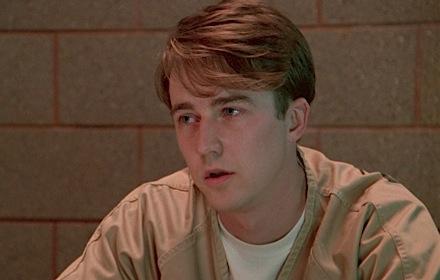 The case proceeds to trial in a rushed and hasty manner. But as it does, Vail suspects a third man present in the bishop's quarters. Aaron's defense, as shaky as it is, rests on his blackouts and this third person. When Vail hires a psychiatrist (Frances McDormand, Fargo) to dig into Aaron's mental state she finds evidence that might clear him, if permitted.
One of the strengths of Primal Fear is the acting. This is Norton's debut and he gives a tremendous performance as a poor boy in the middle of something bigger than he can imagine. His star potential is evident in this film. Gere, already a star, is solid as an arrogant but only half-jaded attorney who still see some good in humanity. These two make the movie work.
 The film gets a little confusing with a sub-plot related to property development. But this does tie in, as becomes clear later. The other plot twists move the story along at a decent pace. Venables, though, seems more trapped than Aaron. With a case that appears open-and-closed, her position becomes more and more precarious. Her final confrontation with Aaron seems over-the-top for a lawyer, and triggers the climactic interactions.
One of the issues Hoblit deals with is the make-up of mankind. Vail espouses the thinking clearly, when asked by a reporter why he defends alleged criminals:
I believe in the notion that people are innocent until proven guilty. I believe in that notion because I choose to believe in the basic goodness of people. I choose to believe that not all crimes are committed by bad people. And I try to understand that some very, very good people do some very bad things.Innocent until proven guilty is fundamental to the justice system in the States. But the basic goodness of people is a moral and theological position. In Hoblit's eyes, good people do bad things. We could turn Melvin Tinker's book title, "Why do Bad Things Happen to Good People," around and get Hoblit's question, why do good people do bad things?
The Biblical answer to this question is that all people (except Jesus, the only sinless human) are tainted by sin (Rom. 3:10). We are not fundamentally good, in the sense of being good through and through. We may appear so from the outside. But even these "very, very good people" are corrupt. Indeed, sin has caused each of us to be morally depraved (Gen. 6:5). Each one of us is quite capable of the worst crimes committed by humanity. We can see this when we get angry. We are a hair's breath away from pulling the trigger that could end a life. More often than not we control our urges and anger. This is partly due to social expectations, partly due to judicial punishment (that would be imposed), and partly due to habit and training. But strip away the veneer of civilization and we are no better than the rest.
This is not to paint a totally gloomy picture of mankind. We can do good things. We do. All the time. But even these "are like a filthy rag" (Isa. 64:6). Our good deeds are seen by God through the eyes of our inner motives. These are self-serving. Just as Vail's offer of free legal aid was self-serving. Only when our sin nature has been replaced with a new nature in Christ can we find that our motivations become other-centered and godly.
 The other major theme of Primal Fear is that of hypocrisy. It is clear from the tagline: "sooner or later a man who wears two faces forgets which one is real." Almost all the main characters are two-faced. Vail offers free legal defense but only because he gets free publicity on prime time television. Aaron has his own hypocrisy. Even the District Attorney has a hidden agenda concealed behind his execute justice slogans.
Hypocrisy is a sin that Jesus vehemently decries in the New Testament. Surrounded by hypocrites, he saved his strongest language for them: "Woe to you, teachers of the law and Pharisees, you hypocrites!" (Matt. 23:13) Those whose public face showed righteous character was in reality a mask hiding corruption within. Judas was another, more personal, figure who lived a hypocritical life. Though he walked with Jesus as an intimate companion for 3 years, he was secretly serving his selfish and greedy ends. He complained when the woman poured a years' worth of perfume on Jesus' feet to wash them in preparation for his death, upset because the money seemed squandered yet was pilfering to profit his own pocket book (Jn. 12:3-6). Hypocrisy is an insidious thing.
When we wear two faces it can be difficult to keep track of both. It is surely better to maintain one face, speak with one voice, and be open and transparent. When we follow Jesus, we not only have him as our defense attorney (1 Jn. 2:1), but he enables us to have victory over our hypocrisy.
Copyright ©2010, Martin Baggs


 She has worked for four years without missing a day, and when she is called into the boss' office she is afraid she is being fired. On the contrary, she is being told to take a vacation, to go relax and enjoy herself. But her work is her coping mechanism. It is her avoidance. At home, order is her retreat. She is almost obsessive-compulsive, but this is another of her coping mechanisms. At work, her hearing aid is her shield. She can turn it off and keep people away, not hearing them means no involvement. No friends, no family, she is alone and isolated.
 rriving by helicopter, she finds the rig is almost abandoned. It is being shut down and there are just a handful of workers left. Her job is to care for one of them, Josef (Tim Robbins,
  him. She is his nurse and has to be able to hear him. So her hearing aid is turned on. His conversations are one-sided; she will not answer his questions. But slowly a picture of both comes into focus. When the cook, Simon (Javier Camara, the male nurse Benigno in

 John Hammond (Richard Attenborough) has created a new theme park, Jurassic Park. A Disney Land-type environment, the exhibits are not mechanical rides but living creatures: dinosaurs. Using genetic technology and dino DNA extracted from insects encased in amber, he has brought these giants back to life as a capitalist venture. But an accident has the investors worried. And he needs testimonials from a pair of independent scientists to keep his project on track. Dr. Grant (Sam Neill) is the paleontologist; his girlfirend, Dr. Sattler (Laura Dern) is the paleobotanist. Dr. Malcolm (Jeff Goldblum), the mathetician and chaos theorist, is thrown in as the wild card (and Hammond's conscience).
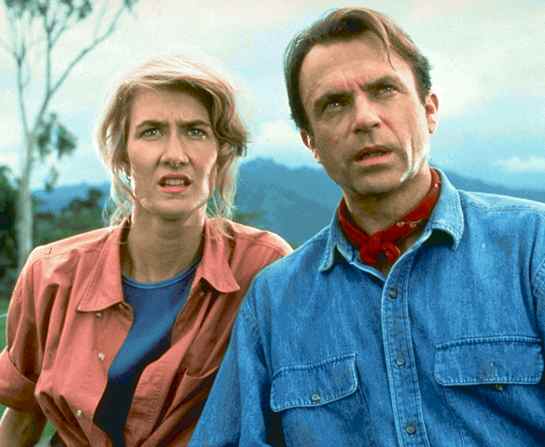 When Hammond brings these scientists to his remote tropical island, their initial reaction, upon seeing herds of dinosaurs roaming free, is spectacular. And it is not unlike our own reaction the first time we see these creatures, especially if it is on the big screen. Unbelievable! (I had a similar reaction when seeing the 3D creatures in
  The story moves into high gear when the nerd computer scientist turns off the electricity and the security systems, allowing the dinosaurs to escape their paddocks. With this comes the first sighting of T-Rex, and the famous jeep chase. Added to that are the velociraptors, smaller but more cunning than Rex. These beasts hunt in packs, run like cheetahs, and can even open doors. The third act, where Hammond's two grandchildren are trapped in the kitchen with two raptors hunting them, is as intense and suspenseful as any recent movie.
 Though the movie is clearly evolution-centric, Malcolm quips, "God creates dinosaurs. God destroys dinosaurs. Man destroys God. Man creates dinosaurs. . . " Regardless of the type of evolution in mind, micro or macro, God is still the Creator. Malcolm has it right. God creates (Gen. 1:1). He made all creatures. But Malcolm is wrong on God's destruction. Man has not and cannot destroy God. God is above mankind. If we could destroy him he would not be God! Although man has tried to replace God, the creature cannot obsolete the Creator, as Hammond eventually finds out to his chagrin.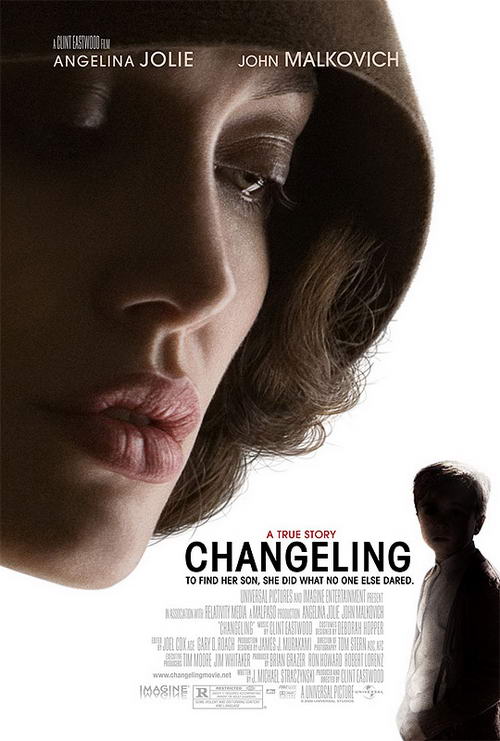

 Set in Los Angeles in 1928, this is based on the true story of Christine Collins (Angelina Jolie,
  Briegleb's mission, to fight the police corruption, harkens back to the prophets of the Old Testament. Theirs was a call for social justice, exposing all manner of injustice. They were God's spokesmen in the fight against evil and corruption that was often rampant, even amongst the Israelites (Isa. 1:21-27), God's chosen nation (Lev. 26:12; 2 Sam. 7:23). They decried injustice and called out for repentance, a turning back to God's laws and the way of equity and justice. Micah proclaimed what God required of man: "To act justly and to love mercy and to walk humbly with your God" (Mic. 6:8). Like Briegleb, though, the prophets were often ignored, sometimes punished (1 Kings 19:10), but nevertheless used by God for his purposes.
 Christine's gritty determination fuels her relentless quest for the truth and for her son. But this puts her at odds with the police, who still want her to accept the changeling as Walter, which she insists she will not do. Using intimidation tactics, they accuse her of hysteria and worse, and lock her in a mental asylum. The corruption and perversion of power is pervasive. The scenes in the mental hospital are among the most wrenching, but underscore Christine's resolve, and highlight Jolie's acting strength. (We recall that she won her Supporting Actress Oscar for the 1999 role of an asylum inmate in Girl Interrupted; here she is "Mother Interrupted," and lost this Oscar to Kate Winslett for The Reader.)